AIニュース
AI weekly news (2026-05-12): Claude, Codex, Gemini, MCP — what landed
12 分
Claude Code 2.1.140 corrects a subtle subagent /goal interpretation bug — important if you run autonomous loops. We explain the symptom, the fix, and how to validate.

中澤 圭志
@keishi_nakazawaSales Claw maintainer

Key Facts
Release
2.1.140 (2026-05-13)
Fix
Subagent /goal interpretation
"Got the /goal + Agent View in 2.1.139. What changed in 2.1.140 the next day?" 2.1.140 lives in the shadow of the prior day's flashy release, but it's packed with quiet production-readiness fixes. This article walks through the impact on AI sales automation and Sales Claw, using the official Changelog as primary source.
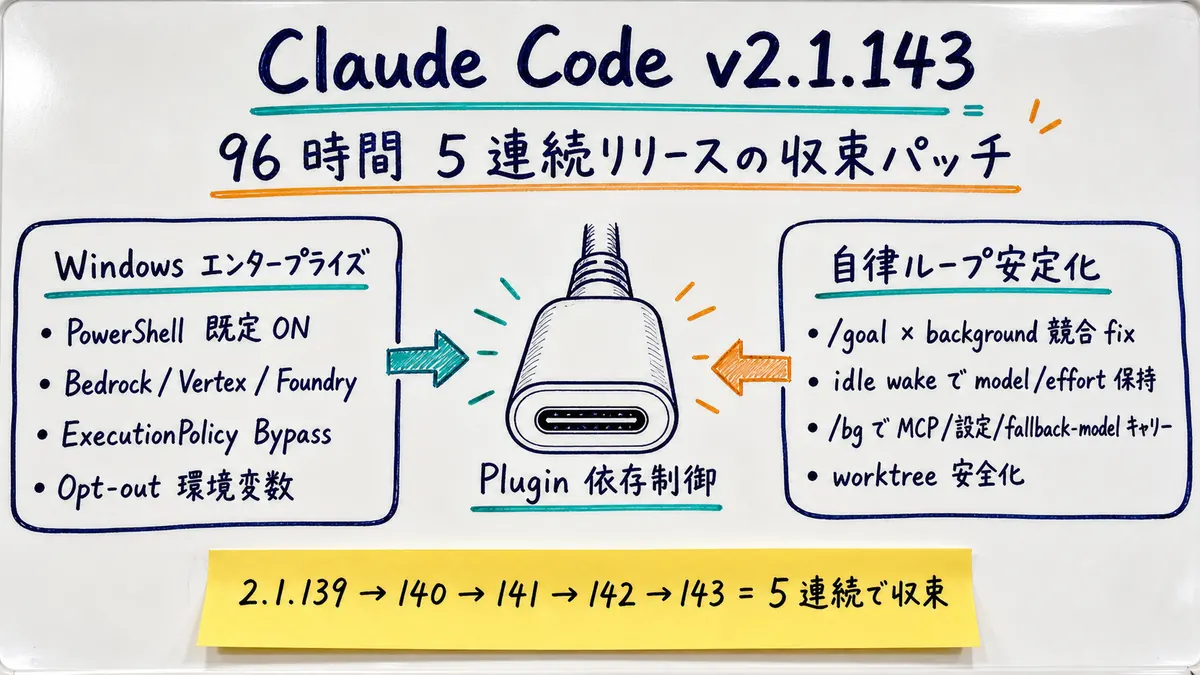
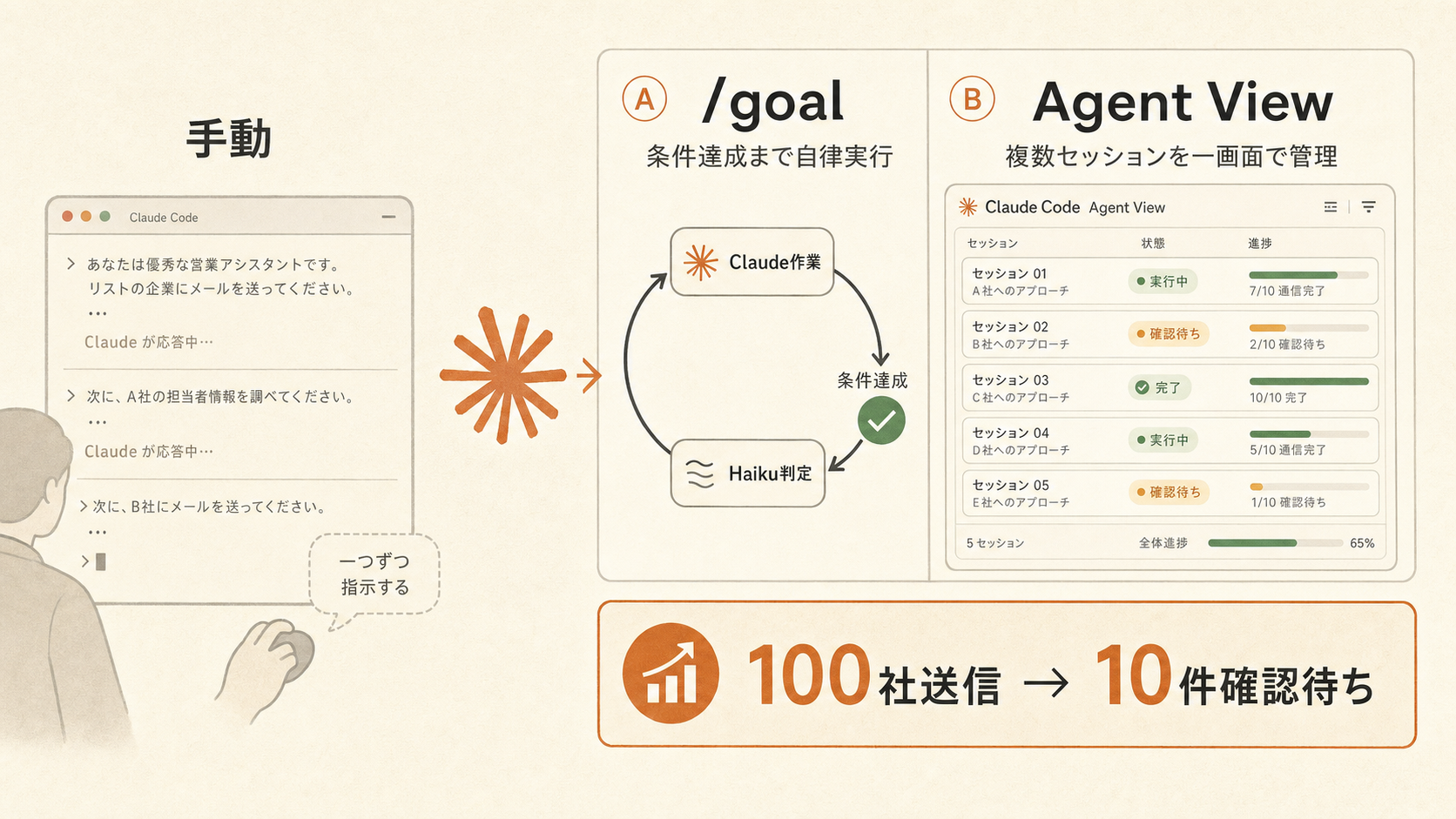
On 2026-05-12, Anthropic released Claude Code 2.1.140 — a follow-up to the previous evening's 2.1.139 that introduced /goal and Agent View.
2.1.140 has no headline feature. Instead it includes four stability and robustness fixes:
subagent_type matching improvement — case- and separator-insensitive/goal silent-hang fix — resolves no-response with disableAllHooks / allowManagedHooksOnly setclaude --bg + event-loop improvements — stabilizes Windows / pre-idle-shutdown / enterprise security setupsPrimary sources: Claude Code official Changelog, GitHub Releases, Claude Code Docs. For the prior 2.1.139 feature deep-dive, see the /goal + Agent View article.
Claude Code ships fast. 2.1.139 and 2.1.140 shipped within ~24 hours. 2.1.139 added /goal + Agent View (50 CLI changes). 2.1.140 is a fix pack focused on "run that new feature in production."
New-feature day → next-day bug reports → next-day fixes is Anthropic's Claude Code rhythm. For products like Sales Claw that run AI sales automation on Claude Code, these consecutive patches are "rarely article-worthy but most important operationally."
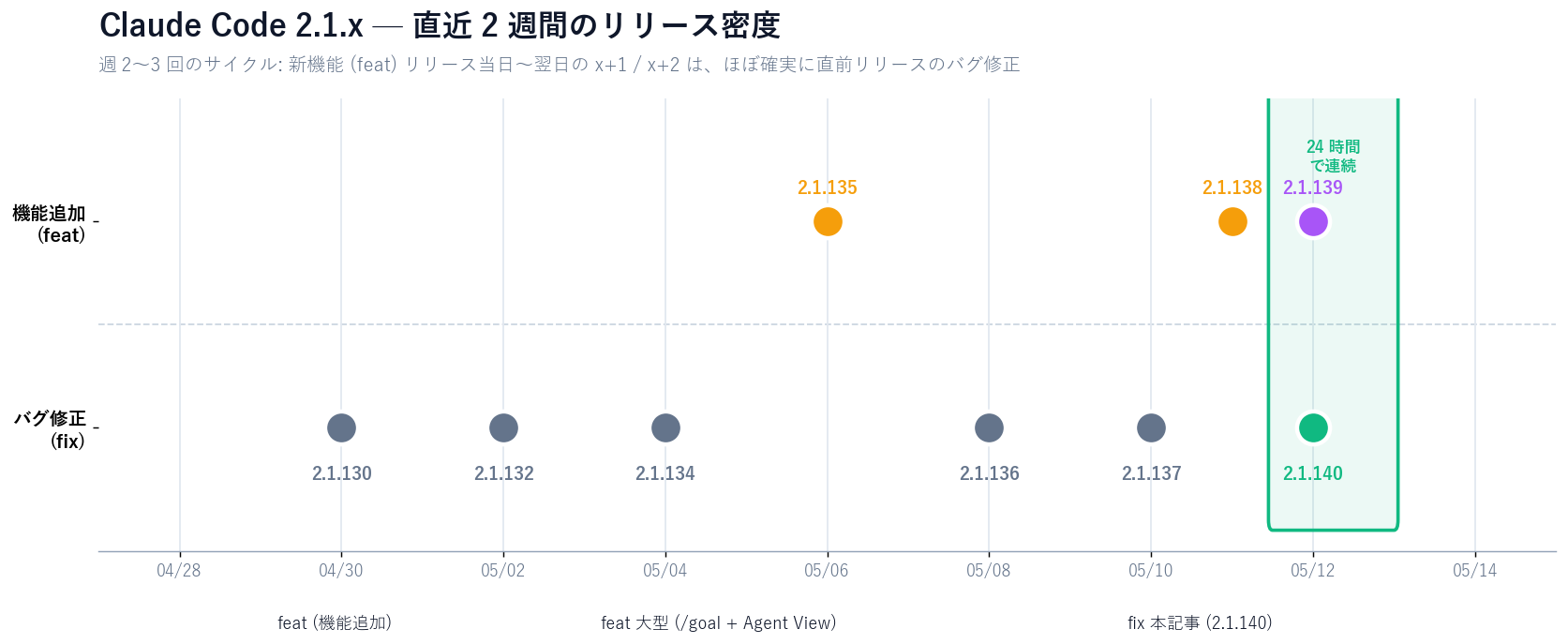
Excerpts from the official Changelog. Excludes anything covered in 2.1.139.
Agent-tool (Agent(...)) subagent_type matching becomes case- and separator-insensitive.
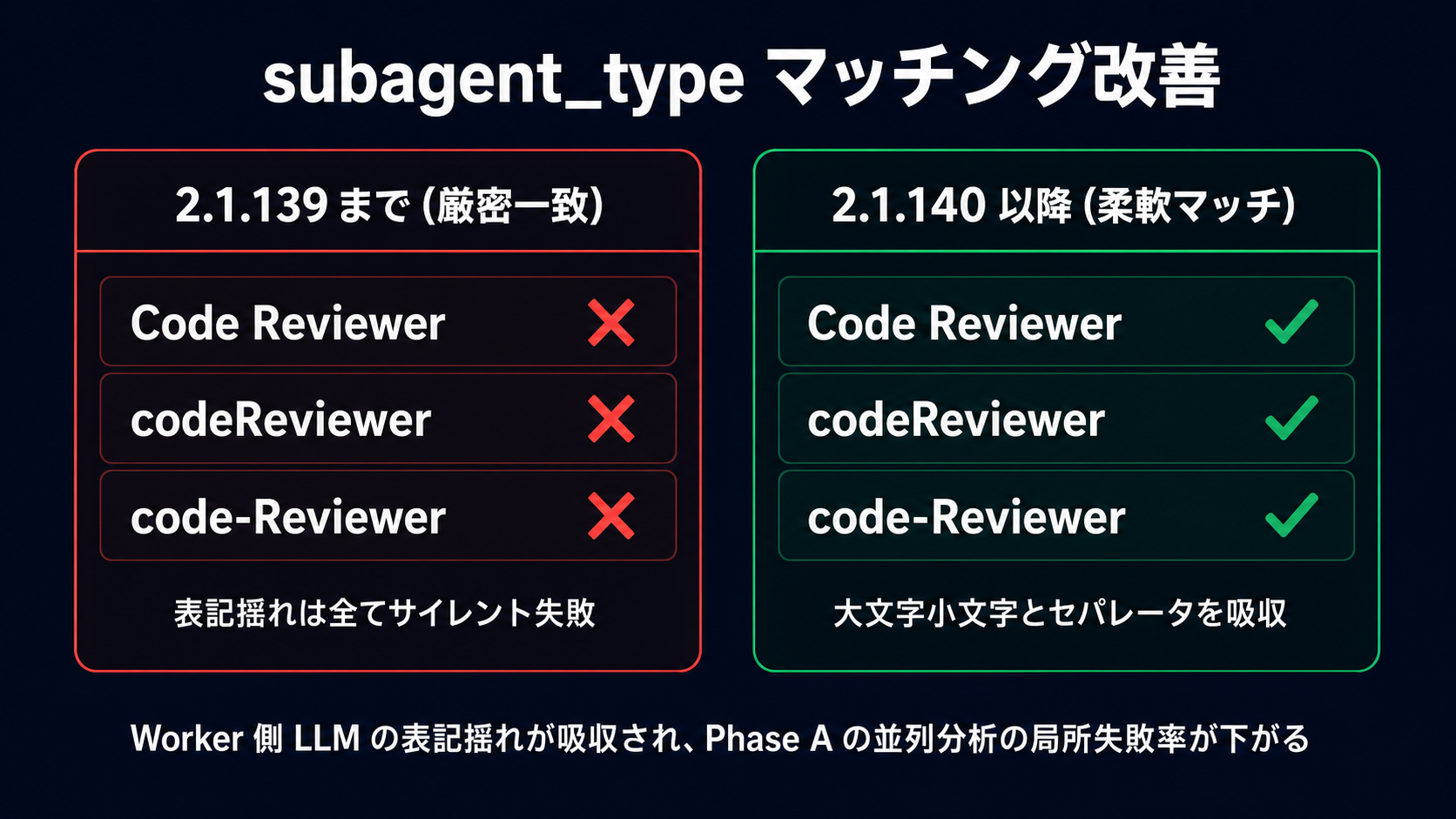
Previously strict-match:
# Until 2.1.139 (strict match only)
Agent(subagent_type: "code-reviewer", ...)   # ✅ resolves
Agent(subagent_type: "Code Reviewer", ...)   # ❌ fails
Agent(subagent_type: "code reviewer", ...)   # ❌ fails

# 2.1.140+ (case / separator insensitive)
Agent(subagent_type: "code-reviewer", ...)   # ✅
Agent(subagent_type: "Code Reviewer", ...)   # ✅ resolves
Agent(subagent_type: "code reviewer", ...)   # ✅ resolves
Agent(subagent_type: "Code_Reviewer", ...)   # ✅ resolves
Small but real: when the Worker LLM naturally generates a subagent name from a prompt phrase (a user says "use the code reviewer," the Worker normalizes to "code reviewer"), robustness goes up a notch.
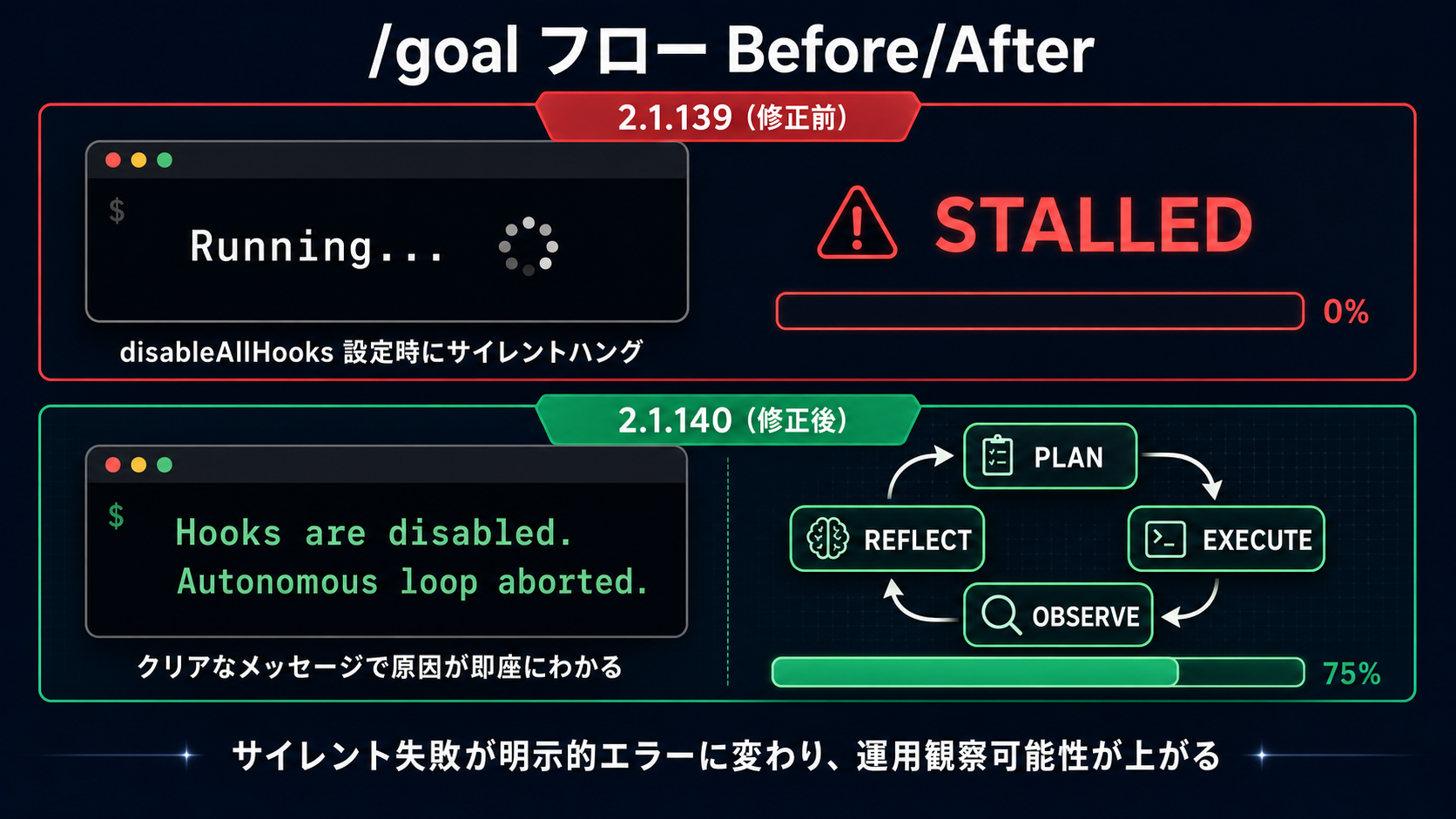
2.1.139's /goal command was silently hanging in environments configured with disableAllHooks or allowManagedHooksOnly. Before the fix, the indicator would spin forever, no error message — users perceived "hang" / "freeze."
From 2.1.140, a clear message appears — "you can see why it's not working." Now you can decide: relax the Hooks policy, or switch to a different automation approach.
Several fixes around background services:
claude --bg failing with connection dropped mid-request if a request was sent just before the background service's idle shutdowngh or another missing executable triggered a synchronous re-spawn of where.exe on every checkFor AI sales automation that keeps background agents running for hours to days, these fixes flow directly into uptime.
Three enterprise-management fixes:
extraKnownMarketplaces auto-update wasn't persisted to known_marketplaces.jsonConfigChange hooksOther fixes: Read tool offset argument validation for space-padded or +-prefixed strings; native cursor remaining in the input caret when the terminal loses focus.
Sales Claw runs Phase A as 3–5 parallel haiku subagents per target company via the CLI Agent tool. The Worker (the main Claude) calls Agent(subagent_type: "...", prompt: "...") per company.
When the user prompt contains Japanese labels (e.g., "code reviewer" in some language) and the Worker normalizes them to English subagent_type, normalization sometimes drifts:
"Code Reviewer" (spaces)"codeReviewer" (camel)"Code-Reviewer" (hyphen + leading caps)Strict matching in 2.1.139 caused these to silently failor fall back to a default agent. Sales Claw saw this as "occasionally a company gets a strangely shallow analysis" — low-reproducibility, hard-to-bug-report.
With case- and separator-insensitive matching, the drift above is absorbed. No code change required in Sales Claw; the gain accumulates as Phase A parallelism increases.
| 項目 | ≤ 2.1.139 | 2.1.140+ |
|---|---|---|
| subagent_type resolution | Strict match only | Case + separator insensitive |
| On variant input | Silent failure / default fallback | Resolves to the correct subagent |
| Worker LLM burden | Must follow exact normalization | Natural-language-like text works |
| Effect with parallelism | Failure rate accumulates | Accumulated failures disappear |
No public benchmark numbers, but for Sales Claw — which calls the Agent tool dozens to hundreds of times per batch — even a small failure-rate improvement compounds.
2.1.139's /goal command continues autonomous execution across turns until a condition is met. With either of these set in settings.json, it silently hung:
disableAllHooks: true — disable all HooksallowManagedHooksOnly: true — only managed Hooks allowedThe symptom: /goal showed a progress indicator, but no response came regardless of how long you waited. No error message. Users had no way to know whether it was running or stuck.
disableAllHooks and allowManagedHooksOnly are commonly set in enterprise environments to control arbitrary-code-execution risk via Hooks. IT teams that forbid non-managed Hooks were the typical case.
In those environments, trying /goal in 2.1.139 looked like a freeze, and teams might conclude "Claude Code's autonomous loops are unusable." 2.1.140's clear error ("Hooks are restricted, so /goal is not available") gives teams the input they need to decide between relaxing the policy or switching to claude -p pipe mode.
Sales Claw is OSS that lowers misfire and policy-violation risk through policy control, pre-send checks, do-not-contact detection, CAPTCHA-on-detect stop, rate limits, audit logging, and automatic stop conditions. Since Claude Code is the CLI backend, Claude Code stability flows directly into Sales Claw.
# 1. Upgrade Claude Code to 2.1.140
npm install -g @anthropic-ai/claude-code@latest

# 2. Confirm
claude --version
# → 2.1.140 or newer

# 3. Restart Sales Claw dashboard
#    Click [Start Claude] to relaunch the managed PTY
No Sales Claw code changes. See Sales Claw Quick start for setup.
Sales Claw Phase A launches Agent(subagent_type: "general-purpose", model: "haiku", prompt: ...) with 3–5 in parallel per target. See Workflow overview for context.
From 2.1.140, the Worker LLM's casing / separator variations still resolve. Local failure rate in Phase A subagent calls drops.
2.1.140 doesn't affect model pricing or API spec. Monthly cost estimates for 10,000-company workloads from the prior article remain valid. Assumptions, variance bands, and the sample-measurement recommendation are in the prior cost-estimate section. Always sample 100 companies before scaling.
2.1.140 stabilizes things, but running AI sales automation unattended over long periodsstill requires multiple guards. Don't claim "safe" — lower risk structurally.
preferences.complianceFooter: trueawaiting_approval, log on detectWith /goal now working in enterprise environments, the responsibility for termination-condition design increases. The accidental safety of "it didn't work so it didn't run away" is gone.
Checks when switching to Claude Code 2.1.140
Claude Code 2.1.140 is a stabilization patch you can read in 30 seconds. For AI sales automation — calling the Agent tool dozens to hundreds of times per batch, keeping background agents alive for hours to days — those quiet fixes are the actual floor under production operation.
The /goalenterprise improvement is especially important: teams with Hooks restrictions finally have the input they need to decide "use it or not." Subagent-call robustness compounds as parallelism scales.
Next action: npm install -g @anthropic-ai/claude-code@latest, restart the Sales Claw dashboard, validate Phase A on a 5-company sample. See Quick start and Workflow overview for details. Sales Claw itself is free at the download page.