AI NewsClaude for Small Business

Claude for Small Business: Anthropic launches into SMB with 7 SaaS × 15 workflows and an approval-everywhere model

Anthropic announced Claude for Small Business on 2026-05-13. 7 SaaS integrations × 15 workflows, with every task user-initiated and user-approved. We walk through what overlaps with Sales Claw and how the approval-everywhere philosophy is becoming the SMB-AI industry standard.

中澤 圭志

中澤 圭志

@keishi_nakazawa

Sales Claw maintainer

·14 min
Claude for Small Business: Anthropic launches into SMB with 7 SaaS × 15 workflows and an approval-everywhere model
This English article is a concise version of the original. For the full Japanese deep-dive, see the Japanese original.

Key Facts

Release

Claude for Small Business (2026-05-13)

Integrations

HubSpot / QuickBooks / PayPal / Microsoft 365 / Google Workspace / Canva / Docusign (7)

Workflows

15 (accounting / sales / marketing / contracts / HR — ready-to-run)

Approval model

Every task initiated by you / Existing permissions hold

"Anthropic just launched ‘Claude for Small Business’? With HubSpot and Microsoft 365 integrations, doesn't that compete with Sales Claw?" On 2026-05-13, Anthropic announced Claude for Small Business. Using their official Newsroom as primary source, this article walks through the 7 SaaS integrations, the 15 ready-to-run workflows, and the approval model — then analyzes "what it means that Anthropic stepped into the SMB segment" and "how the pre-send-approval philosophy is becoming industry-standard" from a Sales Claw maintainer's perspective.

Sales Claw is an OSS desktop tool that specializes in automating contact-form outreach, targeting B2B SDRs and small business sales teams. Claude for Small Business is a SaaS that covers SMB operations broadly (accounting / sales / marketing / contracts). The markets overlap completely, but the workflows are different — so they end up complementary, not competing. That's the thesis of this article.

Primary sources: Anthropic official Newsroom (2026-05-13 announcement), Claude for Small Business product page, official Anthropic X account. Release date, integrations, workflow names, and verbatim quotes follow the official spellings.

1. What Claude for Small Business is — Anthropic's SMB strategy

On 2026-05-13, Anthropic announced Claude for Small Business via its Newsroom and official X. This is a strategically important release that expands Anthropic's ICP from Fortune 500 enterprises and individual developers to the SMB segment (companies under a few hundred employees).
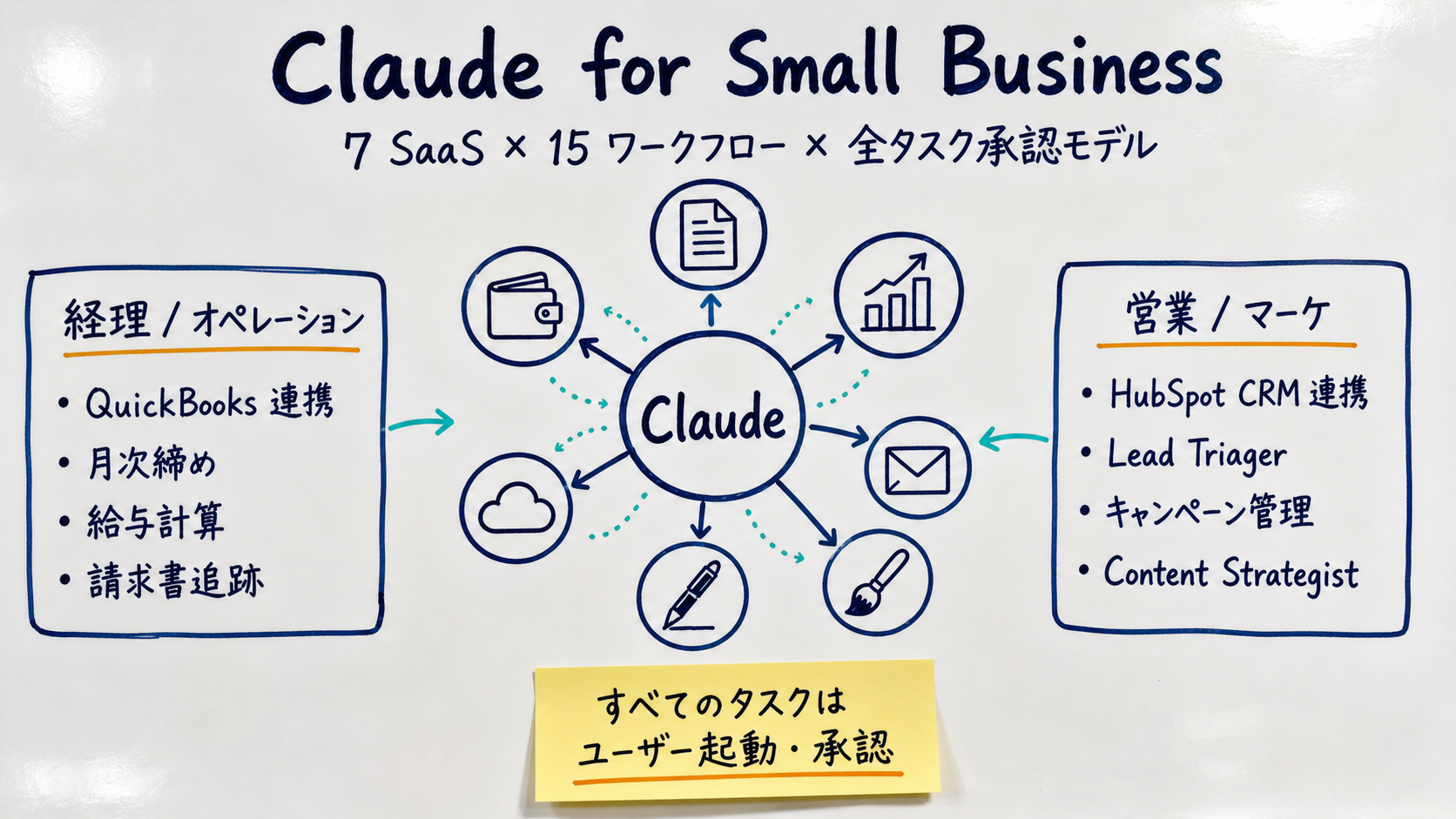
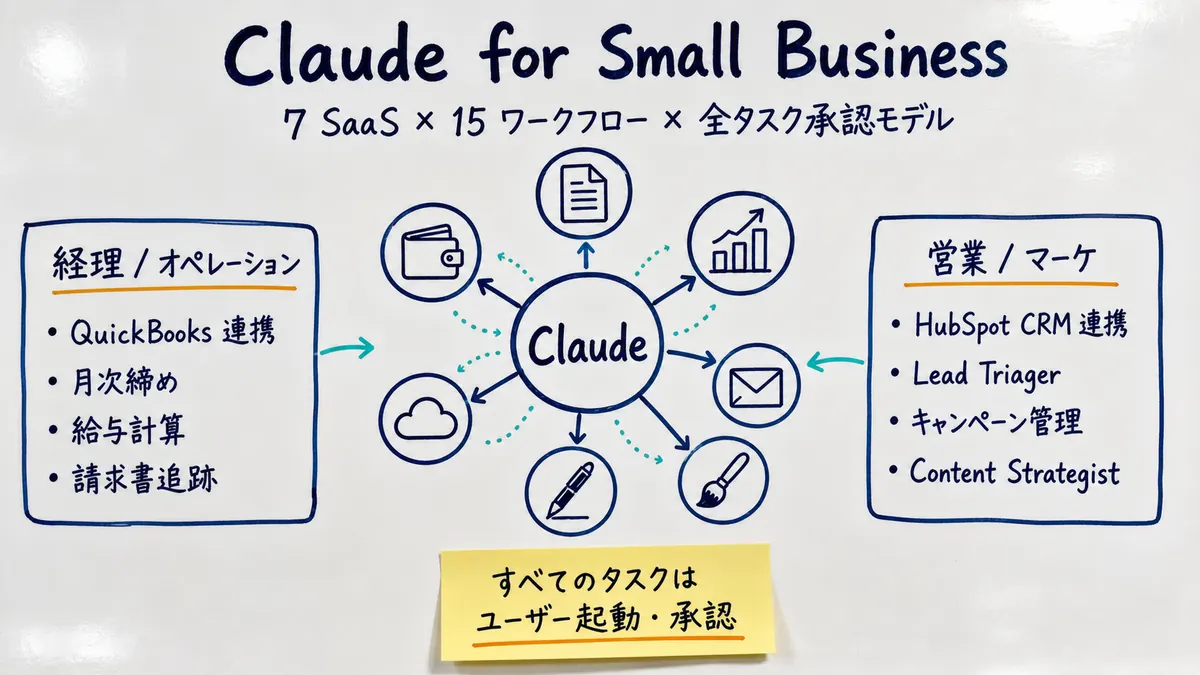
Hero image for Claude for Small Business. Top-center headline 'Claude for Small Business' with subtitle '7 SaaS × 15 workflows × user-approved every task.' Centerpiece: a hub-and-spoke metaphor (Claude symbol at center, seven SaaS icon zones radiating outward). Left zone 'Accounting / Ops' (QuickBooks, PayPal, Month close, Payroll, Invoice chaser). Right zone 'Sales / Marketing' (HubSpot, Canva, Lead triager, Campaigns, Content strategist). Bottom yellow sticky note: 'Every task is user-initiated and user-approved.'
Figure: Claude for Small Business — 7 SaaS × 15 workflows under an approval-everywhere model (mid-density whiteboard)

Key numbers and phrases pulled from the announcement:

Why Anthropic is going after SMB

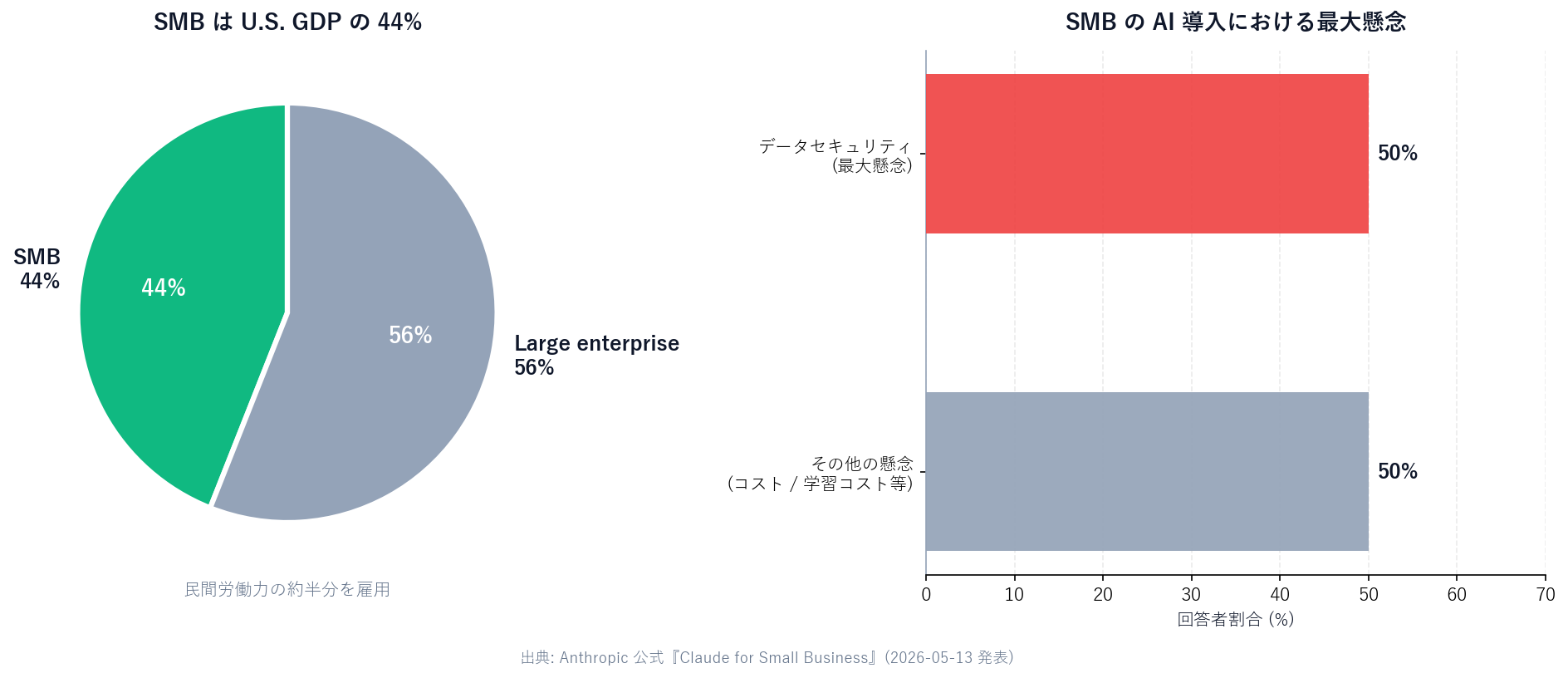
Two emphasized points: "SMB = 44% of U.S. GDP" (huge market) and "data security is the top hesitation" (clear differentiation axis). The first shows market scale; the second shows the lever Anthropic can pull against competitors.

Where OpenAI and Google emphasize "powerful general AI," Anthropic is leading with "explicit control" via "Every task initiated by you / Existing permissions hold." That's the same directionas Sales Claw's "policy-controlled autonomous operation / pre-send automated checks" design philosophy.

2. Seven SaaS integrations — Anthropic targets "the bloodstream of SMB"

Organizing the seven by business category makes Anthropic's selection logic visible:

CategorySaaSRole
Accounting / FinanceIntuit QuickBooksTop SMB accounting software. Backbone for invoicing / month-end / payroll.
PaymentsPayPalUnderpins B2B / B2C payments for SMBs. Central to the Invoice Chaser workflow.
Sales / CRMHubSpotDe facto standard for SMB SDRs. Backbone of Lead Triager / Campaigns.
Marketing / DesignCanvaDesign layer of SMB marketing. Powers the Content Strategist workflow.
Contracts / LegalDocusignIndustry-standard e-signature. Powers the Contract Reviewer workflow.
Work OS (Google)Google WorkspaceGmail / Drive / Docs / Sheets — the SMB doc-management OS.
Work OS (Microsoft)Microsoft 365Outlook / Teams / OneDrive / Excel — the other work OS for SMBs.

Notable: Slack and Salesforce are not on the list. Both are standard mid-market and up, but SMB penetration is relatively lower. Anthropic seems to have selected only "tools SMBs actually touch" for the first wave.
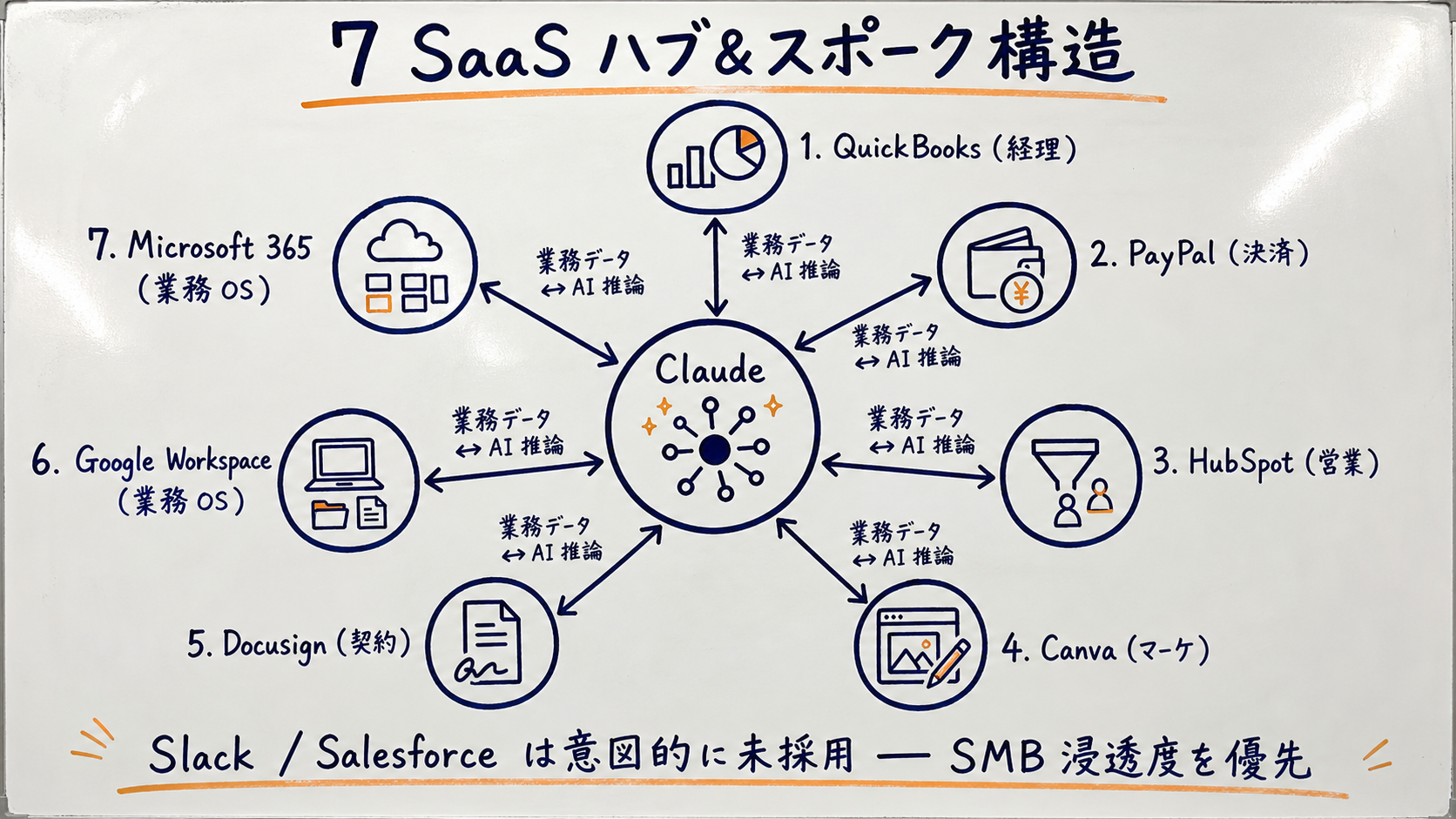
Hub-and-spoke diagram of the 7 SaaS integrations. Center: Claude symbol. Spokes outward to 7 SaaS apps (QuickBooks Accounting, PayPal Payments, HubSpot Sales, Canva Marketing, Docusign Contracts, Google Workspace Work OS, Microsoft 365 Work OS). Bidirectional arrows between each SaaS and Claude indicate 'business data ↔ AI inference.' Footer note: 'Slack / Salesforce intentionally excluded — SMB penetration prioritized.'
Figure: Figure 2: Hub-and-spoke structure of the 7 SaaS integrations (high-density whiteboard) — selection prioritized SMB penetration

3. The 15 ready-to-run workflows — Anthropic's abstraction of SMB operations

Organizing the eleven named workflows by category shows SMB operations cleanly factor into four axes (accounting / sales / marketing / contracts):

AxisWorkflow (official)Primary SaaS
Accounting / FinancePlanning payrollQuickBooks / Microsoft 365
Closing the monthQuickBooks / Google Workspace
Invoice chaserQuickBooks / PayPal / Gmail
Margin analyzerQuickBooks / Excel
Month-end prepper / Tax-season organizerQuickBooks / Google Drive
Sales / MarketingLead triagerHubSpot / Gmail
Running campaigns / Content strategistHubSpot / Canva
Business-wideGetting business pulseCross-7-SaaS dashboard
Contracts / LegalContract reviewerDocusign / Google Docs

What the workflow design tells us about Anthropic's intent

The eleven (+ four estimated) workflows share one trait: "monthly recurring obligations an SMB owner cannot skip." Month-end prepper, Tax-season organizer, Closing the month — all closing tasks. Lead triager, Running campaigns, Invoice chaser — all prioritization of in-flight tasks. Anthropic specifically targeted "recurring work that drains an SMB owner's time."

Sales Claw targets the same shape: "contact-form outreach a B2B SDR has to do every day." Anthropic and Sales Claw share the strategic stance that "point AI at recurring SMB work that consumes time."

Sales Claw uses the same philosophy on B2B SDR recurring work. Try it.

無料・MIT ライセンス。インストールせずにライブデモも試せます。

4. "Every task initiated by you" — Anthropic's approval model

The two principles the official announcement spelled out

From the official announcement:

What the design principles actually mean

Unpacking the two principles: Anthropic is answering SMBs' biggest concern — data security — at the product-design layer.
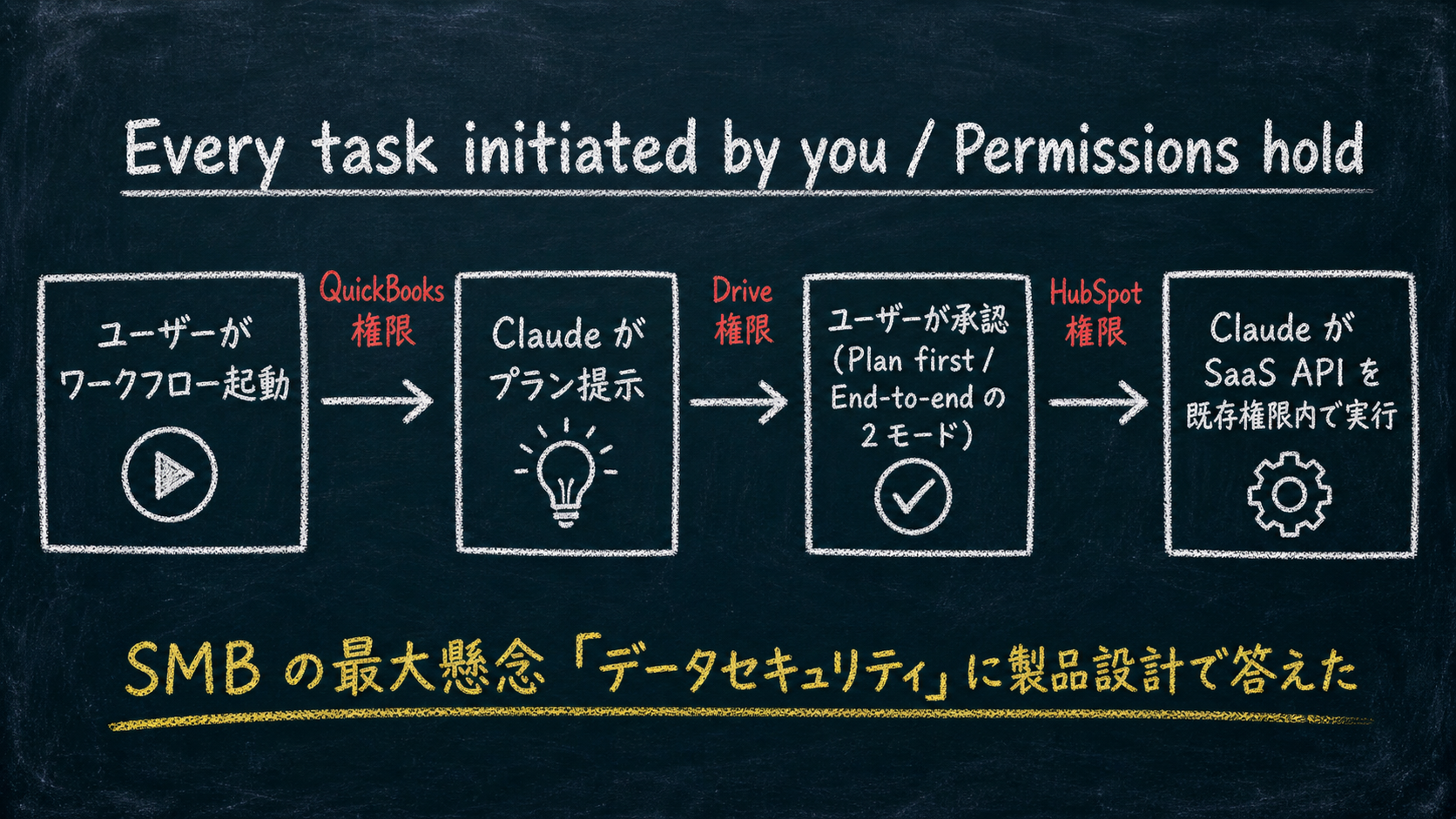
Chalkboard-style hand-drawn diagram of Anthropic's approval model. Top-center headline: 'Every task initiated by you / Permissions hold.' Four-stage flow left-to-right: (1) user starts a workflow, (2) Claude proposes a plan, (3) user approves (choosing between 'plan first' or 'end-to-end' mode), (4) Claude executes via SaaS APIs within existing permissions. Between stages, red chalk annotations indicate existing permissions checks (QuickBooks RBAC / Drive ACL / HubSpot roles). Footer: 'Answers SMBs' top concern — data security — at the product-design level.'
Figure: Figure 3: The Claude for Small Business approval model (chalkboard) — two design principles answering SMBs' #1 concern
  1. "User-initiated" — Claude doesn't run in the background. The user always pulls the trigger. Structural defense against "Claude sent an email at 3 AM" or "Claude hit an API and racked up charges."
  2. "Plan-first OR end-to-end" — Two execution modes: approve plan first (high-risk operations) and end-to-end auto (low-risk recurring work). SMB risk tolerance varies by task; a two-tier model handles both.
  3. "Permissions inherit" — Claude doesn't mint new permissions. The RBAC already configured on the SaaS side is the contract. Structurally prevents "Claude got admin access and saw everything."

5. Claude for Small Business vs Sales Claw — competition or complement

項目Claude for Small Business (Anthropic)Sales Claw (OSS desktop)
TargetSMB owners / all-ops staffB2B SDRs / small business sales
CoverageAccounting / sales / marketing / contracts / HR (broad)Contact-form submission (focused)
IntegrationAPI integration with 7 SaaS appsReal-browser automation via Playwright
Execution modelCloud SaaS (Anthropic side)Local Electron app (user-side)
Data residencyAnthropic serversFully local (action-log.json)
Approval modelPlan-first or end-to-end (user-selectable)Pre-send automated checks + awaiting_approval audit log
PricingNot disclosed (1-month Max trial available)Free (MIT License)
Primary strengthBreadth of SaaS API integration + official supportForm-submit-specific check logic + local operation

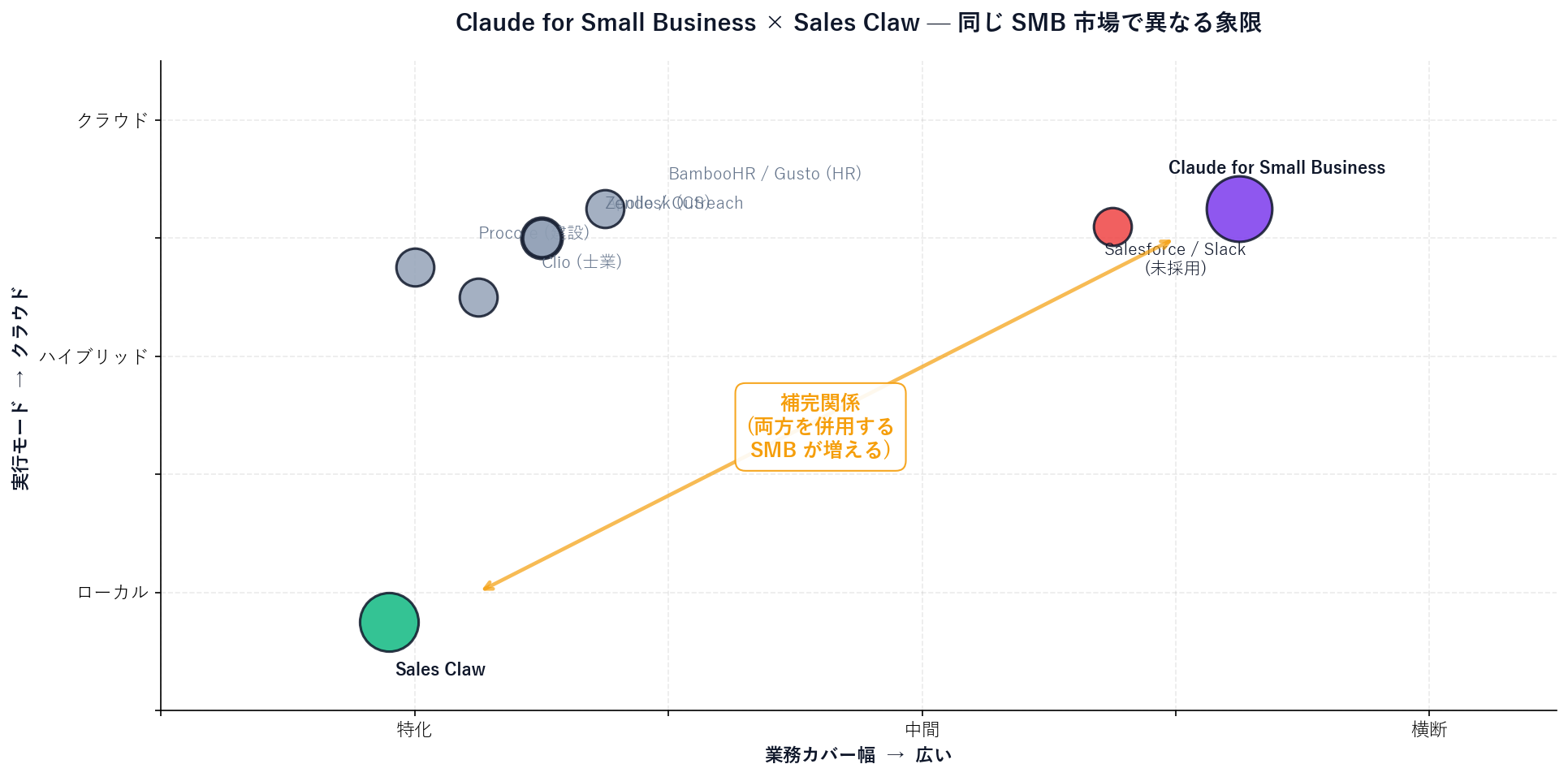
Using them together is realistic. An SMB might run "Claude for Small Business for lead management (HubSpot) and analytics (QuickBooks) + Sales Claw for contact-form submission"— leaning into each tool's strength.

6. Implications for Sales Claw design — approval as industry standard

Shared design philosophy

Sales Claw is OSS designed to lower misfire and policy-violation risk through policy control, pre-send checks, do-not-contact detection, CAPTCHA-on-detect stop, rate limits, audit logging, and automatic stop conditions. Different wording from Anthropic, same direction:
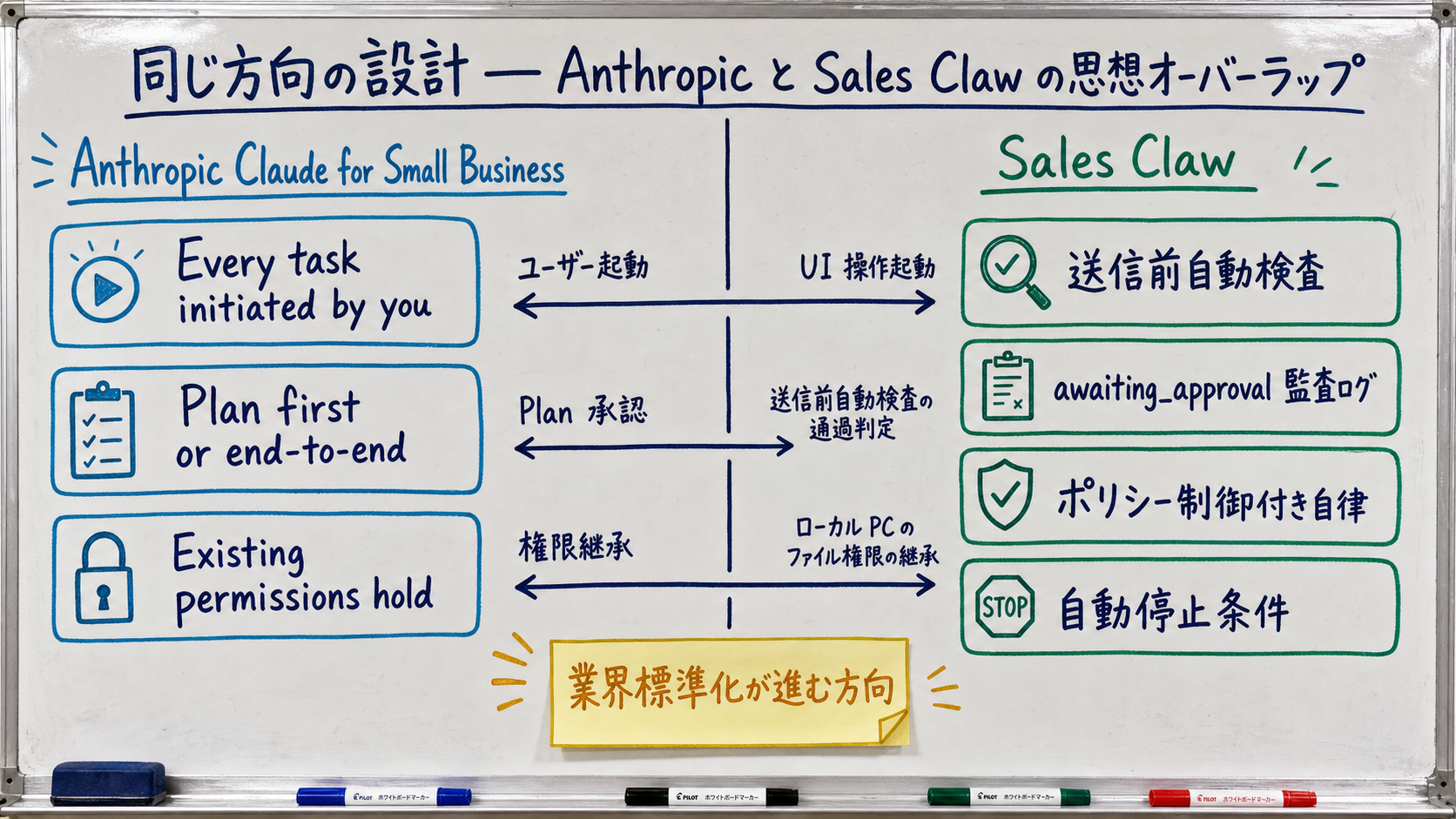
Hand-drawn whiteboard diagram of 'Anthropic vs Sales Claw philosophy overlap.' Center top headline: 'Same direction in design.' Left side Anthropic Claude for Small Business: three principles boxed (Every task initiated by you / Plan first or end-to-end / Existing permissions hold). Right side Sales Claw: four principles boxed (pre-send automated check / awaiting_approval audit log / policy-controlled autonomy / auto-stop conditions). Three central arrows link them: (1) 'user-initiated' = 'Sales Claw UI-initiated runs,' (2) 'plan approval' = 'pre-send check pass judgment,' (3) 'permission inheritance' = 'local PC file permissions inheritance.' Bottom yellow sticky: 'Industry standard direction.'
Figure: Figure 4: Shared philosophy across the two products (high-density whiteboard) — overlap on approval, permissions, and staged execution
項目Anthropic Claude for Small BusinessSales Claw
Task initiationEvery task initiated by youUser starts Phase B from the dashboard
Pre-execution approvalPlan first (high-risk work)Pre-send automated check + awaiting_approval
Auto-execution modeEnd-to-end (low-risk recurring work)/goal-driven autonomous loop until condition
Permission inheritanceSaaS RBAC inherited as-isLocal PC file permissions inherited
AuditExecution logs stored on Anthropic sideaction-log.json stored locally

Five design patterns to copy for SMB-targeted AI

Abstracting the two products' commonalities, here are five patterns to copy when designing SMB AI:

  1. The user always initiates the task (no background auto-start).
  2. Two execution tiers (Plan-approval mode and End-to-end mode).
  3. Inherit existing permissions and authentication (don't mint new permissions).
  4. Store execution logs in a place the user can read.
  5. Lead the product message with "data security" (the SMB's biggest concern).

7. Risks and open problems — what remains after industry standardization

The Anthropic approval model is well-designed, but it doesn't solve every SMB problem. As a Sales Claw maintainer, here are the structural gaps to keep in mind.

Cloud SaaS and data residency

Claude for Small Business is cloud SaaS, so SMB data is sent to Anthropic. For SMBs that name "data security" as their biggest concern, there's a gap between marketing and operational reality(Anthropic may provide zero-retention options separately, but the launch announcement doesn't spell that out).

Sales Claw runs fully local; data lives in action-log.jsonon the user's PC. For operations that cannot tolerate data leaving the device (financial, medical, public-sector), Sales Claw's local approach stays advantageous.

Domains the 7 SaaS don't cover

Anthropic's seven cover the SMB core, but vertical SaaS isn't covered:

  • Construction (Procore), legal (Clio), and other industry-specific ERPs / CRMs
  • HR / payroll deep-dive (BambooHR, Gusto)
  • Customer support (Zendesk, Intercom)
  • B2B outbound specialized tools (Apollo, Outreach)

Vertical / function-specialized OSS like Sales Claw fills the gaps Anthropic's seven cannot.

Pricing and SMB willingness-to-pay

The official launch doesn't disclose pricing. Given Claude Max is around $100/seat/month, the per-seat cost for SMBs may be on the higher side. Sales Claw being free (MIT License) remains relevant for "SMBs trying their first AI."
Autonomous-loop runaway prevention (shared)

8. SMB-targeted AI design checklist + bottom line

Market overlap chart between Claude for Small Business and Sales Claw (Python). Horizontal axis: workflow coverage (narrow → broad). Vertical axis: execution model (local → cloud). Claude for Small Business in the 'broad × cloud' quadrant; Sales Claw in the 'narrow × local' quadrant. Both target the 'SMB / B2B SDR' market but occupy different positions. Center annotation: 'complementary (SMBs increasingly use both).' Reference plots show non-adopted SaaS (Slack / Salesforce) and vertical-specialized tools (Apollo / Outreach).
Figure: Figure 5: Claude for Small Business vs Sales Claw market positioning (Python diagram) — same SMB market, different quadrants
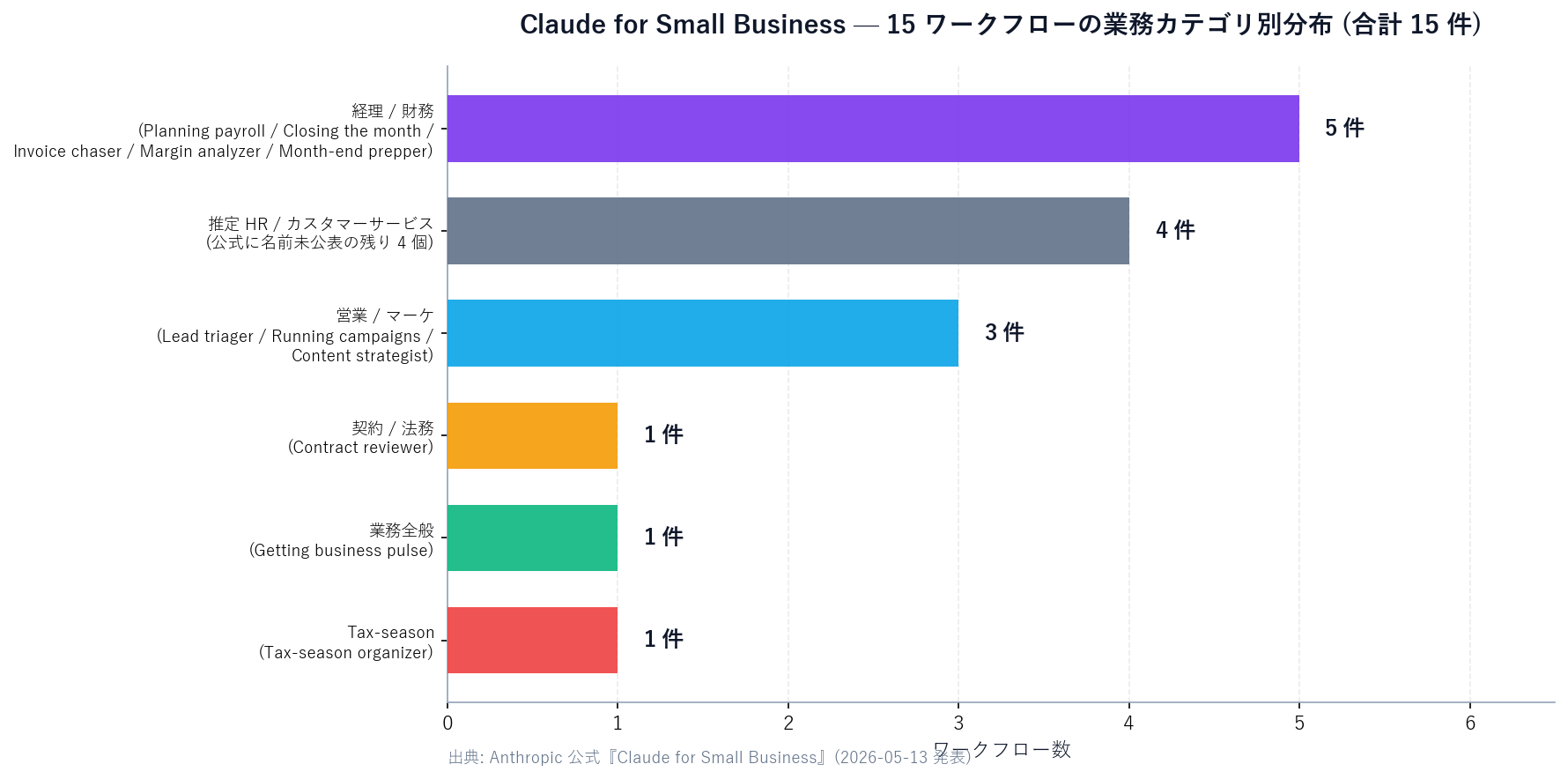
Horizontal bar chart of the 15 Claude for Small Business workflows by category (Python). Accounting / Finance: 5 (Planning payroll, Closing the month, Invoice chaser, Margin analyzer, Month-end prepper). Sales / Marketing: 3 (Lead triager, Running campaigns, Content strategist). Contracts / Legal: 1 (Contract reviewer). Business-wide: 1 (Getting business pulse). Tax-season organizer: 1. Estimated HR / customer service: 4. Total 15. Source: Anthropic Newsroom (2026-05-13). Accounting is the largest category.
Figure: Figure 6: Workflow distribution by category (accounting is the largest)
Visualization of SMB economic scale and AI-adoption concerns from the official announcement (Python). Left panel: pie chart of SMB share of U.S. GDP (SMB 44%, large enterprise 56%). Right panel: bar chart of the top SMB AI-adoption concern (data security 50%, other concerns combined 50%). Footer annotation: 'Source: Anthropic Newsroom — Claude for Small Business (2026-05-13).'
Figure: Figure 7: SMB market scale and AI-adoption concerns from the official announcement

Checklist for designing / choosing SMB-targeted AI

  • Tasks are always user-initiated (no background auto-start)
  • Execution has two tiers: Plan-approval and End-to-end
  • Existing SaaS RBAC / file permissions inherited as-is
  • Execution logs are stored where users can read them
  • Data residency policy is officially documented (what goes to Anthropic / the cloud)
  • Pricing model fits SMB willingness-to-pay
  • End-to-end mode has ANDed volume + elapsed + turn caps
  • Audit-log human review process is defined
  • Vertical gaps the 7 SaaS don't cover are filled by other tools (e.g., Sales Claw)
  • "Data security" leads the product message

Bottom line — the year approval models become standard

Claude for Small Business signals that Anthropic is seriously going after the SMB segment (44% of U.S. GDP). Putting the "Every task initiated by you / Existing permissions hold" approval model at the product's core also signals that "AI does not run on its own" is becoming the industry-standard direction for SMB-targeted AI.

For function-specialized / locally-run OSS like Sales Claw, this is tailwind. When Anthropic officially declares "the approval model matters," it's easier to position Sales Claw's "policy-controlled autonomy / pre-send check / audit log / auto-stop" as the same direction as industry standard.

Next action: if you're considering adopting Claude for Small Business, start by confirming the approval model and data-residency policy in the official docs. To combine Sales Claw on the contact-form outreach side, see Quick start and Workflow overview. Sales Claw itself is free at the download page.

Read this. Then build approval into your own AI ops.

無料・MIT ライセンス。インストールせずにライブデモも試せます。

よくある質問

What is Claude for Small Business?
Announced by Anthropic on 2026-05-13, it's a new AI service for small businesses. It connects Claude directly to seven leading SaaS apps (HubSpot / QuickBooks / PayPal / Microsoft 365 / Google Workspace / Canva / Docusign) and ships 15 ready-to-run workflows (Planning payroll / Closing the month / Lead triager / Invoice chaser / Content strategist and more) for SMB accounting, sales, marketing, contracts, and HR. Two design principles sit at the core: "Every task and workflow you run within Claude is initiated by you" (user-initiated and user-approved) and "Your existing permissions hold" (existing SaaS permissions are inherited as-is).
Does Sales Claw compete with Claude for Small Business?
The markets overlap (both target SMB) but the target workflows differ, so they're complementary rather than competing. Claude for Small Business is a cloud SaaS that covers SMB operations broadly (accounting / sales / marketing / contracts / HR) across seven SaaS apps. Sales Claw is an OSS desktop tool specialized in contact-form outreach with fully local execution. A realistic deployment: "Claude for Small Business for lead management and analytics + Sales Claw for contact-form submission."
How does the "Every task initiated by you" approval model differ from Sales Claw's?
The philosophy is identical in direction. Anthropic's four-stage flow: user initiates → Claude proposes a plan → user approves → Claude executes via SaaS APIs under existing permissions. Sales Claw's four-stage flow: user starts from the dashboard → pre-send automated checks → awaiting_approval audit log → only items that pass checks are submitted. Anthropic inherits SaaS RBAC in cloud SaaS; Sales Claw inherits PC file permissions locally. The differences are in execution model, but the design core (initiation / approval / permission inheritance / audit) matches completely.
Is the "SMB = 44% of U.S. GDP" figure accurate?
It's a direct quote from the official Anthropic announcement. "Small businesses account for 44% of U.S. GDP and employ nearly half the private-sector workforce" is the framing Anthropic used to justify scaling into the SMB segment — economically huge, strategically important.
How do you cover industries the 7 SaaS apps miss?
Anthropic's 7 SaaS cover the SMB core, but vertical SaaS (Procore / Clio / BambooHR / Gusto / Zendesk / Apollo / Outreach etc.) is not covered. Function-specialized OSS like Sales Claw, or other vertical SaaS, fills those gaps. Read this announcement as a "first wave" — Anthropic will likely add more SaaS over time.

参考文献

本記事は X 公式アカウントと公式ドキュメントを一次情報として参照しています。

  1. [01]
  2. [02]
  3. [03]
  4. [04]
  5. [05]
  6. [06]
  7. [07]
  8. [08]

この記事の著者

中澤 圭志

中澤 圭志

Sales Claw maintainer

Designs and develops Sales Claw. Writes from the field on B2B sales automation and applied AI.
Share this article