AIニュース
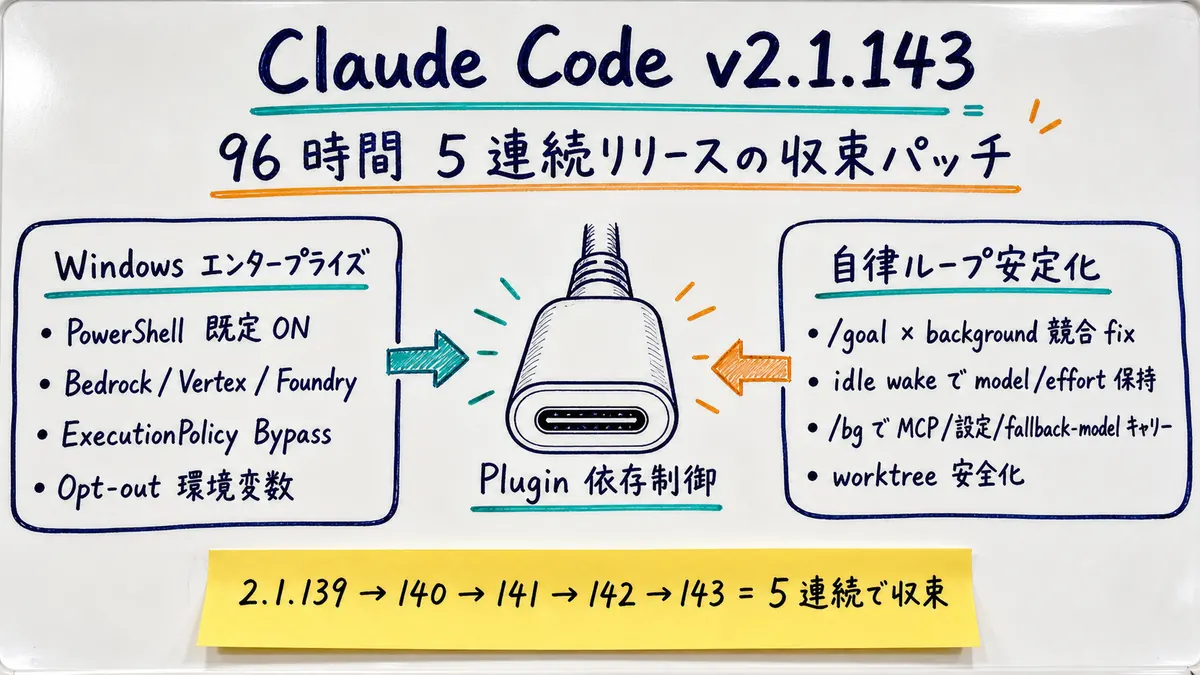
Claude Code 2.1.143: Plugin dependency enforcement + PowerShell default-on + /goal × background race fix — closing the 96-hour 5-release streak
16 分
Claude Code 2.1.142 introduces --agents and a remote-control API that lets you delegate sub-tasks to other agents (including Codex) from inside a Claude session. We map the architecture, the safety model, and the practical patterns.

中澤 圭志
@keishi_nakazawaSales Claw maintainer

Key Facts
Release
Claude Code 2.1.142 (2026-05-15)
Capability
--agents flag + remote control API for cross-agent orchestration
"Claude Code's claude agents and Codex CLI's codex remote-control dropped the same week. Both expose headless programmatic control — but how far does AI sales automation actually accelerate when you combine them?" This article walks through a Sales Claw-maintainer-eye design guide for that combination, using Claude Code 2.1.142 (2026-05-14) and Codex CLI 0.130.0 (2026-05-11) official Changelogs / GitHub Releases / App Server Docs as primary sources.
On 2026-05-11, Codex CLI 0.130.0 added codex remote-control as "a simpler entrypoint for starting a headless, remotely controllable app-server." Three days later, on 2026-05-14, Claude Code 2.1.142 added eight new flags to claude agents so dispatched background sessions can be fully isolated per session. In a single week, both CLIs evolved in the same direction: "don't use the TUI — control them programmatically from an external process."
This article covers how to combine these two CLIs as a single parallel headless agent platform. The summary:
--permission-mode isolation. Use claude agents --add-dir ... --mcp-config ... --permission-mode ... --model ... to launch fully isolated per-session workers.codex remote-control exposes 100+ methods like thread/start, turn/start, command/exec, fs/readFile for external processes.Primary sources: Claude Code official Changelog, GitHub Releases (v2.1.142), Codex CLI Changelog (developers.openai.com/codex/changelog), Codex App Server Docs (developers.openai.com/codex/app-server), Codex Non-interactive Mode Docs. For the Claude Code 2.1.142 standalone deep-dive, see the 2.1.142 8-flag + Fast Mode Opus 4.7 article.
May 2026 in AI coding CLIs: Claude Code shipped 2.1.139 → 2.1.140 → 2.1.141 → 2.1.142 in 72 hours, and Codex CLI went from 0.129.0 (Vim mode etc.) → 0.130.0 (remote-control etc.). Both products are layering "automation / pipeline / parallel jobs" capabilities on top of their original interactive TUIs.
![Same-week release timeline for Claude Code and Codex CLI from May 1 to May 15, 2026. Top half: Claude Code 2.1.x (2.1.137 → 2.1.139 [5/12 major: /goal + Agent View] → 2.1.140 [5/12] → 2.1.141 [5/13] → 2.1.142 [5/14 8 flags + Fast Mode Opus 4.7]). Bottom half: Codex CLI (0.128 → 0.129.0 [5/7 Vim mode + extended Chrome] → 0.130.0 [5/8-11 remote-control + plugin sharing] → 0.131.0-alpha [5/12-15 pre-release]). The major releases cluster in the same 8-day window of May 7–14.](/images/blog/diagram-2026-05-15-claude-codex-release-timeline.png)
"Two major CLIs evolved in the same direction in the same week" is more than coincidence. Anthropic and OpenAI each independently are moving their product position from "a CLI a single developer types at" to "a platform that schedules many parallel jobs." For AI sales automation that takes long-running, multi-pipeline, multi-model setups as table stakes, combining them got a step more practical.
claude agents flagsClaude Code 2.1.142 (2026-05-14 22:55 UTC) added 8 new flags to claude agents for launching dispatched background sessions:
--add-dir <path> — additional working directories (repeatable)--settings <path> — settings file for this session only--mcp-config <path> — MCP config for this session only--plugin-dir <path> — plugin directory for this session only--permission-mode <mode> — default / ask / acceptEdits / bypassPermissions / plan--model <model> — model for this session (haiku / sonnet / opus)--effort <level> — reasoning effort (high / medium / low)--dangerously-skip-permissions — fully bypass permissions (sandbox / trusted only)Each had been available to claude in foreground mode; 2.1.142 carries them to dispatched background sessions. The same release promotes Fast Mode default from Opus 4.6 → Opus 4.7 and removes the 60-second timeout cap on remote HTTP / SSE MCP.
codex remote-control and the App ServerCodex CLI 0.130.0 (2026-05-08 ~ 11) introduced codex remote-control as the headless control entrypoint.
The backing codex app-server uses JSON-RPC 2.0: stdio newline-delimited JSON (JSONL) by default, with experimental WebSocket via --listen ws://127.0.0.1:4500. The Codex App Server Docs publish 100+ methods. Key categories:
thread/start, thread/resume, thread/fork, thread/list, thread/archiveturn/start, turn/steer, turn/interruptmodel/list, experimentalFeature/listcommand/exec, command/exec/write, command/exec/resizeskills/list, app/list, plugin/listfs/readFile, fs/writeFile, fs/watchaccount/read, account/login/start, account/logoutStateless codex exec "..." (pipeline-friendly) and stateful, programmable codex remote-control + JSON-RPC co-exist as two automation layers inside the same Codex CLI.
| 項目 | Claude Code 2.1.142 (claude agents) | Codex CLI 0.130.0 (codex remote-control) |
|---|---|---|
| Automation entrypoint | claude agents <flags> --bg | codex remote-control / codex exec |
| Protocol | CLI flags + file-based config | JSON-RPC 2.0 (JSONL / WebSocket) |
| Config isolation | --settings / --mcp-config / --plugin-dir | thread/start parameters |
| Permission control | --permission-mode + Hooks | --sandbox + per-thread approval policy |
| Models | Claude (Opus 4.7 / Sonnet 4.6 / Haiku 4.5) | GPT-5.x / Codex family |
| Local file edits | Strong (Edit / Write) | OK (via fs/writeFile) |
| Image generation | Indirect (separate CLI) | Direct (codex exec with gpt-image-2) |
| MCP integration | Per-session via --mcp-config | OK (plugin/list via App Server) |
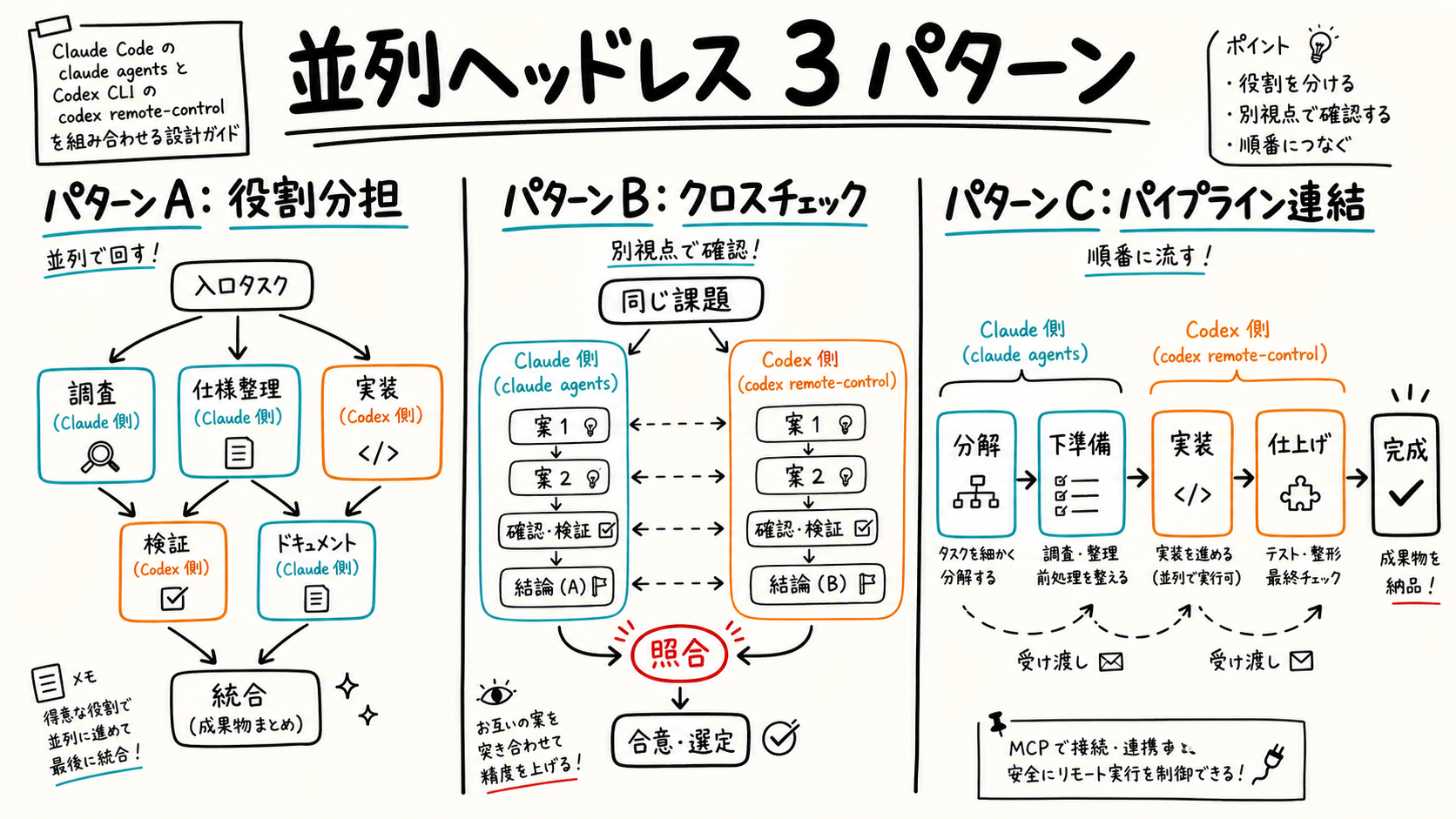
The simplest and most practical. Claude Code is strong at local file edits and MCP integration; Codex CLI is strong at image generation (gpt-image-2) and external-API pipelines. Split by workload.
codex exec --full-auto -m gpt-image-2 ...), data via external APIs, JSON-RPC-driven image conversion as independent jobsSend the same task to both Claude and Codex; compare outputs. For sales copy where "subtle brand-voice drift" and "missed banned terms" affect quality, two-LLM cross-check is effective. Plug it in as an additional layerin Sales Claw's pre-send checks.
awaiting_approval with audit-log entryClaude's output feeds Codex's input (or vice versa). Pipe codex exec --json JSONL output into Claude Code, or pass Claude Code's --output-format json result to thread/start on the Codex App Server.
# Pattern C example: Claude drafts 5 copy candidates → Codex brand-checks them
claude agents \
  --add-dir ./lines/btob-saas \
  --settings ./lines/btob-saas/.claude/settings.json \
  --permission-mode acceptEdits \
  --model sonnet \
  --output-format json > drafts.json

# Brand-check job on Codex side
codex exec --json --ephemeral \
  --sandbox workspace-write \
  "Read drafts.json. Run each draft against the Sales Claw brand guidelines. Output PASS/FAIL JSON." \
> brand-check.jsonl| 項目 | Claude only | Claude + Codex combined |
|---|---|---|
| Sales copy generation | Claude Sonnet 4.6 | Same + Codex cross-check for banned terms |
| Image generation | Needs separate external API call | codex exec calls gpt-image-2 directly |
| Local code editing | Claude is strong by default | Same (Codex assists) |
| MCP server integration | Per-session via --mcp-config | Same (plugin/list on Codex side) |
| Programmable control | CLI flags + stdio | Same + JSON-RPC 2.0 (Codex) |
| Cost | Anthropic API only | Anthropic + OpenAI both billed |
Sales Claw is OSS that lowers misfire and policy-violation risk through policy control, pre-send checks, do-not-contact detection, CAPTCHA-on-detect stop, rate limits, audit logs, and automatic stop conditions. Adding Codex CLI as a secondary backend alongside the existing Claude Code path lets one dashboard expose image generation and copy cross-check in addition to the standard flow.
# 1. Install Claude Code 2.1.142
npm install -g @anthropic-ai/claude-code@latest
claude --version
# → 2.1.142 or newer

# 2. Install Codex CLI 0.130.0
npm install -g @openai/codex@latest
codex --version
# → 0.130.0 or newer

# 3. Sales Claw auth
#    Register both Anthropic and OpenAI API keys in ~/.sales-claw/credentials
# (Configurable via the Sales Claw dashboard settings UI)Per-pipeline assignment: Claude Code as Worker, Codex as image-gen / cross-checker. See Workflow overview for the broader context.
# Pipeline A: B2B SaaS / Claude as Worker, Codex for image gen
claude agents \
  --add-dir ~/work/sales-claw/lines/btob-saas \
  --settings ~/work/sales-claw/lines/btob-saas/.claude/settings.json \
  --mcp-config ~/work/sales-claw/lines/btob-saas/.claude/mcp.json \
  --permission-mode acceptEdits \
  --model sonnet \
  --effort high \
  --bg

# Codex remote-control runs as a separate listening process
codex remote-control --listen ws://127.0.0.1:4500 &

# Pipeline A's copy cross-checker hits Codex App Server via JSON-RPC
# → thread/start → turn/start → collect JSONLMinimal TypeScript JSON-RPC client driving Codex App Server from a Sales Claw copy cross-checker:
// Within sales-claw, spawn Codex App Server as a sub-process
// JSONL over stdio
import { spawn } from 'node:child_process';

const codex = spawn('codex', ['remote-control'], { stdio: ['pipe', 'pipe', 'inherit'] });

let id = 1;
function rpc(method: string, params: Record<string, unknown>) {
  const req = JSON.stringify({ jsonrpc: '2.0', id: id++, method, params }) + '\n';
  codex.stdin.write(req);
}

// 1. Start a thread (sandbox = workspace-write, ephemeral)
rpc('thread/start', {
  sandbox: 'workspace-write',
  ephemeral: true,
  workingDirectory: '/work/sales-claw/lines/btob-saas',
});

// 2. Submit a turn (run brand-check on 5 Claude-generated drafts)
rpc('turn/start', {
  threadId: 'thread_abc',
  input: 'Run brand-check on each of these 5 sales copy drafts and return PASS/FAIL JSON.\n\n' + JSON.stringify(drafts),
});

// 3. Receive JSONL events from stdout
codex.stdout.on('data', (chunk) => {
  for (const line of chunk.toString().split('\n').filter(Boolean)) {
    const msg = JSON.parse(line);
    handleCodexMessage(msg);
  }
});
Sales Claw itself is free at the download page. The 1.2.x line plans GUI Codex CLI detection and credential registration; today, set up manually.
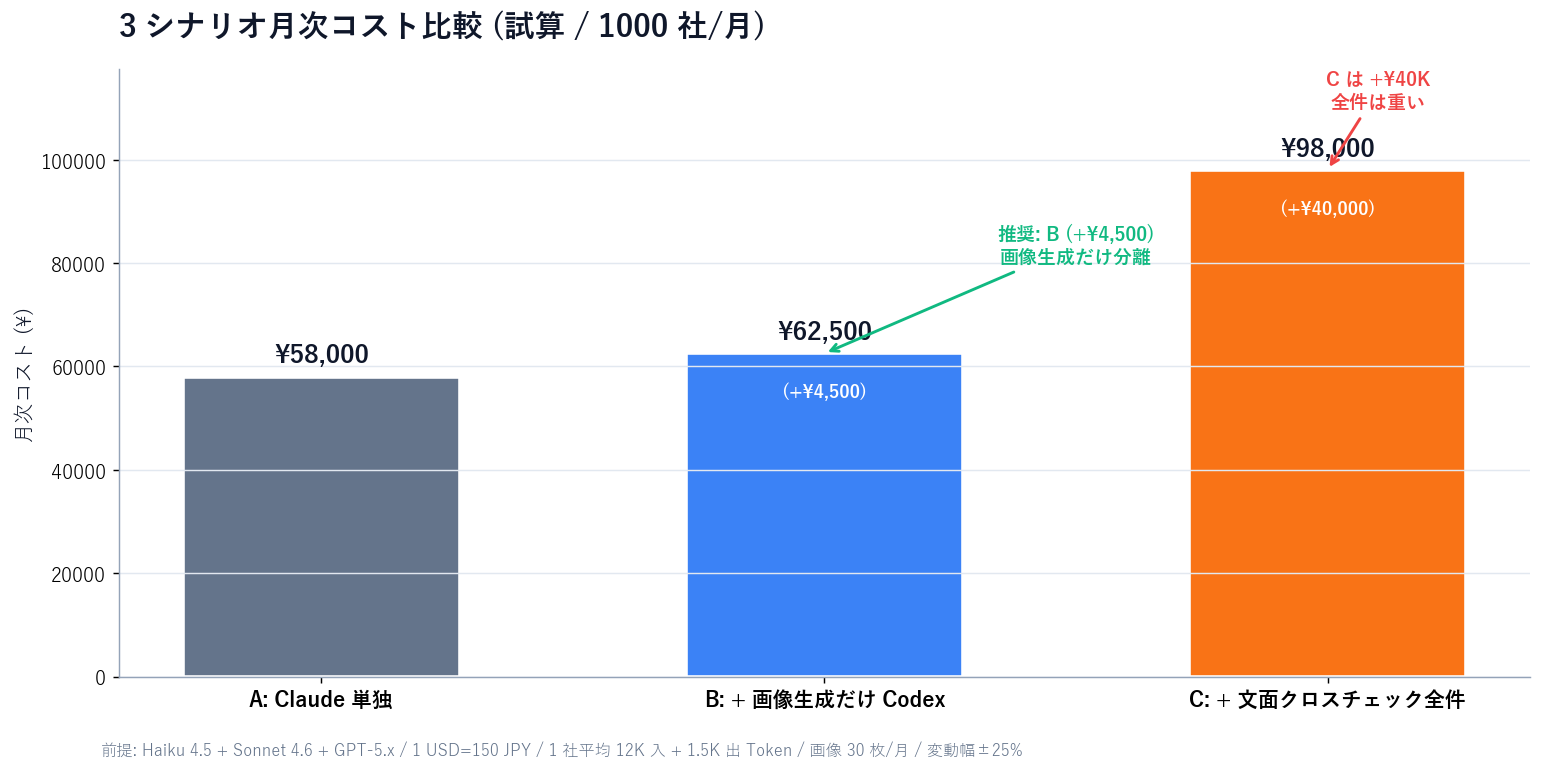
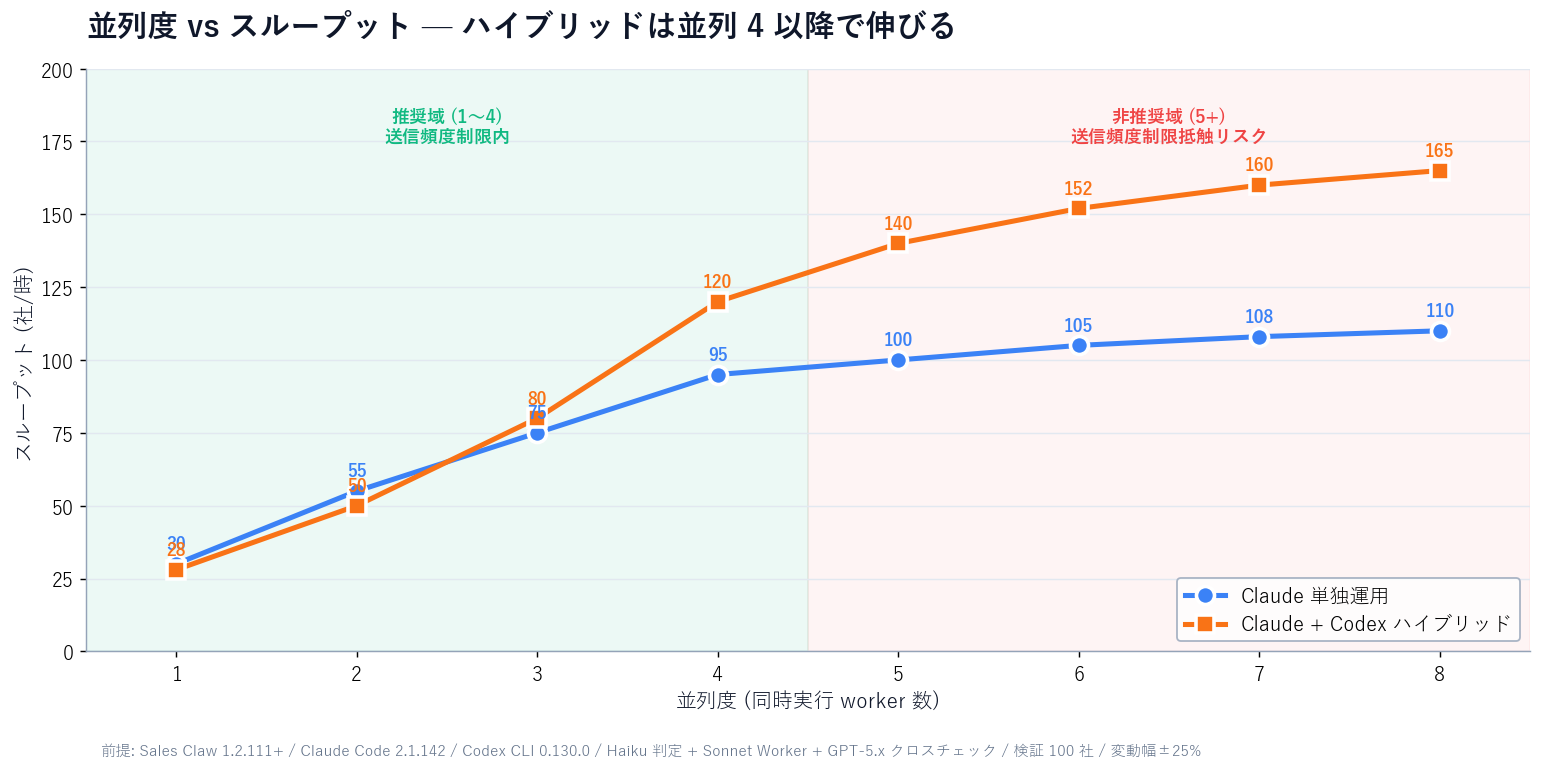
codex exec -m gpt-image-2 is simple and adds ~¥3,000–¥8,000/mo.Running two CLIs in parallel gives big headless / programmable wins. It also introduces a new risk: permission policy splits across two paths. Don't claim "safe" — lower risk structurally.
Claude Code builds pre-send checks via --permission-mode + Hooks. Codex CLI builds a different system via --sandbox + per-thread approval policy. Running both on one machine, it's easy to relax one side's guard while the other holds — creating the illusion of safety while leaving an open path.
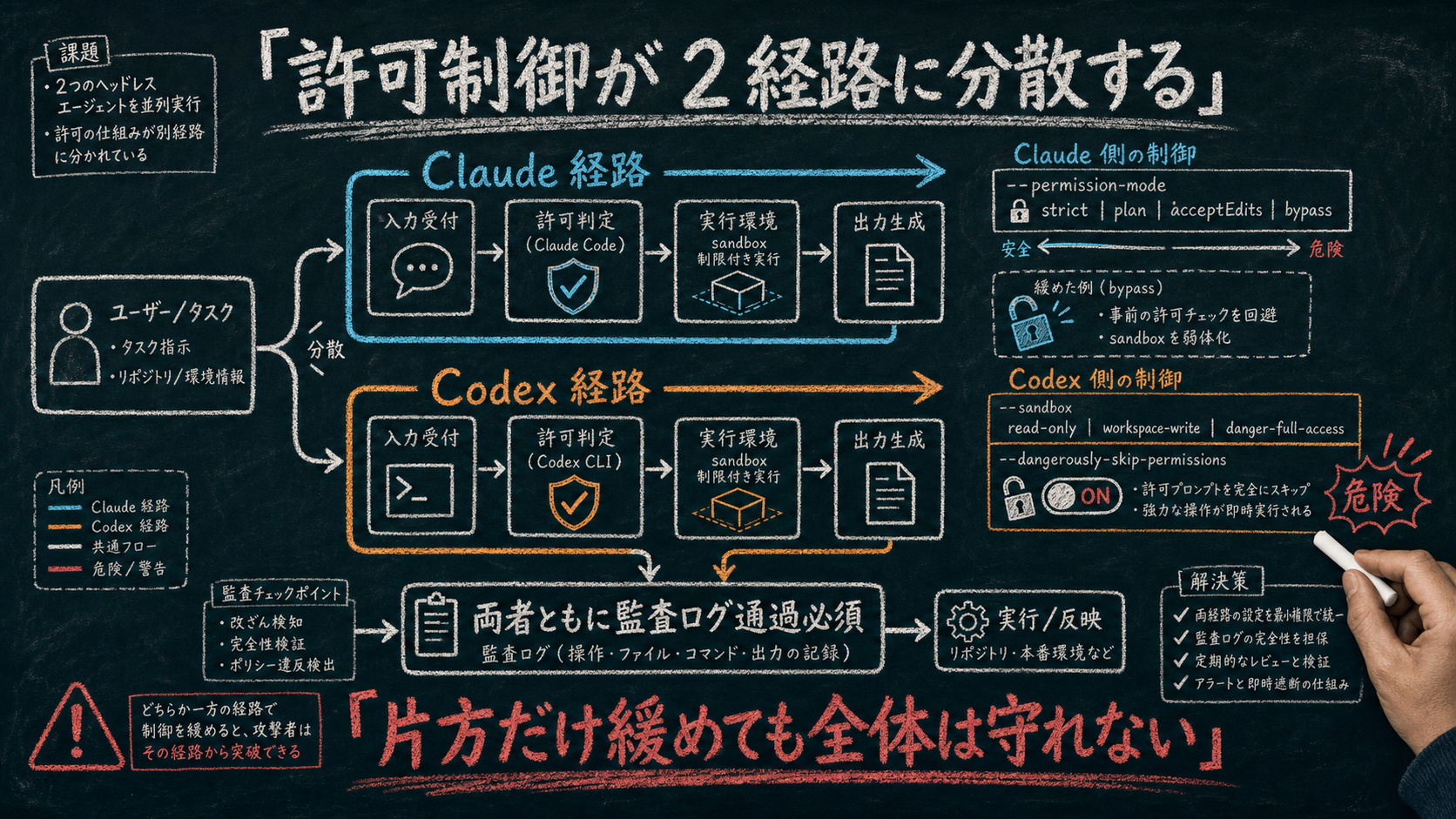
awaiting_approval, log on detect--listen ws://127.0.0.1:4500) accidentally exposed externally — always bind localhost; confirm firewallBefore launching a Claude Code × Codex combined operation
Claude Code 2.1.142 (2026-05-14) and Codex CLI 0.130.0 (2026-05-11) added features in the same direction the same week: "from TUI to programmatic control." They are complementary. claude agents's 8 flags excel at "config isolation + permission split"; codex remote-control + JSON-RPC 2.0 excels at "programmable control + image-gen pipelines."
For workloads that take long-running, multi-pipeline, multi-model setups as table stakes — like AI sales automation — combining them is now practical. Choose role split (Pattern A), cross-check (B), or pipeline chain (C) based on your workload. Adding the second LLM only for image gen and banned-term detection is a balanced compromise between cost and quality.
Next action: npm install -g @anthropic-ai/claude-code@latest @openai/codex@latest and start with Pattern A — split image generation to Codex first. See Quick start and Workflow overview for setup, and the Claude Code 2.1.142 standalone deep-dive for the other side.