Claude for Government vs ChatGPT Gov: which one wins, and why Japan is still behind
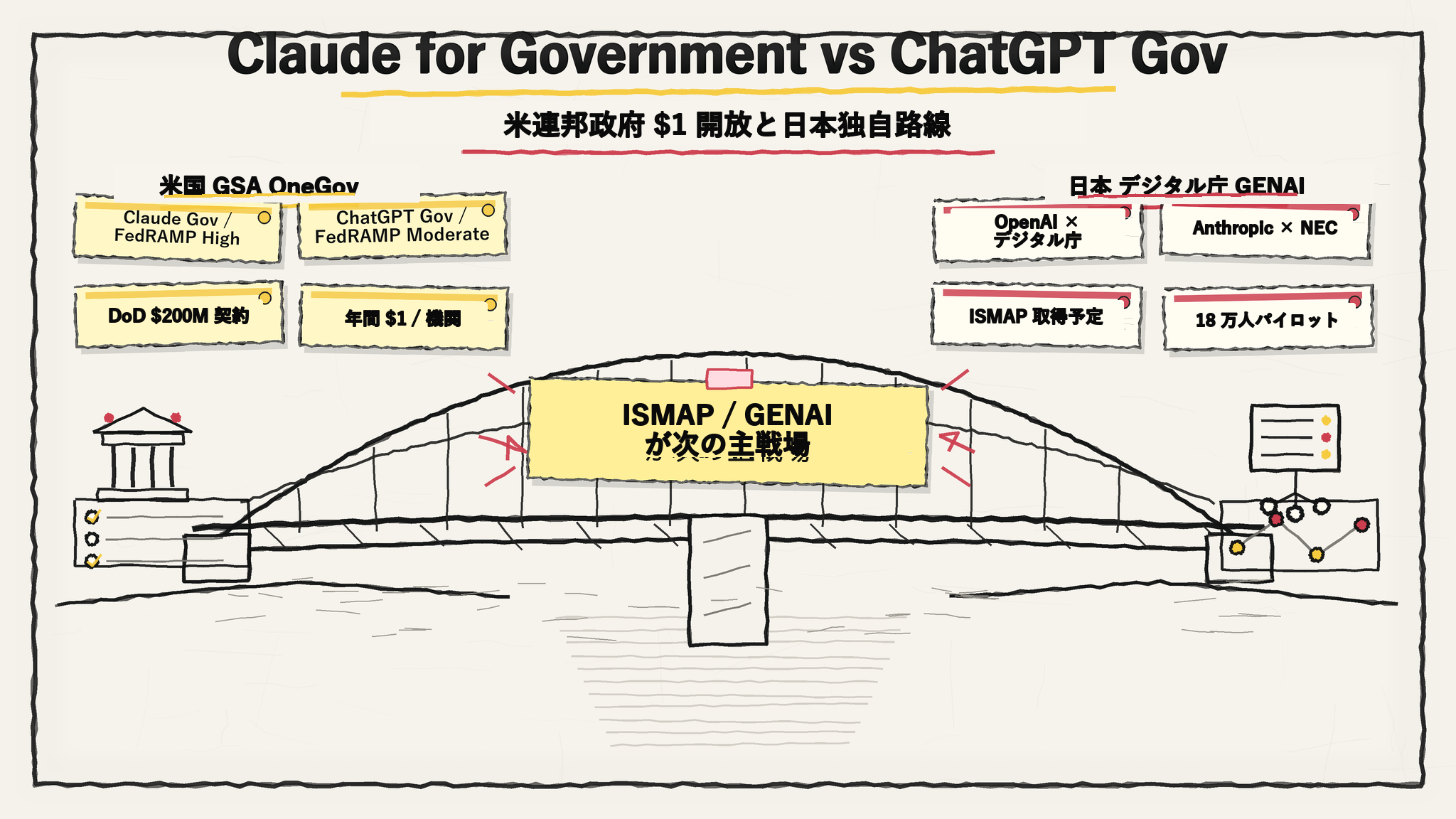
The U.S. opened both Claude Gov and ChatGPT Gov to all federal agencies at $1/agency/year via GSA OneGov. Japan is building GENAI in-house, collaborating with OpenAI, while Anthropic enters via NEC and a Tokyo office. Here's the full landscape, the FedRAMP gap, and the practical three-year roadmap for Japanese sales and procurement teams.

中澤 圭志
@keishi_nakazawaSales Claw maintainer
Key Facts
Announced
Claude Gov 2025-08-12 / ChatGPT Gov 2025-01-28
FedRAMP
Claude Gov: High (DoD IL5) / ChatGPT Gov: Moderate
Japan
OpenAI x Digital Agency (2025-10-02) / Anthropic x NEC (2026-04-23)
GSA OneGov pricing
Both $1 / federal agency / year (until 2026-08)
"Claude for Government vs ChatGPT Gov — which one is stronger, and why is Japan still behind on adoption?"— this article answers both, sourced from Anthropic Newsroom, OpenAI Global Affairs, GSA press releases, and Japan's Digital Agency GENAI policy page, with a Sales Claw lens on what it means for Japanese enterprises, local governments, and SDR teams.
As of May 2026, the U.S. has opened both Claude for Government (announced 2025-08-12) and ChatGPT Gov (announced 2025-01-28) to all federal agencies at $1 per agency per year via GSA OneGov contracts — an unprecedented entry-cost. Japan, by contrast, has taken a different path: the Digital Agency is building its own GENAI (Government AI) platform in-house, and has signed a strategic collaboration with OpenAI, while Anthropic operates through a Tokyo office and an NEC partnership rather than a direct government deal.
1. Why "Government AI" suddenly became a Japan topic

What is actually news for Japan
- 2025-05: AI Promotion Act takes effect; Digital Agency announces GENAI
- 2025-10-02: OpenAI and Digital Agency announce strategic collaboration (ISMAP certification planned)
- 2025-12: Cabinet approves the AI Basic Plan
- 2026-04-23: Anthropic and NEC announce a strategic partnership for industry-specific solutions (finance, manufacturing, local government)
2. What Claude for Government is, as of May 2026
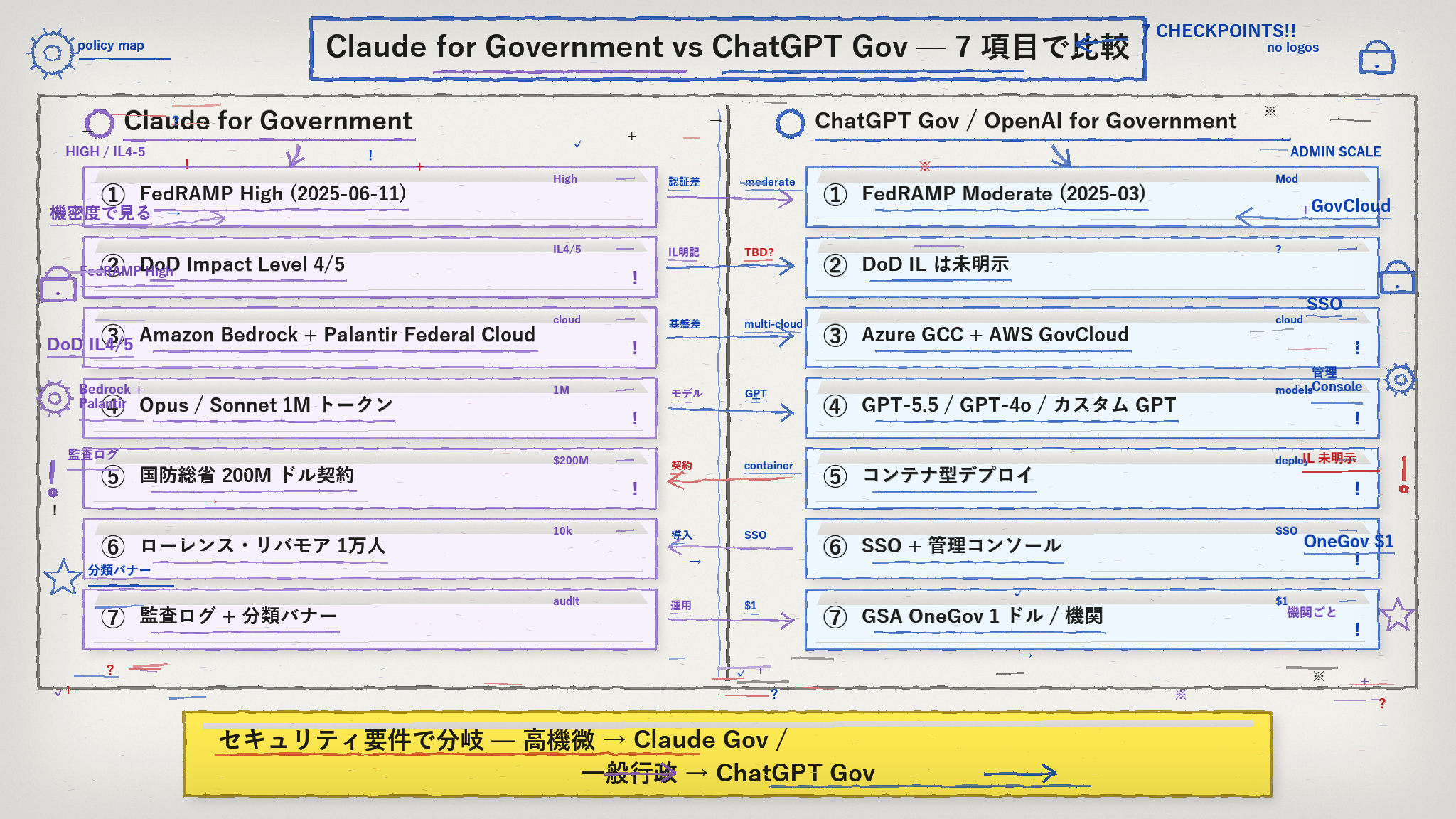
- Models: Claude 3.5 Sonnet v1, Claude 3 Haiku, Claude Opus 4.6 / 4.7 (added progressively)
- Context window: 1M tokens for Sonnet / Opus, 200K for Haiku
- Hosting: Amazon Bedrock (FedRAMP High region) and Palantir Federal Cloud Service
- Certifications: FedRAMP High (acquired 2025-06-11), DoD Impact Level 4/5
- Features: full audit logging, admin controls, classification banners, end-to-end encryption in transit and at rest
3. What ChatGPT Gov / OpenAI for Government is
- Models: GPT-5.5 (available in FedRAMP environments), GPT-4o (text / code / image), custom GPTs
- Hosting: Azure GCC, Azure Commercial, AWS GovCloud (Codex / API)
- Certifications: FedRAMP Moderate (2025-03), FedRAMP 20x Moderate approval
- Form factor: container-based, deployable into Azure Commercial or Azure Government as the agency requires
4. Feature, certification, and customer comparison

| 項目 | Claude for Government | ChatGPT Gov / OpenAI for Government |
|---|---|---|
| First announced | Phased since 2024; GSA OneGov expansion 2025-08-12 | 2025-01-28 (ChatGPT Gov standalone) |
| FedRAMP | High (2025-06-11) | Moderate (2025-03) / 20x Moderate |
| DoD Impact Level | IL4 / IL5 | Not publicly listed |
| Hosting | Amazon Bedrock / Palantir Federal Cloud | Azure Government / Azure Commercial / AWS GovCloud |
| Models | Claude 3.5 Sonnet v1 / Claude 3 Haiku / Opus 4.6-4.7 | GPT-5.5 / GPT-4o / custom GPTs |
| Context window | Opus & Sonnet 1M, Haiku 200K | GPT-5.5 272K-1M (config-dependent) |
| Pricing (through 2026-08) | $1 / agency / year via GSA OneGov | $1 / agency / year + 60-day unlimited via GSA OneGov |
| Disclosed customers | DoD $200M, Lawrence Livermore Labs, D.C. Health | All executive-branch agencies (specific names rolled out gradually) |
| Audit | Full audit logging, classification banners, admin controls | SSO, admin console, group management |
| Form factor | Managed (Bedrock / Palantir) | Container-based (Azure Commercial or Government) |
| Coding agent | Claude Code (commercial reused) | Codex (within OpenAI for Government scope) |
5. Japan: Digital Agency GENAI and the partners around it
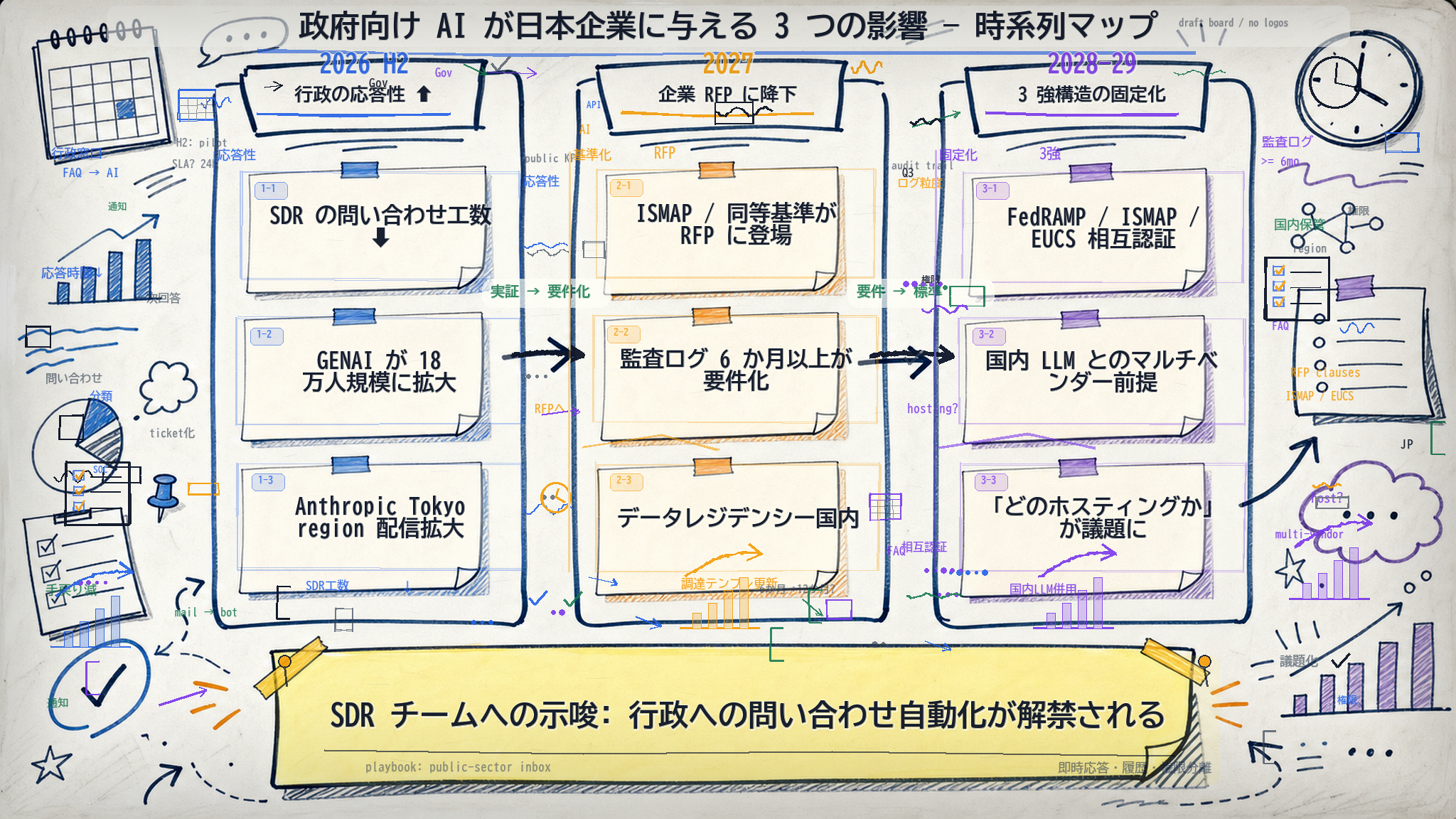
- GENAI scope: by May 2026, over 100,000 civil servants have access; FY2026 plan expands to 180,000
- OpenAI x Digital Agency (2025-10-02): provide AI tools for government staff, co-develop admin workflows, ISMAP certification planned, evaluate domestic data centers
- Anthropic x NEC (2026-04-23): industry-specific Claude-based solutions for finance, manufacturing, local governments
6. Impact on Japanese enterprises, local governments, and SDR teams

Three recommended actions for SDR / sales managers
- Inventory your security posture: list the AI models you use, their hosting region, and data retention policy so you can respond to a procurement question within 24 hours
- Avoid vendor lock-in: route Claude, OpenAI, and Gemini through an abstraction layer (AI Gateway, LiteLLM, or your own proxy) so you can swap providers when certification requirements change
- Get your audit logging in order: keep an audit log (e.g., Sales Claw's
action-log.json), automatic stop conditions, and pre-send safety checks so you can answer "align with government-grade standards" without retrofitting
7. Pitfalls of applying government-grade AI to commercial environments
We've focused on the upside so far, but there are well-known failure modes when commercial teams try to use government-grade AI directly.
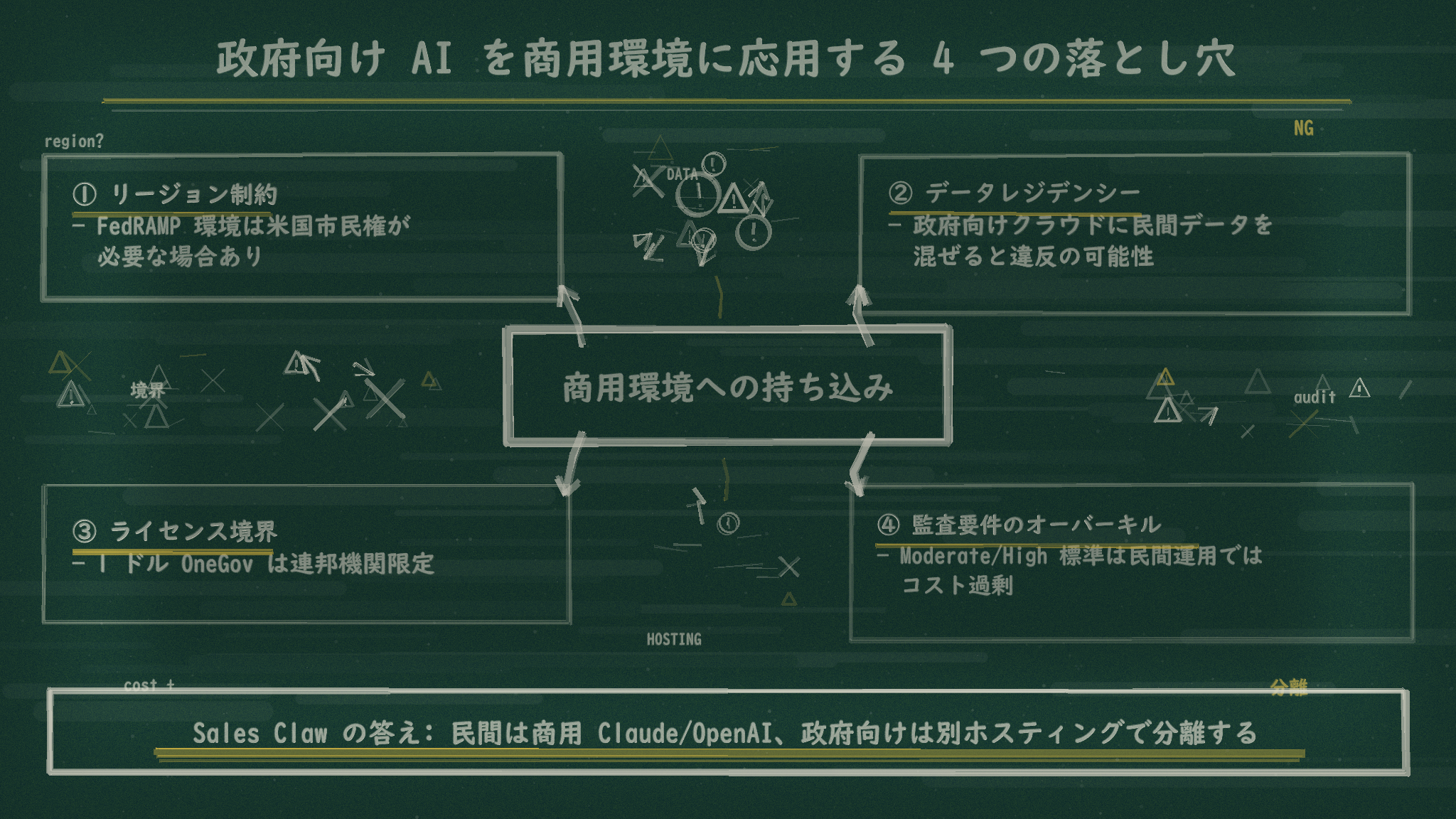
- Data residency drift: FedRAMP High often presumes U.S. citizens operating U.S. data centers — placing private data inside pulls you into government audit scope
- License boundary: GSA OneGov $1/agency is federal-only; commercial users must contract Claude for Enterprise / ChatGPT Enterprise separately
- Audit overkill: Moderate (~325 controls) and High (~425 controls) are overkill for most commercial use cases where cost-impact analysis is more important
- Vendor lock-in acceleration: ISMAP and similar certifications tend to favor incumbent vendors, accelerating consolidation around the "big three"
8. Three-year outlook and what to do now
Five concrete moves to make this year
- Inventory your security posture (data residency, log retention, model-switching) on a single page
- Insert an abstraction layer (AI Gateway / LiteLLM / your own proxy) between code and provider APIs
- Stand up audit logging equivalent to Sales Claw's
action-log.json, with automatic stop conditions and pre-send safety checks - Train procurement teams to explain FedRAMP / ISMAP / EUCS differences in five minutes
- Don't use government-grade AI for commercial workloads — keep the boundary explicit, and use the commercial editions where they suffice
Sales Claw is available as OSS, with policy controls, pre-send safety checks, sales-NG detection, CAPTCHA-stop behavior, send-rate limiting, audit logging, and automatic stop conditions. Regardless of how the government AI story plays out, building a solid private-sector sales automation foundation now is the most rational way to get ready for 2027-era enterprise RFPs. See also our cross-comparison of Codex CLI and Claude Code for context on the commercial coding-agent landscape.
This English edition is a faithful summary; the Japanese-language original is the canonical version with the full Fact Ledger and citation footnotes.
よくある質問
What is the biggest difference between Claude for Government and ChatGPT Gov?
Has the Japanese government deployed Claude Gov or ChatGPT Gov?
What does the FedRAMP High vs Moderate difference actually mean?
Can commercial companies use Claude Gov or ChatGPT Gov?
What is the status of Japan's Digital Agency GENAI?
What should Japanese enterprises and SDR teams do to prepare?
Has Anthropic or OpenAI obtained ISMAP certification in Japan?
参考文献
本記事は X 公式アカウントと公式ドキュメントを一次情報として参照しています。
- [01]
- [02]
- [03]
- [04]
- [05]
- [06]OpenAI — Available at FedRAMP Moderate2025-03-15
- [07]
- [08]
- [09]
- [10]
- [11]
この記事の著者

中澤 圭志
Sales Claw maintainer
Designs and develops Sales Claw. Writes from the field on B2B sales automation and applied AI.