ツール解説
Tune Claude Code to Your Spec — A Practical Harness-Optimization Guide for General Readers
14 分
Claude Skills are 'recipe-book files' for AI: a folder with a SKILL.md that Claude opens only when relevant. Announced 2025-10-16 and opened as a standard 2025-12-18, they fill the gap between lightweight prompts and heavyweight MCP. This is a general-reader walkthrough using the cookbook analogy — three-stage loading, how to write a SKILL.md, the three platforms, and a production checklist.

中澤 圭志
@keishi_nakazawaSales Claw maintainer
Key Facts
Announced / Standard
2025-10-16 launched / 2025-12-18 open standard
Required fields
Just two: SKILL.md name (≤64 chars) and description (≤1024 chars)
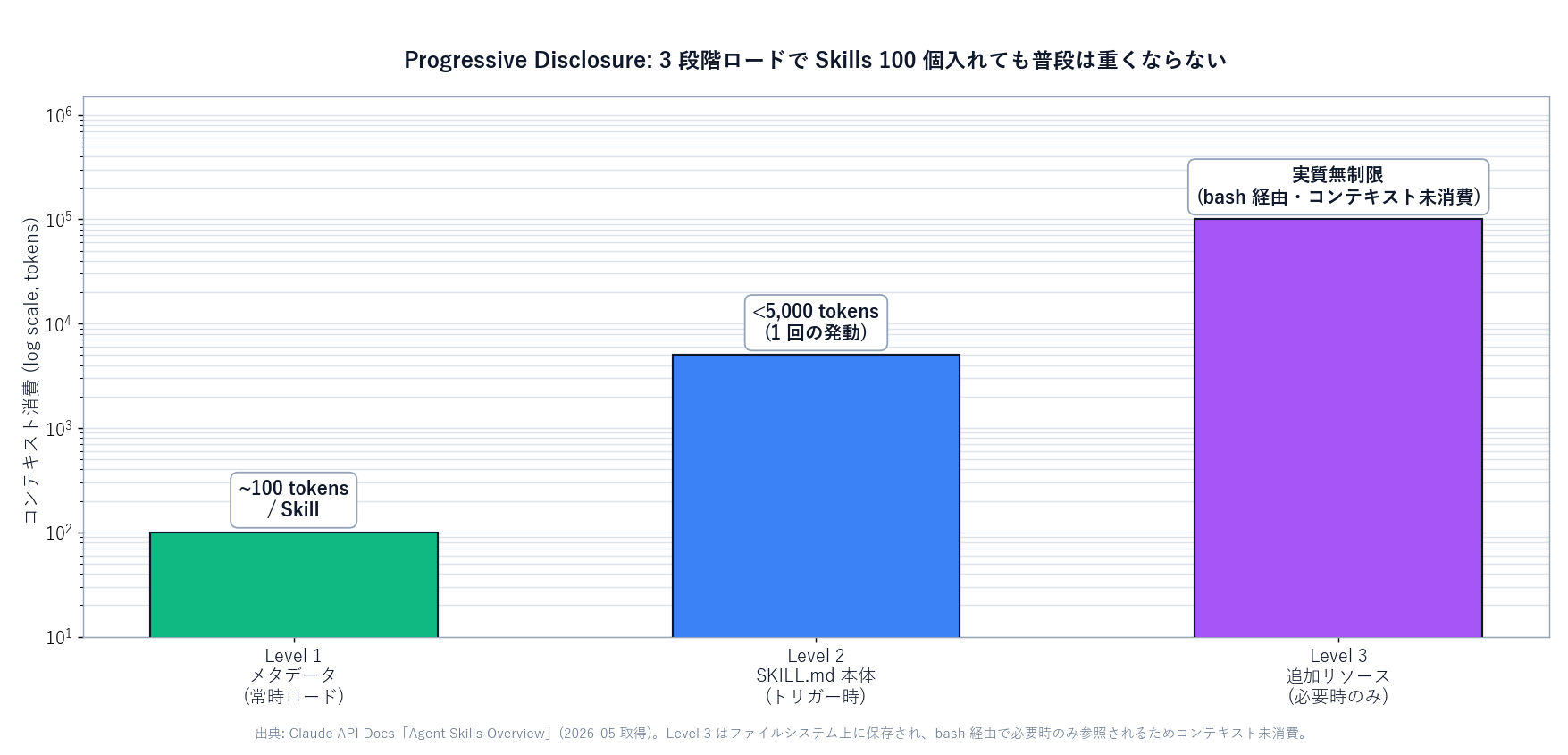
Three-stage loading
Metadata always (~100t) / body on trigger (<5kt) / extras on demand
Platforms
Claude.ai (Pro+) / Claude Code / Claude API (via skill_id)
"What are Claude Skills? How are they different from ChatGPT GPTs? Do I need to build my own, or just use what Anthropic ships?" This is a general-reader walkthrough of Claude Skills (Agent Skills), which Anthropic announced on October 16, 2025. We rely on official sources — Anthropic's blog, engineering blog, API docs, and the public anthropics/skills GitHub repo — to explain what Skills do, where they trip up, and how to start using them tomorrow.
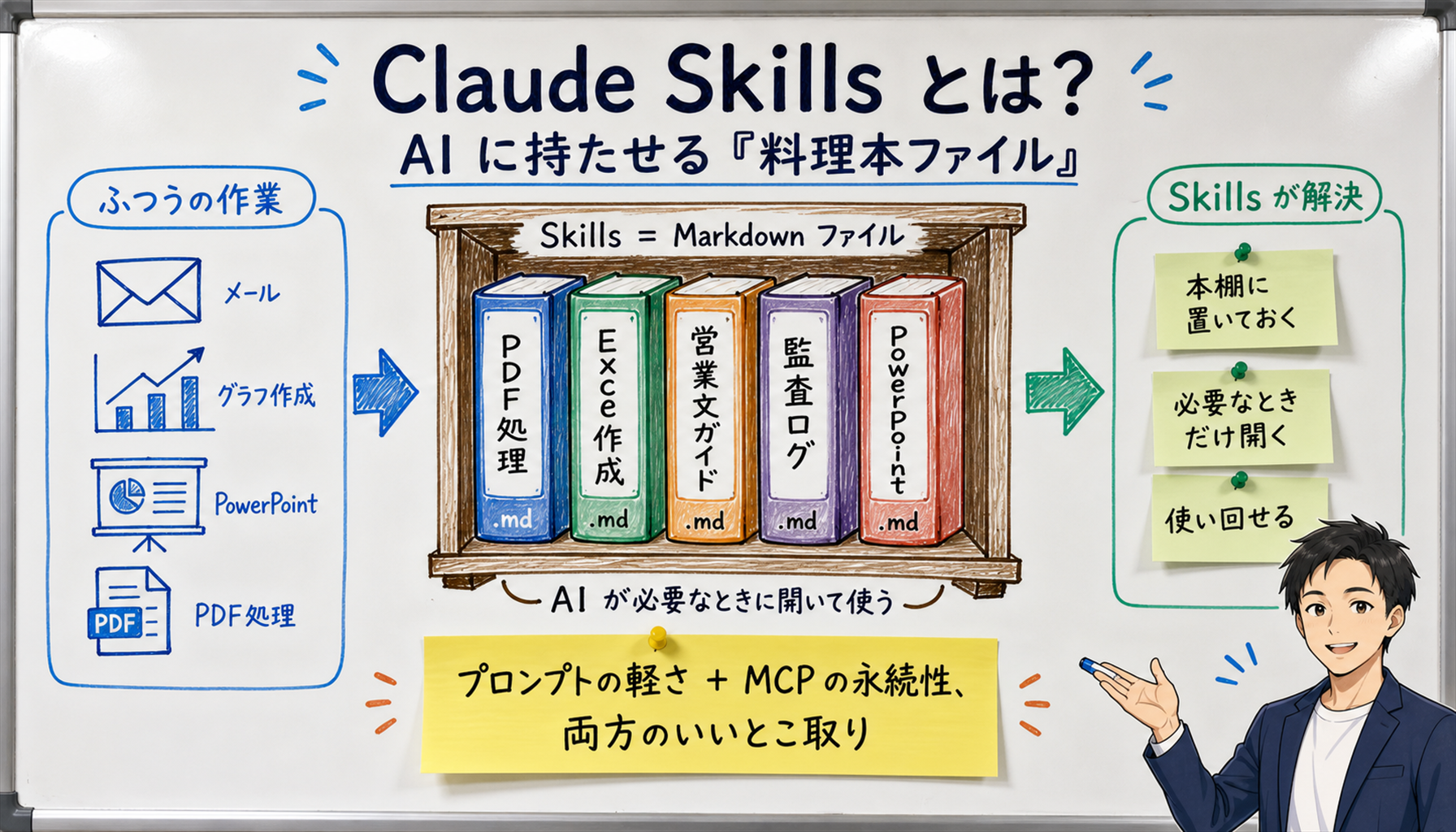
[Official]Anthropic defines Skills as "folders containing instructions, scripts, and resources that Claude can load when needed to improve performance on specialized tasks." The engineering blog describes the design as a well-organized manual, where Claude moves from table of contents to chapter to appendix on demand.
[Author view] The cookbook analogy works best. You cannot ask Claude to memorize every cuisine on Earth, but you can put a few cookbooks (Skill folders) on a shelf — French, Japanese, pastry. When an order comes in, Claude pulls the one relevant book. Skills give Claude that shelf of cookbooks.
The key phrase is "automatically when relevant". You don't have to say "use pdf-skill" — Claude reads each Skill's description and decides on its own. That is the biggest split with prompt-style instruction.
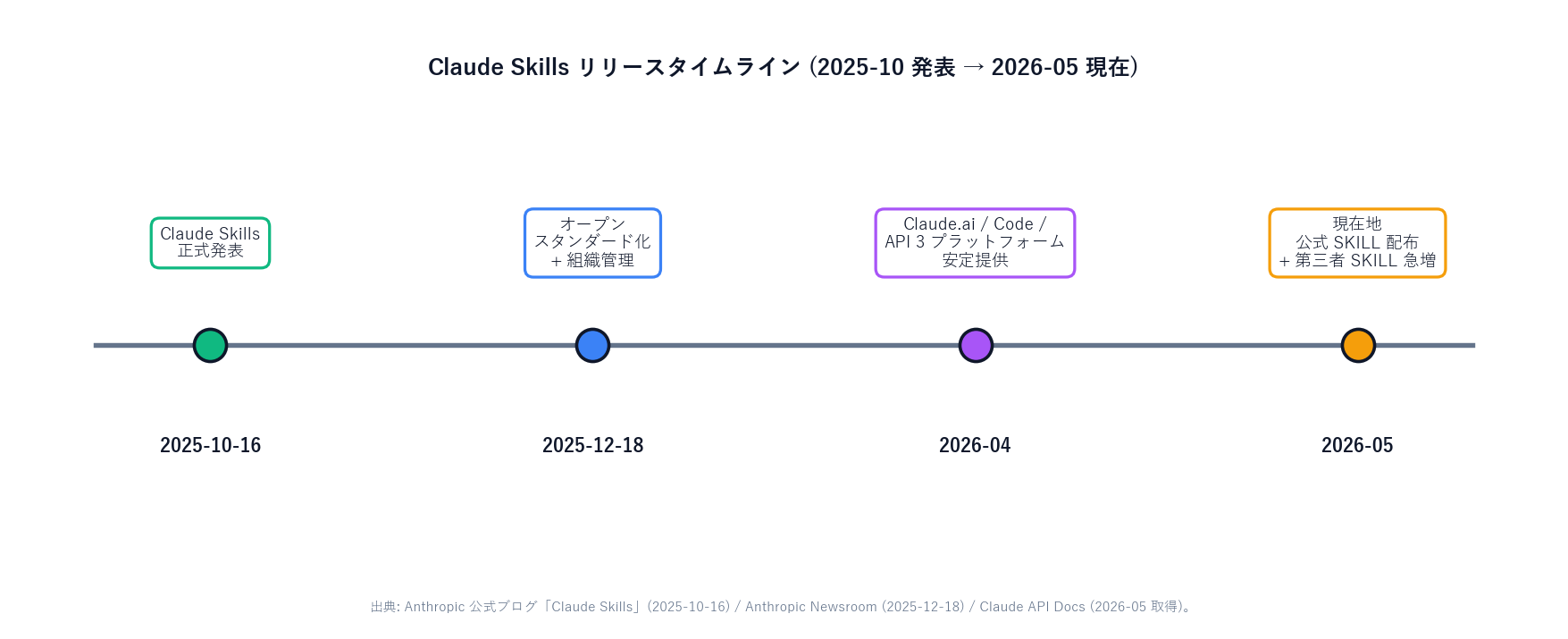
[Official]Per Anthropic's blog, Skills launched on October 16, 2025; on December 18, 2025they added organization-wide management and released Skills as an open standard. Anthropic frames the timing as the moment Claude could meaningfully "interact with full-fledged computing environments."
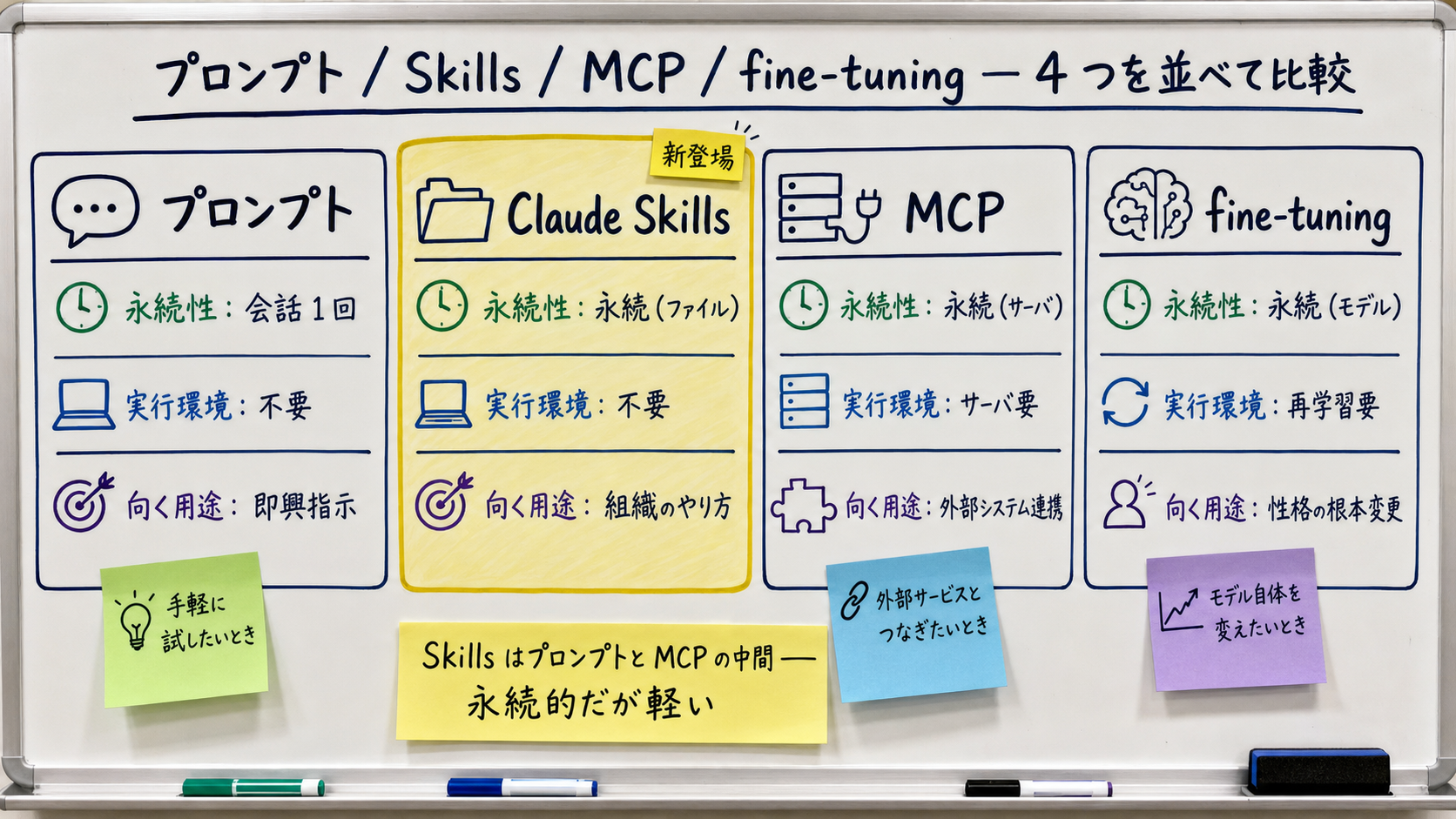
[Author view] There was a real gap between prompts and MCP. Prompts vanish after a session; MCP needs a server. Skills give you a persistent, server-free instruction file. Demand for exactly this gap was loud through 2025, and Skills landed on it.
| Mechanism | Persistence | Runtime | Best for |
|---|---|---|---|
| Prompt (chat) | Disappears after one conversation | None | Ad-hoc instructions |
| Claude Skills | Persistent (file) | None (filesystem only) | How your team works |
| MCP server | Persistent (server) | HTTP/Stdio server required | External system integration |
| Fine-tuning | Persistent (model weights) | None | Reshaping the model itself |
[Official] Per Claude API Docs, the three levels are:
name and description from the YAML frontmatter, included in the system prompt at startup.SKILL.md via bash.[Author view]Even with 100 Skills installed you spend only ~10K tokens on metadata — roughly 1% of Claude Opus 4.7's 1M-token context. The cookbook spines are always visible; only the one you need gets pulled off the shelf.
---
name: pdf-processing
description: Extract text and tables from PDF files, fill forms, merge documents. Use when working with PDF files or when the user mentions PDFs, forms, or document extraction.
---

# PDF Processing

## Quick start

Use pdfplumber to extract text from PDFs.

For advanced form filling, see FORMS.md.
[Official] Field constraints:
name: up to 64 chars, lowercase letters, digits, and hyphens. No XML tags. Cannot contain "anthropic" or "claude".description: up to 1,024 chars, non-empty. Should include both what the Skill does and when to use it.[Author view] Writing descriptionwell is the part most people miss. "Handles PDFs" is not enough. Write "use when working with PDF files or when the user mentions PDFs, forms, or document extraction." Claude reads this string to decide whether to engage.
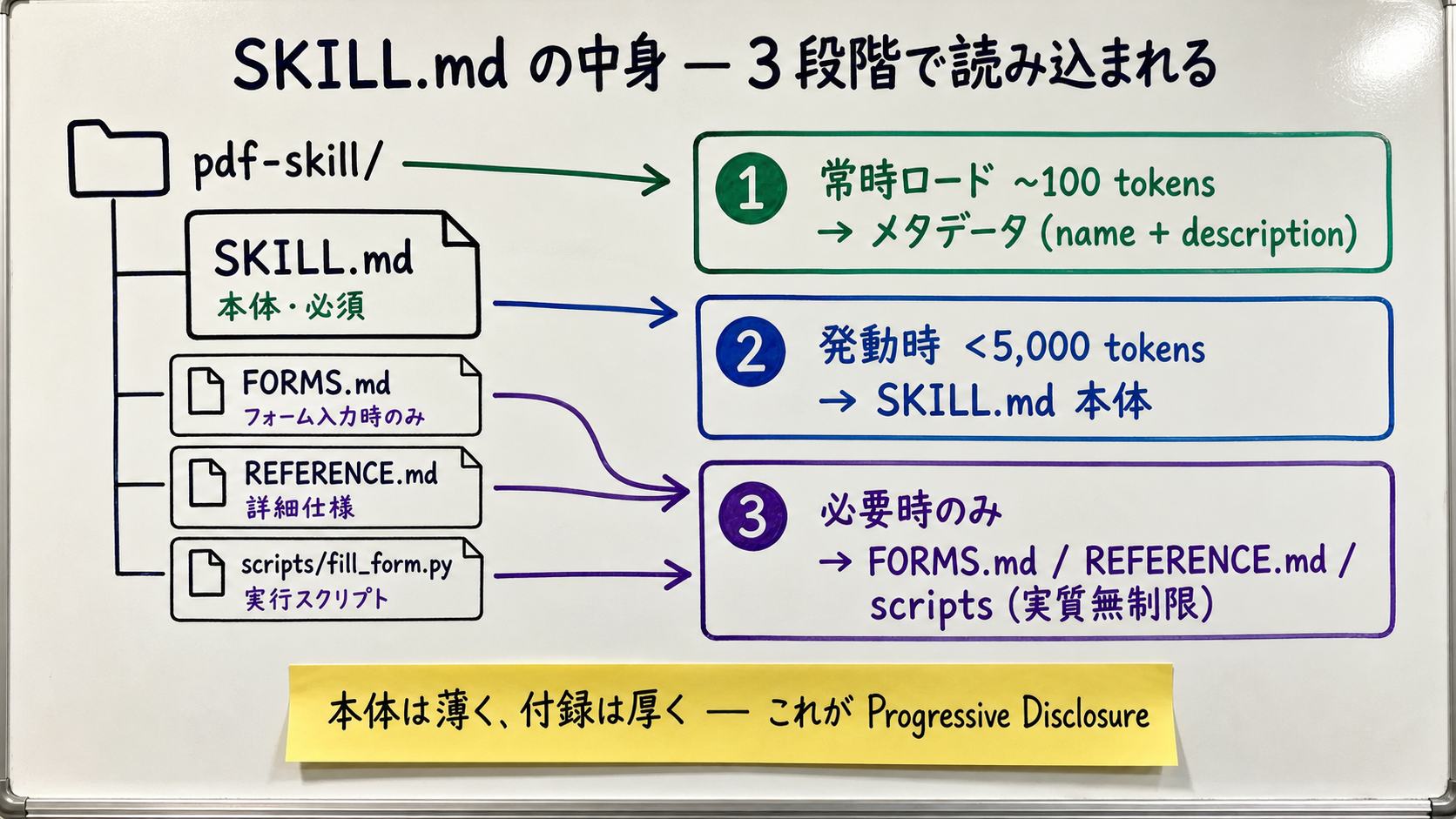
The principle is "thin core, fat appendix". Cramming everything into SKILL.md pays 5,000 tokens every trigger. Split rarely-needed material into separate files. See also ourMCP (Model Context Protocol) complete guide.
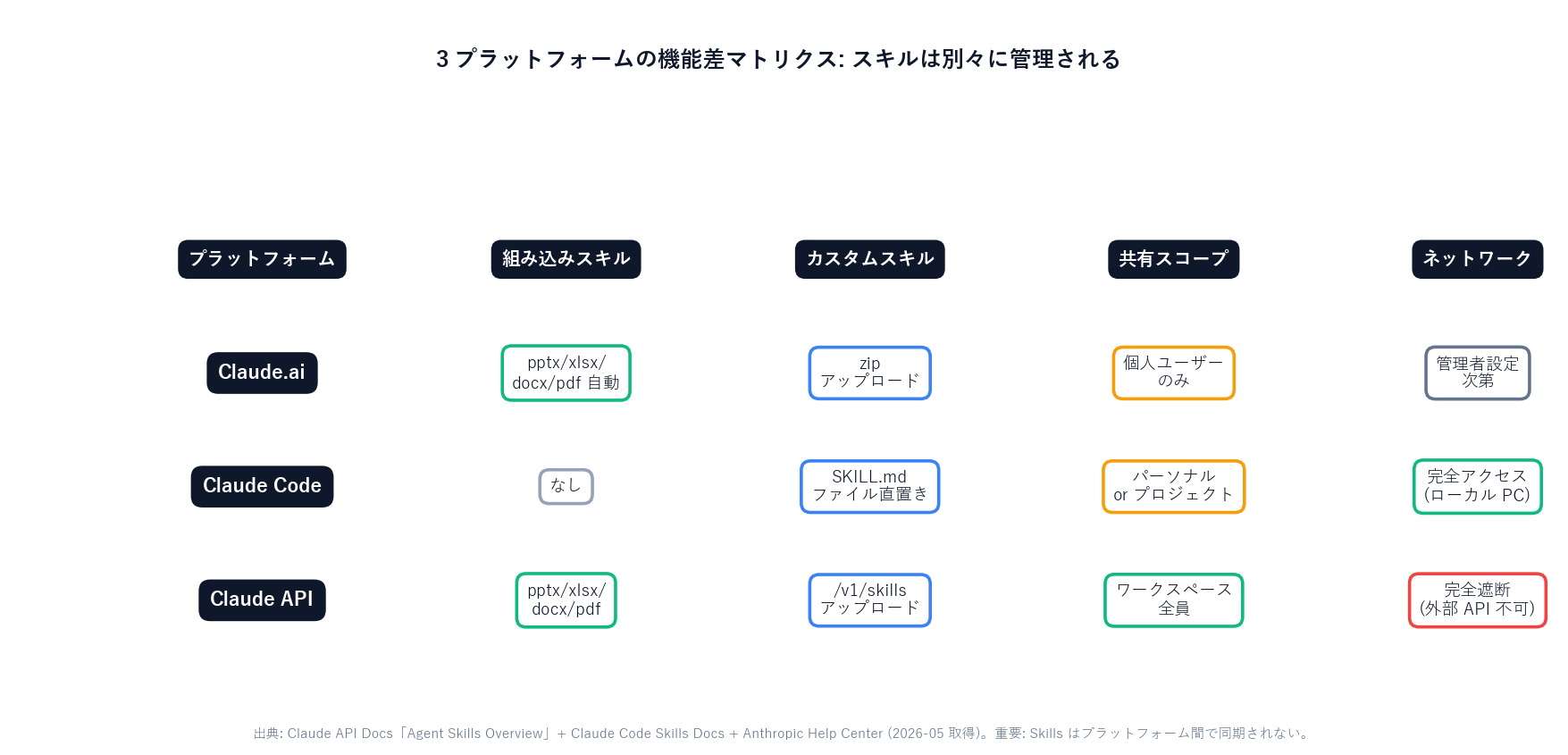
| Platform | Built-in Skills | Custom Skills | Sharing scope |
|---|---|---|---|
| Claude.ai | pptx / xlsx / docx / pdf (automatic) | Upload as zip | Individual user only |
| Claude Code | (none) | Drop SKILL.md as a file | Personal or project |
| Claude API | pptx / xlsx / docx / pdf | Upload via /v1/skills | Workspace-wide |
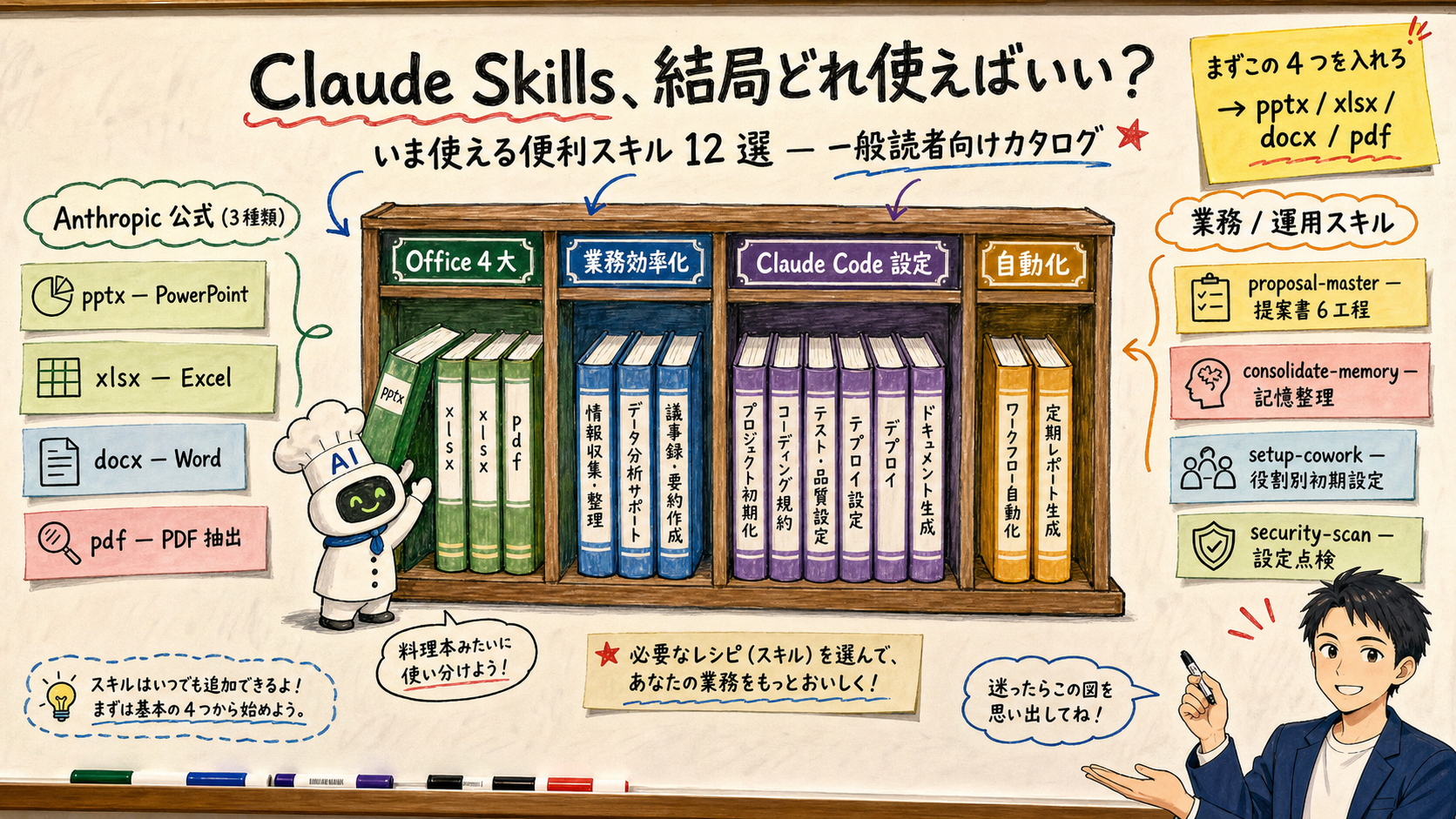
[Official]On Pro / Max / Team / Enterprise plans, users upload Skills as zip files via Settings > Features. Anthropic's built-in PowerPoint, Excel, Word, and PDF Skills run silently — just ask Claude to "build me an Excel file" and the xlsx Skill fires.
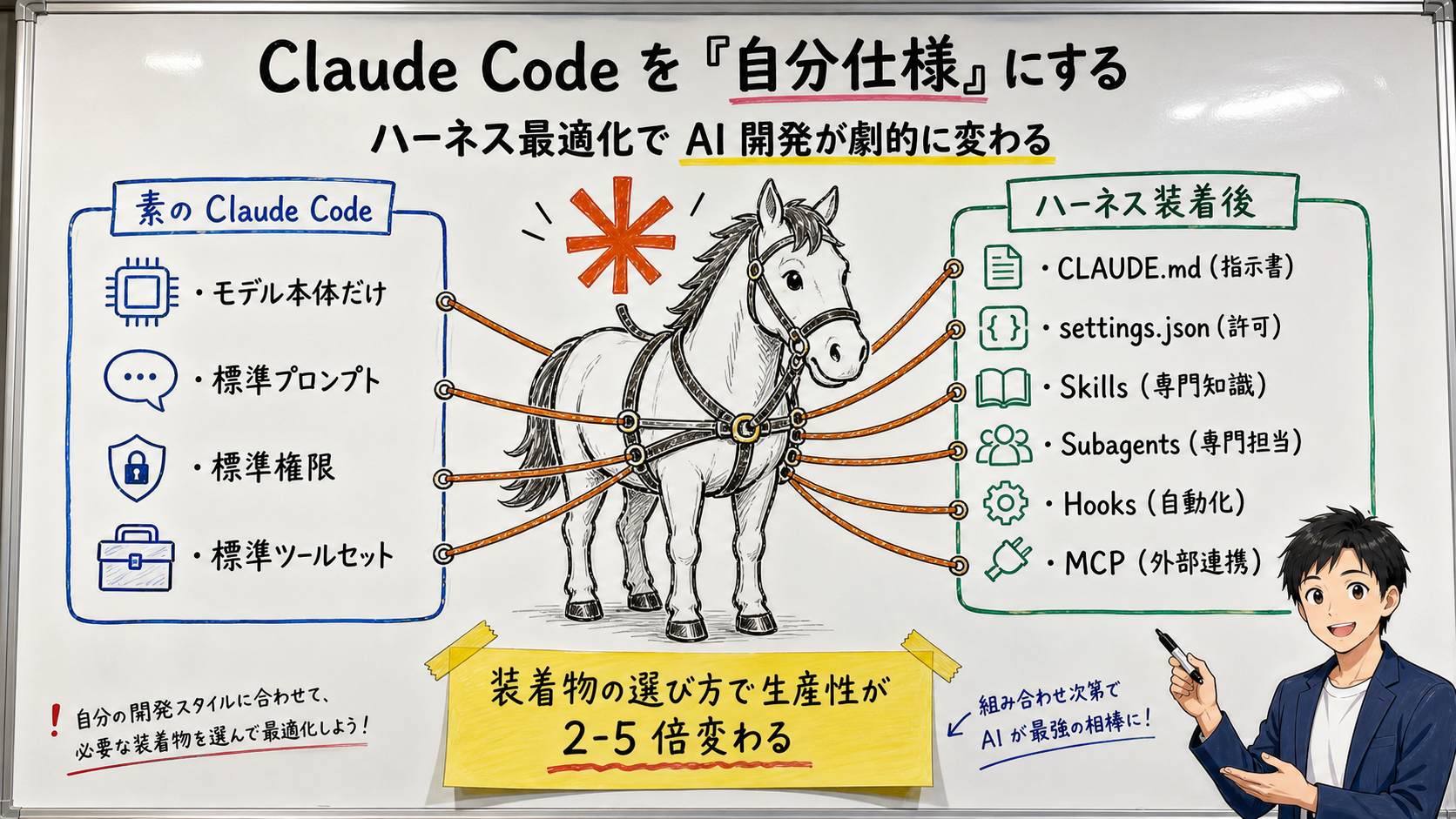
[Official] Claude Code supports custom Skills only. Drop a folder into~/.claude/skills/ (personal) or .claude/skills/ (project) — Claude Code discovers it automatically. No API upload required. Distributable via Claude Code Plugins.
[Official] The API uses /v1/skills for uploads, and Skills are shared workspace-wide. Required beta headers:code-execution-2025-08-25, skills-2025-10-02,files-api-2025-04-14.
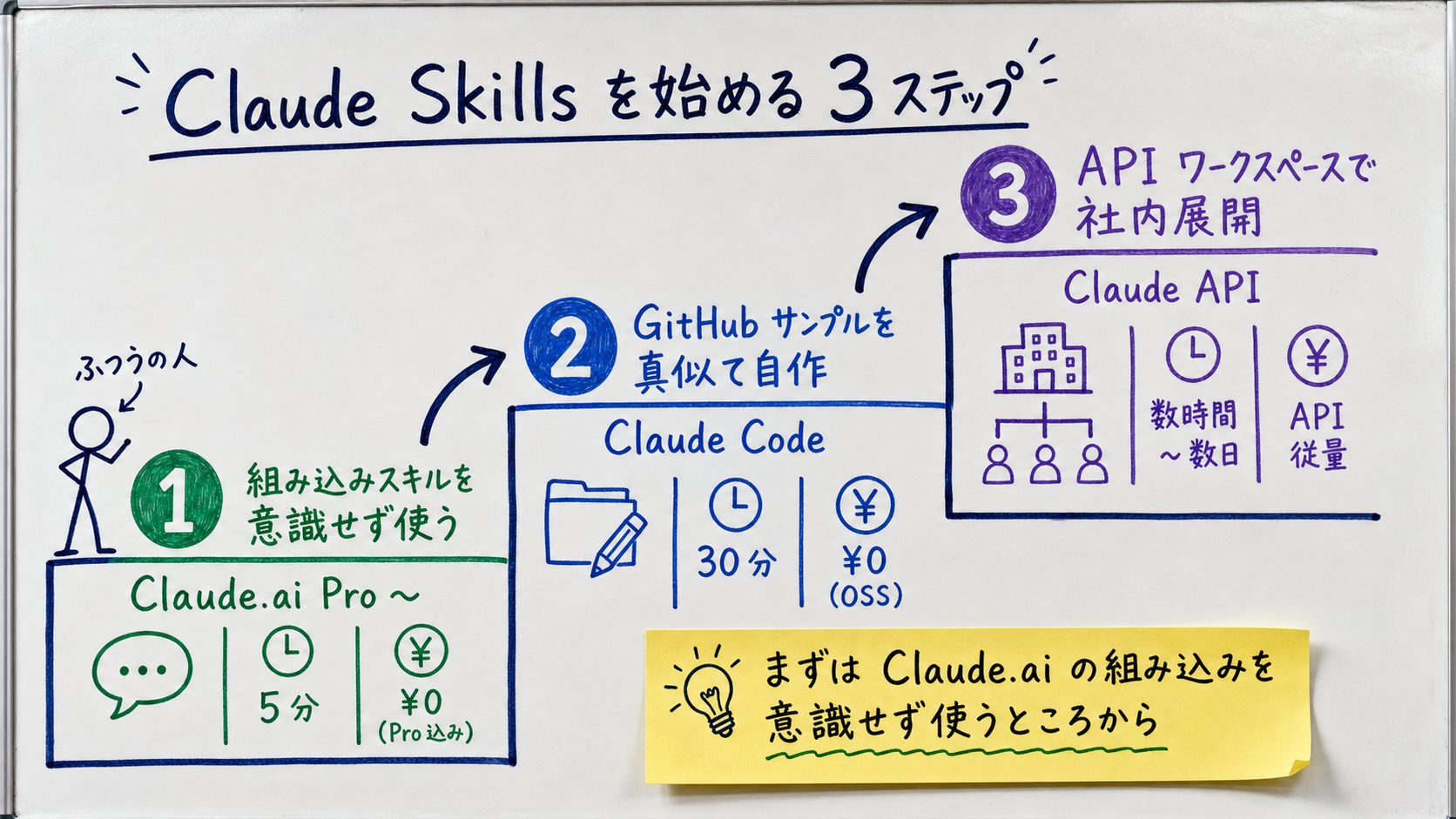
On Claude.ai Pro and up, you are already using Skills. Ask Claude to "clean up this Excel and add a chart" and the xlsx Skill fires invisibly. Start there.
Anthropic publishes open-source Skills atgithub.com/anthropics/skills. For Claude Code, just copy a sample into ~/.claude/skills/and you're live. Customize by editing SKILL.md and adding files under scripts/.
To enforce in-house rules like outbound-email tone or support-reply guidelines, upload a Skill to your API workspace and the entire team gets it. Sales Claw uses Skills the same way for outbound form submission — encoding manners, format rules, and NG words intoSKILL.md.
[Official]Anthropic explicitly warns: "Use Skills only from trusted sources." Skills grant Claude new capabilities; a malicious Skill can misuse file operations, bash, and code execution for data exfiltration, unauthorized access, or destructive operations.
[Official] Anthropic Docs state Skills fall outside ZDR. Skill definitions and execution data are retained under the standard policy. In regulated industries (finance, healthcare, government) check with Legal before adopting Skills.
Claude API has no network access and no runtime package installs. Claude Code has full local access. Claude.ai depends on admin settings. The same Skill may run differently — or with more authority than intended.
Claude.ai Skills are per-user with no central admin management. To roll out the same Skill org-wide, use the API workspace or Claude Code Plugins. Design distribution up front, or different team members will end up with different toolkits.
[Author view]Where you put "how we work" determines quality in AI sales automation. Prompts eat tokens and scatter. MCP is overkill. Skills are the middle layer for NG-word lists, form-filling manners, and audit-log formats.
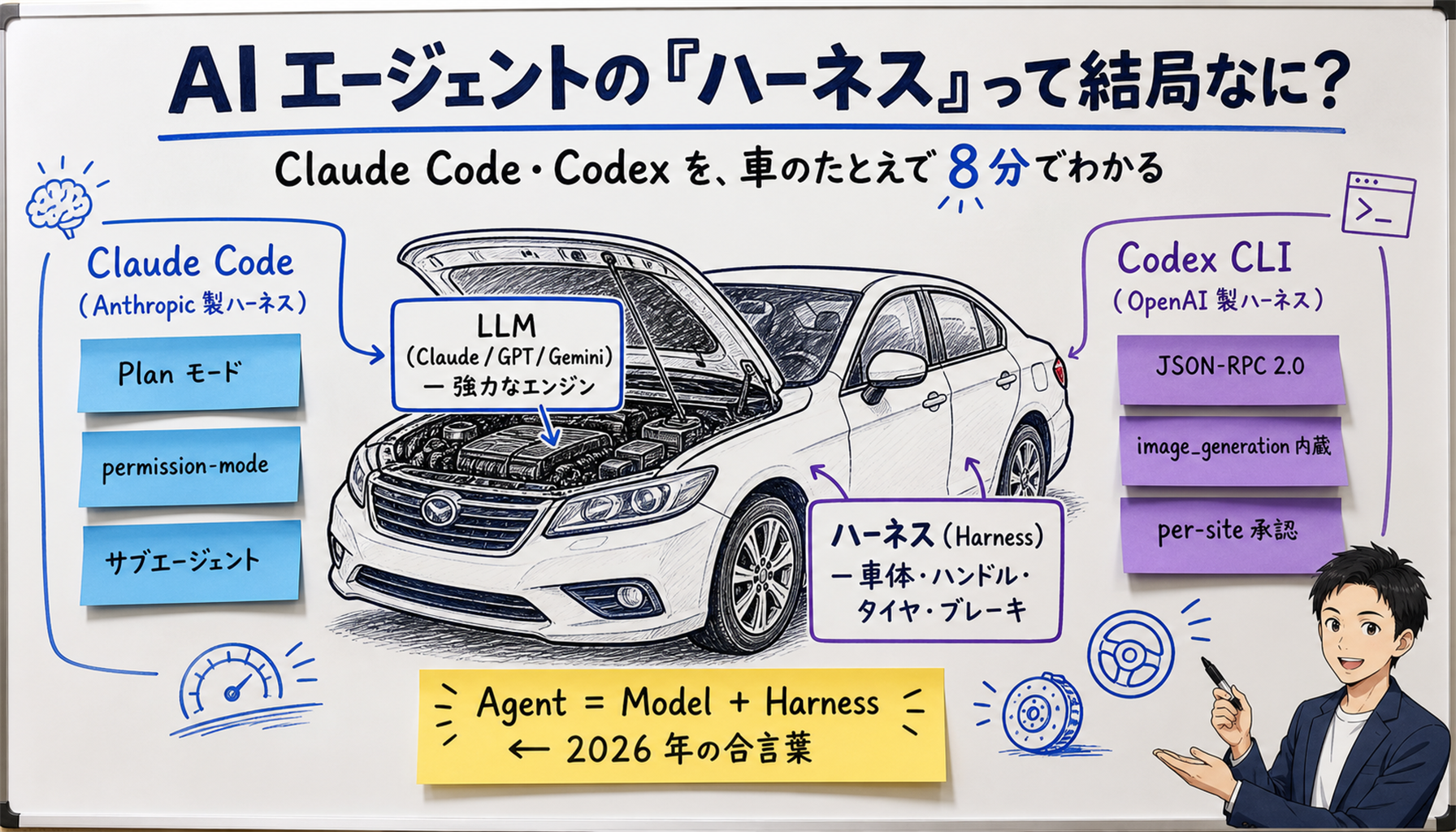
Sales Claw's core (outbound form-submission engine) is Python / TypeScript OSS and doesn't depend on Skills. But our blog automation (blog-write Skill) and note.com posting (note-publish Skill) are Claude Code Skills. The SKILL.mdfiles encode organization-specific rules — the 18-item Fatal Gate, the Brand Editor banned-word list, and the "always call image generation through the wrapper" rule — so Claude rereads them every time before acting.
Claude Skills fills the middle between lightweight prompts and heavyweight MCP. With a single SKILL.md you can start in minutes; Progressive Disclosure keeps context efficient. Now that Anthropic has opened it as a standard, Skills look like a strong candidate to become the dominant format for encoding how organizations workfrom 2026 onward.
Next steps: try the built-ins on Claude.ai Pro ("build me an Excel file"). For Claude Code, copy a sample fromgithub.com/anthropics/skills into~/.claude/skills/. For the sales-automation context, see theSales Claw quickstartorfree download page.
Japanese-language original:Claude Skills とは何か?── AI に「専門技」を覚えさせる仕組みを、料理本のたとえで一般読者向けに解説
本記事は X 公式アカウントと公式ドキュメントを一次情報として参照しています。
この記事の著者
中澤 圭志
Sales Claw maintainer
Designs and develops Sales Claw. Writes from the field on B2B sales automation and applied AI.