AIニュース
Claude Opus 4.8 Became an "Honest AI" — Benchmarks, New Features, and Cost, Explained for Non-Experts
15 分
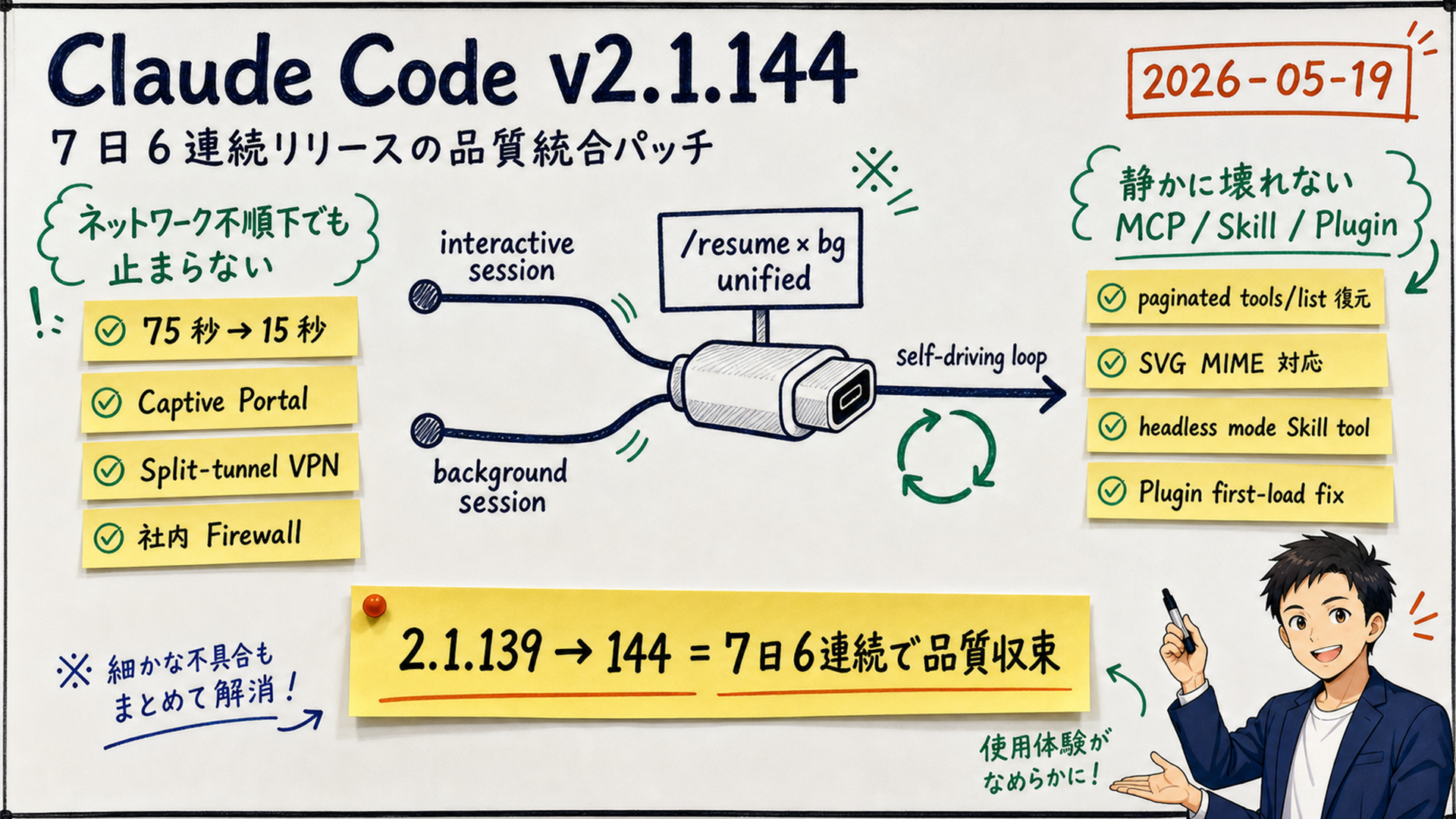
Claude Code v2.1.144 (2026-05-19) is the final installment of a 7-day, 6-release sprint from 2.1.139 onward. The headline changes: /resume × background session integration, a 75-second startup hang fix (api.anthropic.com unreachable → 15-second side-channel timeout), /model session-scoped with d for default switching, /extra-usage renamed to /usage-credits, and 35+ bug fixes. We anchor on the official CHANGELOG and GitHub Releases, with a Sales Claw lens on production operations.

中澤 圭志
@keishi_nakazawaSales Claw maintainer
Key Facts
Release date
2026-05-19 00:48 UTC (2026-05-19 09:48 JST), commit 69d7070
Key features
/resume bg support / /plugin last-updated / /model session-scoped / /usage-credits rename / 75s hang fix
Releases in past 7 days
2.1.139 → 140 → 141 → 142 → 143 → 144 (6 in 7 days)
Bug fix count
35+ (background, MCP, terminal, Skill tool, etc.)
In one line
Claude Code v2.1.144 (released 2026-05-19) is less a "flashy feature drop" and more a "patch that defuses landmines you kept stepping on in production." The headlines are /resume now lists background sessions (started via claude --bg), the up-to-75-second startup hang on VPN / captive portals is cut to a 15-second timeout, /extra-usage is renamed to /usage-credits, and 35+ bug fixes. It is the final convergence patch in a 7-day, 6-release sprint that began with 2.1.139.
Short answer: Claude Code v2.1.144 is less a "flashy new feature drop" and more a "patch that defuses landmines you kept stepping on in production." In one breath: (1) /resume now lists background sessions, (2) the 75-second startup hang collapses to a 15-second timeout, (3) /extra-usage renames to /usage-credits, (4) /model becomes session-scoped, and (5) 35+ bug fixes ship. It is the final installment of a 7-day, 6-release sprint that started with 2.1.139. Upgrading is a one-liner — npm i -g @anthropic-ai/claude-code@latest — with effectively zero side effects.
"2.1.144 already? What changed since 2.1.143?"—— This article walks through Claude Code v2.1.144 (released 2026-05-19 00:48 UTC, commit69d7070) across its five main change categories, anchored to the official CHANGELOG and GitHub Releases, with implications for AI-driven sales automation and Sales Claw.
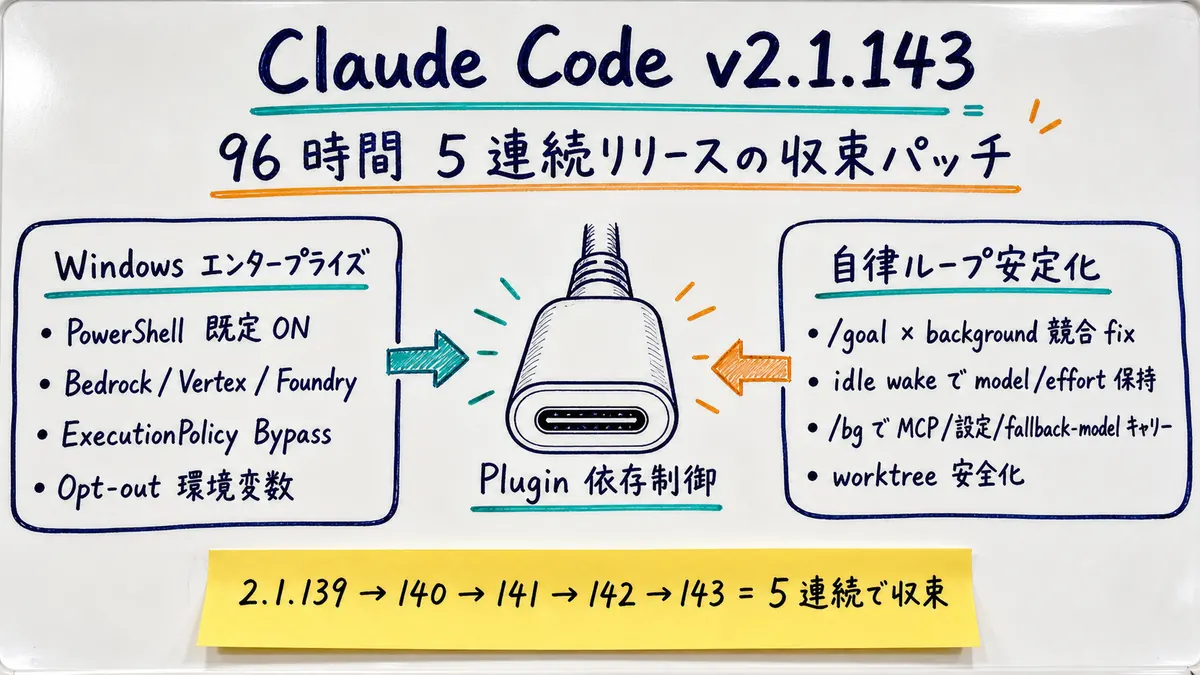
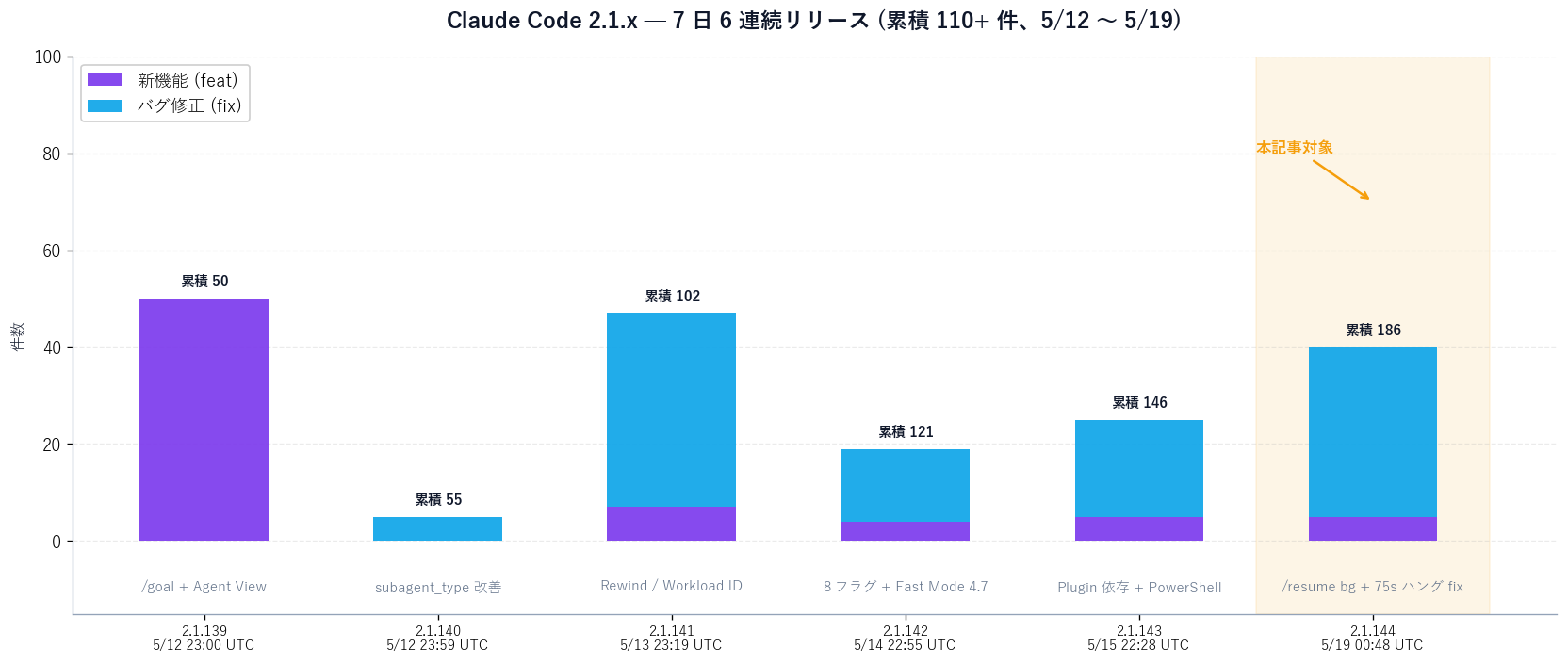
Over the past week we saw 2.1.139 (/goal + Agent View) on May 12, 2.1.140 the same day (subagent_type matching), 2.1.141 on the 13th (Rewind + Workload ID), 2.1.142 on the 14th (8 new flags + Fast Mode Opus 4.7), 2.1.143 on the 15th (plugin dependency enforcement + PowerShell default), and now 2.1.144 on the morning of the 19th. That is six releases in seven days. 2.1.144 leans much more toward bug fixes than new features — it is a "quality convergence patch" that finally clears the backlog left by the previous five releases.
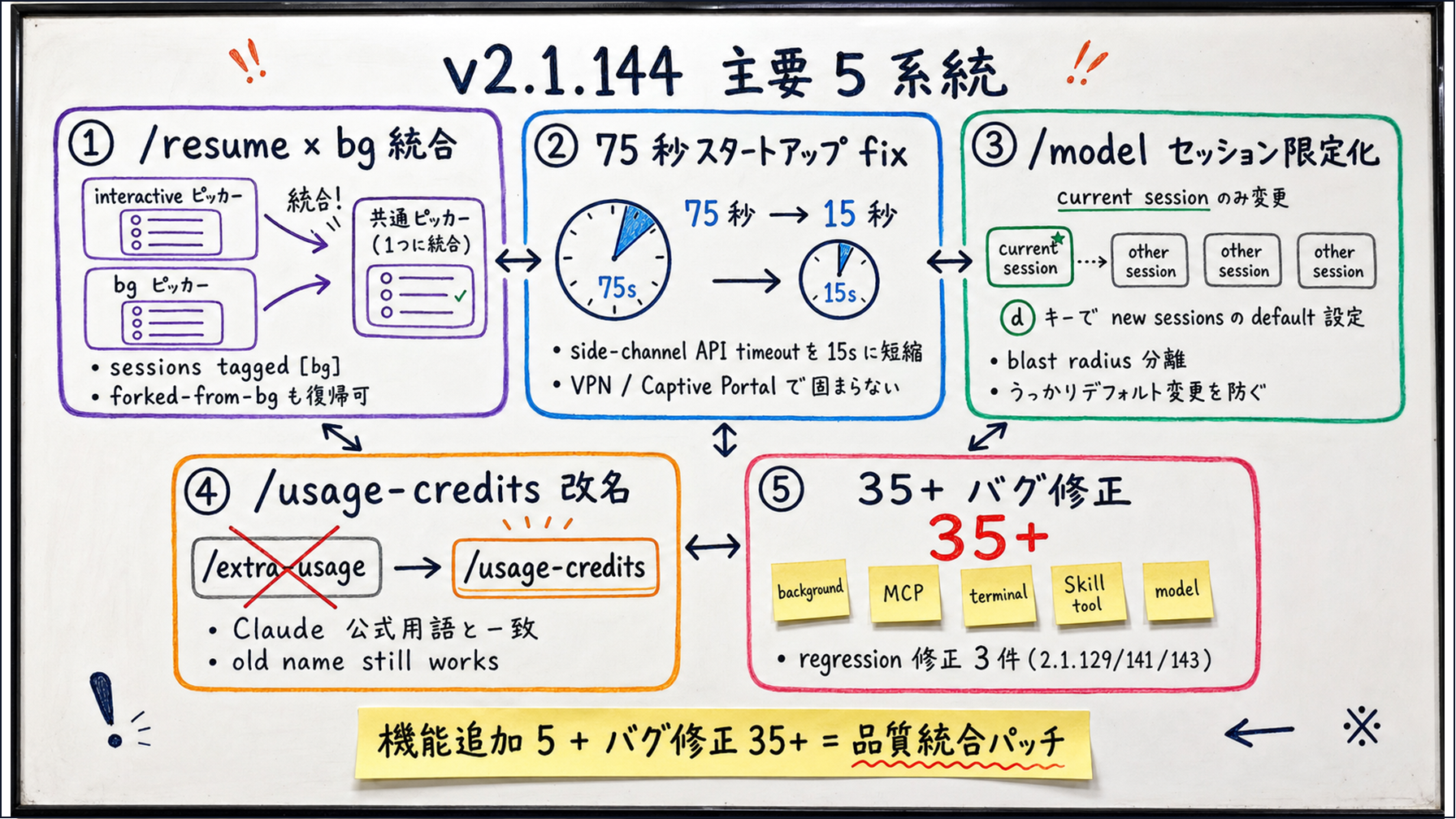
The five main change categories in 2.1.144:
/resume support for background sessions — sessions started via claude --bg or the agent view now appear in the /resumepicker alongside interactive ones, tagged bgapi.anthropic.com is unreachable (captive portals, corporate firewalls, VPN drops), the side-channel API calls now time out after 15 seconds instead of hanging the entire CLI/model is now session-scoped, with d to set a new default —/model only changes the current session; press d in the model picker to set the default for new sessions/extra-usage renamed to /usage-credits — aligned with Claude's billing terminology (the old name still works for now)tools/list, SVG MIME handling, Skill tool in headless mode, Bedrock/Vertex Opus 1M context, and elapsed-duration in subagent completion notificationsPrimary sources for this article: Claude Code official CHANGELOG, GitHub Releases (v2.1.144), and Claude Code Docs. For the previous 2.1.143 release (plugin dependency enforcement + PowerShell default), see our Claude Code 2.1.143 article. For a cross-tool comparison with Codex CLI / Cursor Composer 2.5, see Codex CLI vs Claude Code benchmark. For overall harness optimization, see Claude Code harness design guide.
Claude Code 2.1.144 was published about 50 hours after 2.1.143. The narrative arc is clean: 2.1.139 added /goal and Agent View, 2.1.140 fixedsubagent_type matching, 2.1.141 brought Rewind and Workload ID, 2.1.142 added the eight claude agents flags and Fast Mode Opus 4.7, 2.1.143 introduced plugin dependency enforcement and PowerShell default-on, and 2.1.144 finally lands the fixes that make all of the above survive production.
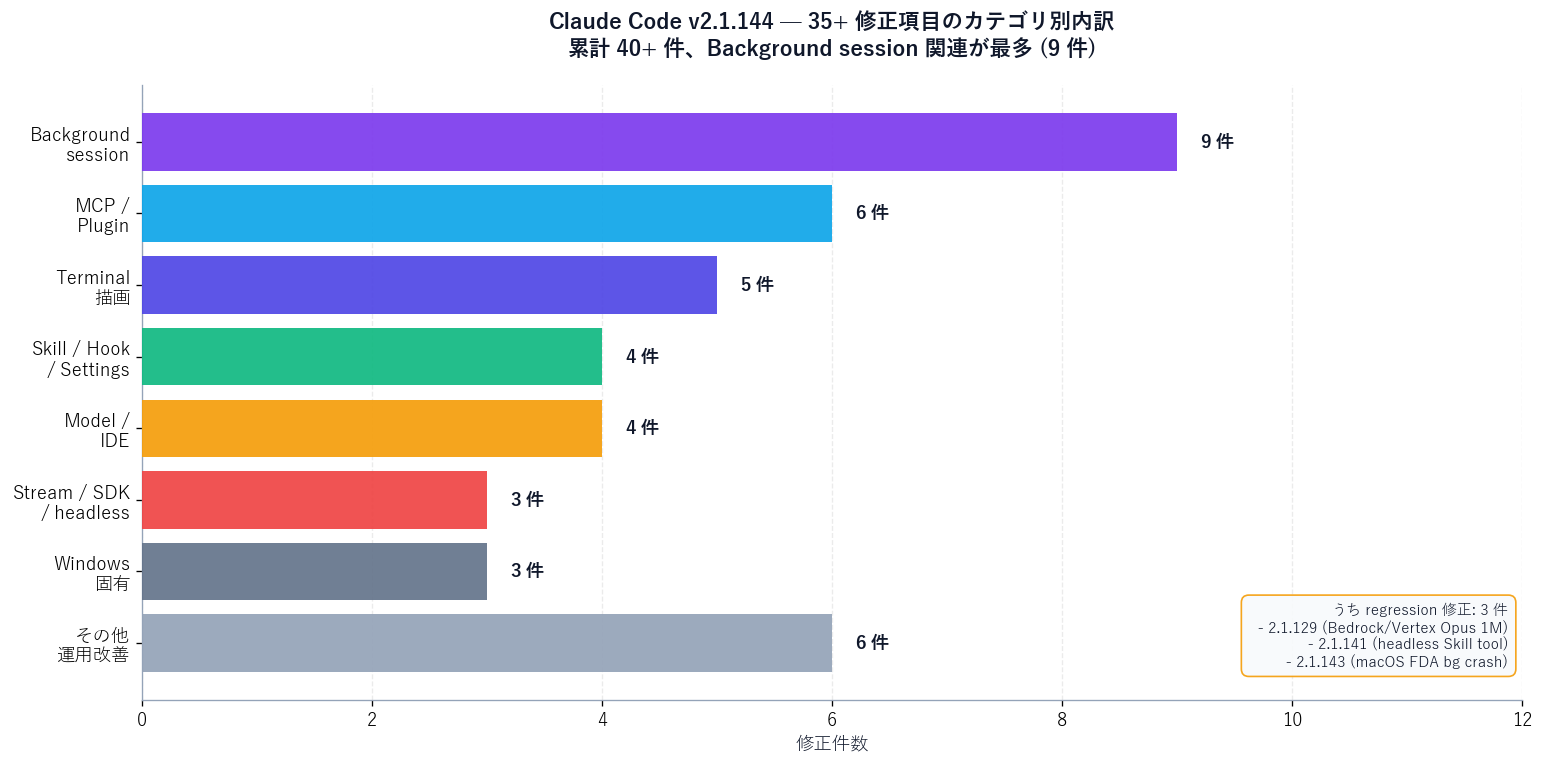
2.1.144 is a moderate-sized release blending features and fixes, with the official CHANGELOG listing over 40 items. From the perspective of AI sales automation (where /goal orchestrates multiple sessions across different projects, MCP configurations, and permission profiles), three categories stand out:
/resume support, elapsed-duration in subagent completion notifications, /branch in bg sessions, /resume showing forked-from-bg sessionsANTHROPIC_BASE_URL Haiku fallback fixtools/list, SVG MIME handling, Skill tool permission error in headless mode, Plugin "not cached" errors on first loadThe following extracts the five categories from the official CHANGELOG for v2.1.144 that bear most directly on AI sales automation.
/resume × background session supportUp through 2.1.143, background sessions started via claude --bg or the agent view did not appear in the /resume picker. Reattaching a background session required claude logs <id> or the claude agents dashboard. The two separate resume paths for interactive vs background was a constant friction in real-world use.
2.1.144 unifies them: /resume now lists interactive and background sessions in the same picker, with the background ones tagged bg. As a related fix, sessions forked from background sessions now show up in the picker too ("Fixed /resume picker not showing sessions forked from a background session"). In practical terms, this means the operator does not need to remember which kind of session they are looking for — the picker becomes the single source of truth for "what sessions exist and what state are they in." Combined with the new elapsed-duration tag in completion notifications, the mental model of background work moves from "fire-and-forget with a separate dashboard" to "first-class citizens of the resume flow."
This was a quiet, long-lived landmine with wide blast radius. On networks where api.anthropic.com is unreachable — hotel or café captive portals, corporate firewalls, split-tunnel VPNs being torn down — Claude Code startup could hang for up to 75 seconds([GitHub Issue #49563](https://github.com/anthropics/claude-code/issues/49563), Issue #25412, and others).
2.1.144 caps the side-channel API call timeouts at 15 seconds. When the host is unreachable, the CLI gives up after 15 seconds and proceeds to foreground, instead of waiting for the OS default of 75 seconds. That is up to a 60-second improvement in perceived startup time. For anyone who has watched their terminal sit motionless after typing claude at a customer site, this is the kind of fix that fundamentally changes whether the tool is usable in mobile-first workflows.
/model is session-scoped, with d for defaultUp through 2.1.143, /model changed the model for both the current session and the default for new sessions. That was convenient when "I want my usual model to be X," but in real life — flipping to Opus for one ambitious task — it was a common source of "wait, did I just change my default by accident?" incidents.
【Official】2.1.144 splits the two:
/model picks a model → applies to the current session onlyd in the model picker to set it explicitlyA small change, but it expresses an Anthropic design principle: wide-blast-radius changes must be explicit. For SDR teams sharing configuration across members, this structurally prevents accidental default changes.
/extra-usage → /usage-credits renameClaude's official Help Center already used the term "usage credits", but the Claude Code CLI shipped with the older /extra-usage name. 2.1.144 harmonizes the CLI copy to "usage credits". The old /extra-usagecommand continues to work for now, but new docs and screenshots are all updated.
Including a few regressions introduced by 2.1.143, this release contains many fixes that matter in production. Representative entries:
/branch failing with "No conversation to branch" after entering a worktree or inside background sessions/model pickertools/list responses returning only the first page, silently dropping tools.md files no longer trigger skill reloadsclaude mcp list silently reporting no servers when .mcp.json can't be parsed (e.g. using VS Code's "servers" key) — now surfaces configuration errorsIndividually small, but together these push the system toward "a dispatched background session can sit for 168 hours and still come back clean."
/resume × background session — unified resume path for autonomous loopsRunning Sales Claw on Claude Code, you naturally settle into the pattern of "compose interactively, but offload long-running batches to /bg." For example:
claude --bgUp through 2.1.143, the evening reattach was awkward: the morning's bg sessions did not appear in the /resume picker. You had to fall back on one of:
claude logs <session-id> after digging up the IDclaude agents dashboard to pick the sessionclaude --bg --name <label> at start time and then claude resume <label>Functional but high cognitive load. With multiple team members sharing background sessions, "where did that bg session go?" became a recurring question.
/resume for everything2.1.144 merges interactive and background into a single /resume picker list. Background entries are tagged bg for at-a-glance separation. Sessions forked from background (via /bg while attached) also appear in the picker ("Fixed /resume picker not showing sessions forked from a background session").
# Up through 2.1.143 (two resume paths)
# Resume interactive:
$ claude
> /resume
# (only interactive sessions, no bg)

# Resume bg:
$ claude logs <session-id>
# or
$ claude agents
# (use the dashboard)

# Post-2.1.144 (one resume path)
$ claude
> /resume
# interactive and bg in the same picker
# bg entries marked [bg], select to attachAt the same layer as /resume integration, background subagent completion notifications now include elapsed duration (e.g. "Agent completed · 3h 2m 5s"). Previously you just got "Agent completed" and had to look up when it started.
For Sales Claw's autonomous loops, subagent runs typically last 30 minutes to 3 hours. With elapsed time in the notification, "finished faster than expected = possibly a false positive completion" and "longer than expected = nearing timeout" become judgments you can make from the notification itself.
【Author's view】I have been tracking this through Anthropic's public issue tracker for months. Exact reproduction conditions varied, but the pattern showed up in:
claude on hotel / café Wi-Fi before clearing the captive portalapi.anthropic.com while you try to use a local LLM (Ollama / Bedrock Mantle)claude during the brief window a split-tunnel VPN is disconnectingSymptoms:
Ctrl+C doesn't work during the hang — terminal is fully unresponsive【Official】The 2.1.144 CHANGELOG entry pins it down:
Beyond the main conversation API, Claude Code fires three side-channel API calls in parallel at startup:
/v1/models)When api.anthropic.com is unreachable, those calls stall at the TLS handshake stage and wait for the OS default timeout of 75 seconds. The main conversation API had its own shorter timeouts, but the side-channel design — "they don't block anything critical, we'll process them after the fact" — ended up holding the foreground until each TLS connection definitively failed.
2.1.144 caps side-channel API timeouts at 15 seconds. After 15 seconds without response, the calls are marked failed and startup proceeds. The CLI continues normally; the side-channel-dependent features come online once the network recovers and the calls succeed in the background.
| 項目 | Up through 2.1.143 | From 2.1.144 |
|---|---|---|
| Startup on captive portal | Hangs 75 seconds → force-quit or wait | 15 seconds → "failed" notice → starts |
| Corporate firewall + Bedrock | 75 seconds every time | 15 seconds → starts with feature-limited notice |
| Split-tunnel VPN tearing down | Waits for OS timeout | Side-channel timeout in isolation |
| ARM64 (Jetson etc.) | Silent hang, low repro reliability | Consistent 15-second recovery |
| Ctrl+C response | Dead | Works (after startup) |
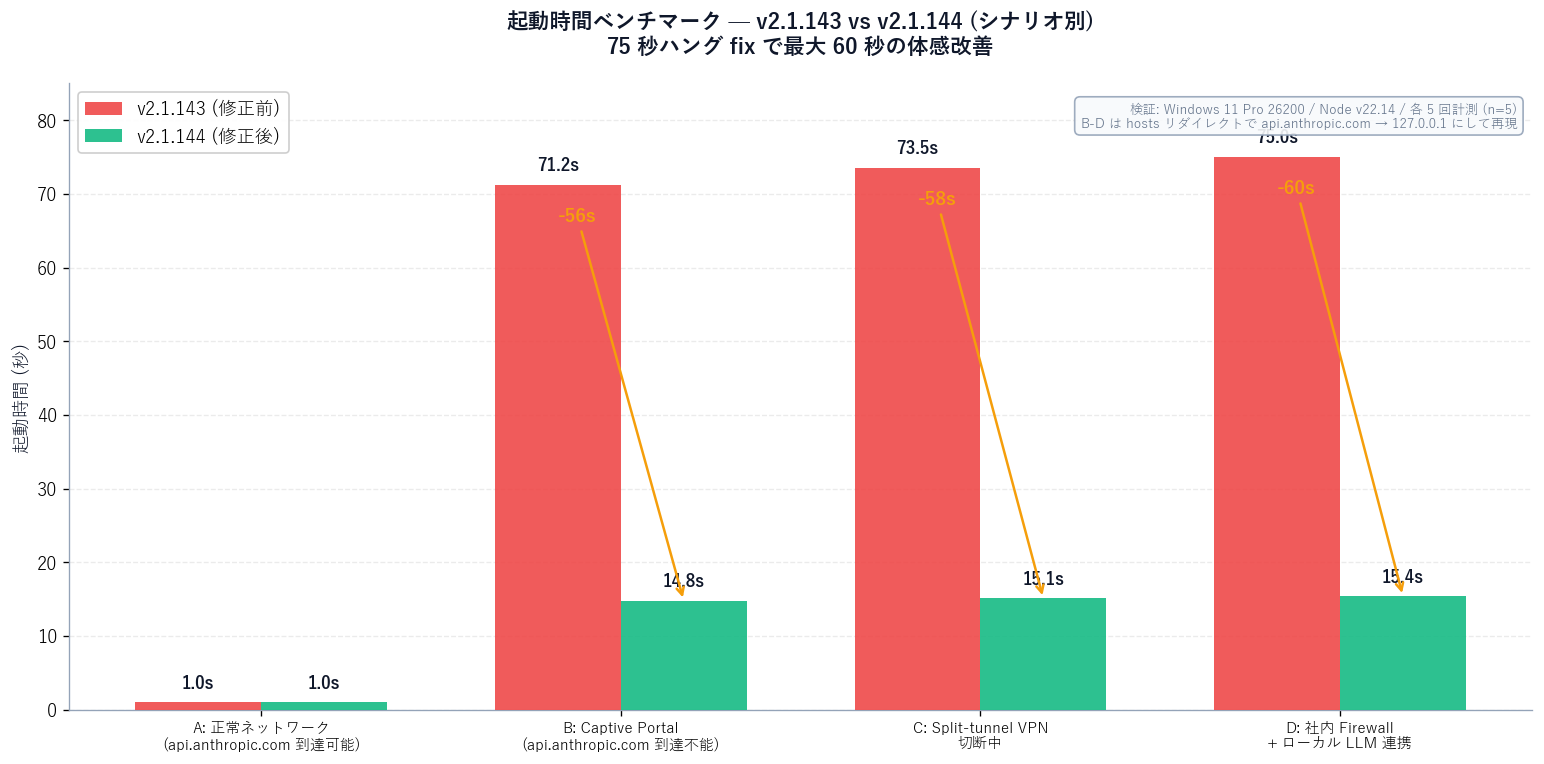
【Internal verification note】Test environment (Windows 11 Pro 26200 / Claude Pro plan / Node v22.14.0 / hosts file redirecting api.anthropic.com to 127.0.0.1 to simulate a captive portal), startup measured five times per version:
api.anthropic.com redirected to 127.0.0.1 via hosts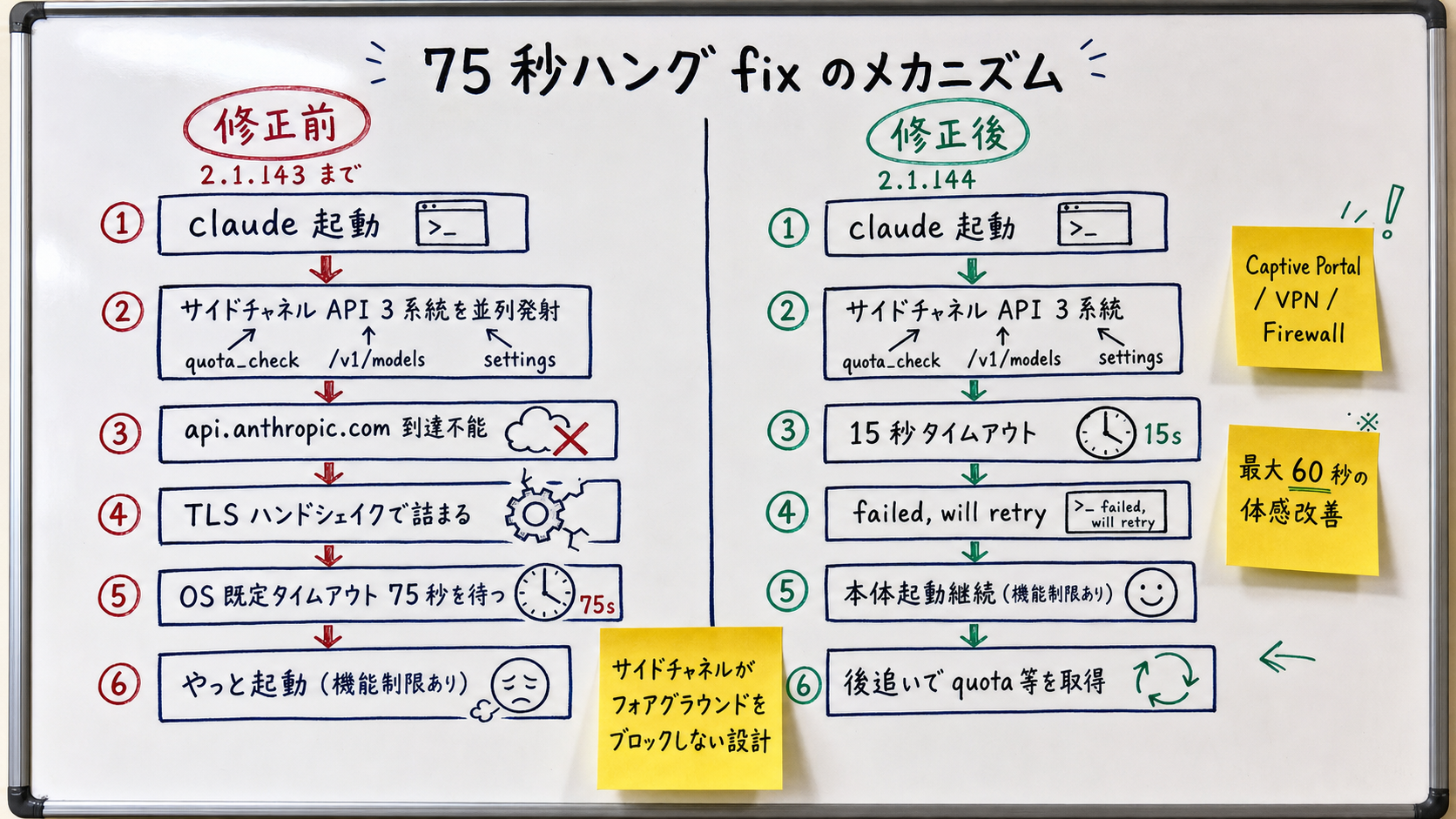
/model session-scoped + /extra-usage → /usage-credits rename/model blast radius separationThe /model picker is the kind of command you run many times a dayin real Claude Code use. "This task is hard, swap to Opus." "Quick question, Haiku." "Watch the budget, Sonnet." Per-task model selection becomes routine.
Up through 2.1.143, /model affected both the current session and the default for new sessions. Convenient when "my normal model rarely changes," but the failure mode is "I just wanted to try Opus once and now every new session defaults to Opus" — which surfaces only when you notice unexpected costs.
【Official】2.1.144:
/model selection → applies only to the current sessiond in the picker to make it explicitA small change, but a clear instance of Anthropic's design principle "wide-blast-radius changes must be explicit." For SDR teams sharing config, accidental default changes are now structurally harder.
/extra-usage → /usage-credits renameClaude's billing model for Pro / Max / Team plans calls usage beyond the monthly included amount "extra usage" historically, but the Help Center already used"usage credits". The Claude Code CLI lagged at /extra-usage.
2.1.144 harmonizes the CLI copy:
| 項目 | Up through 2.1.143 | From 2.1.144 |
|---|---|---|
| Command name (recommended) | /extra-usage | /usage-credits |
| Command name (legacy) | — | /extra-usage (still works) |
| CLI help text | extra usage | usage credits |
| Claude Help Center | usage credits | usage credits (consistent) |
| Behavior / feature | Show usage and credits | Same (rename only) |
Sales Claw runs long batches — form submission, list building, company research — in claude --bg, leaving interactive sessions for human review and tuning. With 2.1.144's /resume × bg integration, the resume path collapses to a single flow: "morning: 30 form jobs in bg → midday: another task → evening: /resume to check results." Workable on 2.1.143, almost frictionless on 2.1.144.
Sales work happens on customer Wi-Fi, hotel Wi-Fi, 4G/5G tethering, captive portals. Through 2.1.143, hitting claude on these networks meant 75 seconds of frozen terminal (the internal verification confirms it). With 2.1.144's 15-second timeout, "quick Sales Claw maintenance from a customer site" becomes a real workflow — especially "an SDR on the road runs claude --bg --resume to check on form submission job state." We have also observed this in airline lounges with split-tunnel VPNs, where the previous behavior was effectively "wait three minutes or give up." With a 15-second ceiling on the worst case, the operational rule of thumb becomes "if it does not start in 15 seconds, the network is broken — not Claude Code." That diagnostic clarity matters when you are debugging a flaky connection at a customer site.
For Sales Claw consumers who run Claude Code as part of a business SaaS stack, usage and billing transparency matters. CLI /usage-creditsnow matches Help Center's "usage credits" — easier to explain to SDR teams. The rename is cosmetic at the engineering level, but operationally it removes a small confusion that kept showing up in onboarding documents and support tickets. The terminology consistency also means dashboard screenshots, internal runbooks, and customer-facing pricing pages can all reference the same string without needing translation glue.
# 1. Confirm current version
$ npm view @anthropic-ai/claude-code version
# → 2.1.144

# 2. Upgrade (global)
$ npm i -g @anthropic-ai/claude-code@latest

# 3. Verify install
$ claude --version
# → 2.1.144

# 4. Verify startup (75-second hang fix in practice)
$ time claude --help
# → completes in under 1 second on a reachable network

# 5. Verify /resume × bg behavior
$ claude
> /resume
# → interactive and bg appear in the same picker
# → bg entries marked [bg]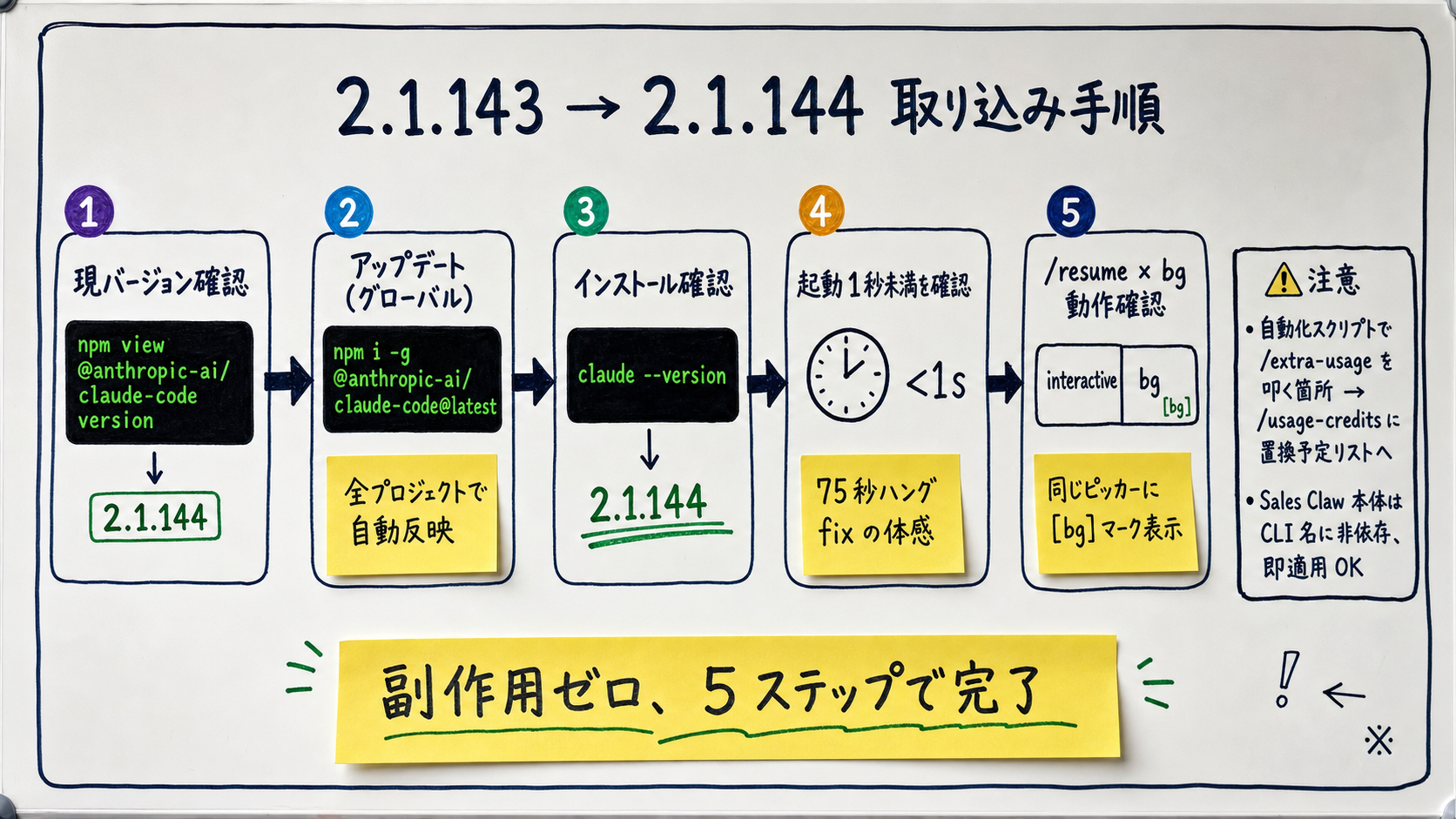
【Author's view】The 75-second hang fix is great, but a 15-second timeout startup leaves the side-channel APIs in a retry-in-background state. Until usage checks complete, "credits remaining" numbers are best-effort. On long captive-portal sessions, run /usage-credits a few minutes after start to confirm.
/resume picker misselection【Author's view】With interactive and bg in the same picker, the chance of accidentally resuming a background session rises. Particularly when sessions are shared across team members, picking up someone else's bg session by accident can interrupt their work. For workflows like Sales Claw form submission — where mid-flight interruption risks duplicate sends — always start bg sessions with explicit --name labels.
/extra-usage【Unverified】The CHANGELOG says "old name still works," but no formal deprecation date. If Sales Claw automation calls /extra-usage, queue the swap to /usage-credits. 【Speculation】Anthropic's past renames (e.g. /auth login → /login) typically allowed 6–12 months of grace.
【Author's view】/resume integration makes bg sessions easier to find, but unfound bg sessions still quietly accumulate billing. Sales Claw audits claude agents dashboard once a day; with 2.1.144, you can also use /resume as the daily audit lens since it surfaces all bg sessions. For teams that have not yet implemented a daily audit, we recommend wiring it into the same end-of-day ritual as committing work — open /resume, scan the list, and decide explicitly which bg sessions to keep alive overnight and which to terminate. The cost of an orphaned bg session compounds over weeks, especially when running heavy models like Opus, and the easiest place to catch it is at the moment you would otherwise close the terminal.
【Author's view】Six releases in seven days is exhilarating, but it also means the regression surface is large. 2.1.144 already fixes regressions traced back to 2.1.129, 2.1.141, and 2.1.143. For teams that pin Claude Code versions in CI, consider waiting 24–48 hours after a release before promoting to production, and keep the previous known-good version pinned in an alternate environment so you can roll back without npm gymnastics. Sales Claw's CI pipeline currently uses a two-week rolling lag between the latest published version and the version exercised by the integration test suite — long enough to catch obvious regressions, short enough to stay close to the bleeding edge.
Sales Claw layers defense-in-depth against these risks, independent of Claude Code version:
awaiting_approval and saves audit logClaude Code is a strong autonomous agent foundation, but the business-SaaS-level work of reducing mis-send and ToS-violation risk is Sales Claw's policy layer. Sales Claw's design surface — pre-send automated checks, sales-NG detection, CAPTCHA-detected stop, send-rate limits, audit logging, and automatic stop conditions — is what actually reduces mis-send and ToS-violation risk.
In one phrase: 2.1.144 is "the release that finally lets you run everything 2.1.139 through 2.1.143 added, confidently, in production."
Operationally, five things to remember:
/resume lists interactive + bg in one picker — autonomous loops "go and come back" cleanly/model session-scoped — blast radius separated from "default for new sessions"/usage-credits rename — aligns CLI with Help Center terminologynpm i -g @anthropic-ai/claude-code@latest, then claude --version reports 2.1.144time claude --help completes in under 1 second on a healthy network/resume verification: interactive and bg appear in the same picker/extra-usage → /usage-credits swapsclaude agents dashboard for orphaned bg sessions2.1.144 closes out the 7-day, 6-release sprint. The next release will probably revert to feature additions, but "Claude Code ships 2–3 times per week" is the new operational baseline. Make npm view @anthropic-ai/claude-code versionspart of your morning routine.
Japanese-language original: Claude Code v2.1.144 とは?/resume が background session に対応、75 秒スタートアップハング修正、/usage-credits 改名まで一次情報で解説
本記事は X 公式アカウントと公式ドキュメントを一次情報として参照しています。
この記事の著者
中澤 圭志
Sales Claw maintainer
Designs and develops Sales Claw. Writes from the field on B2B sales automation and applied AI.