AIニュース
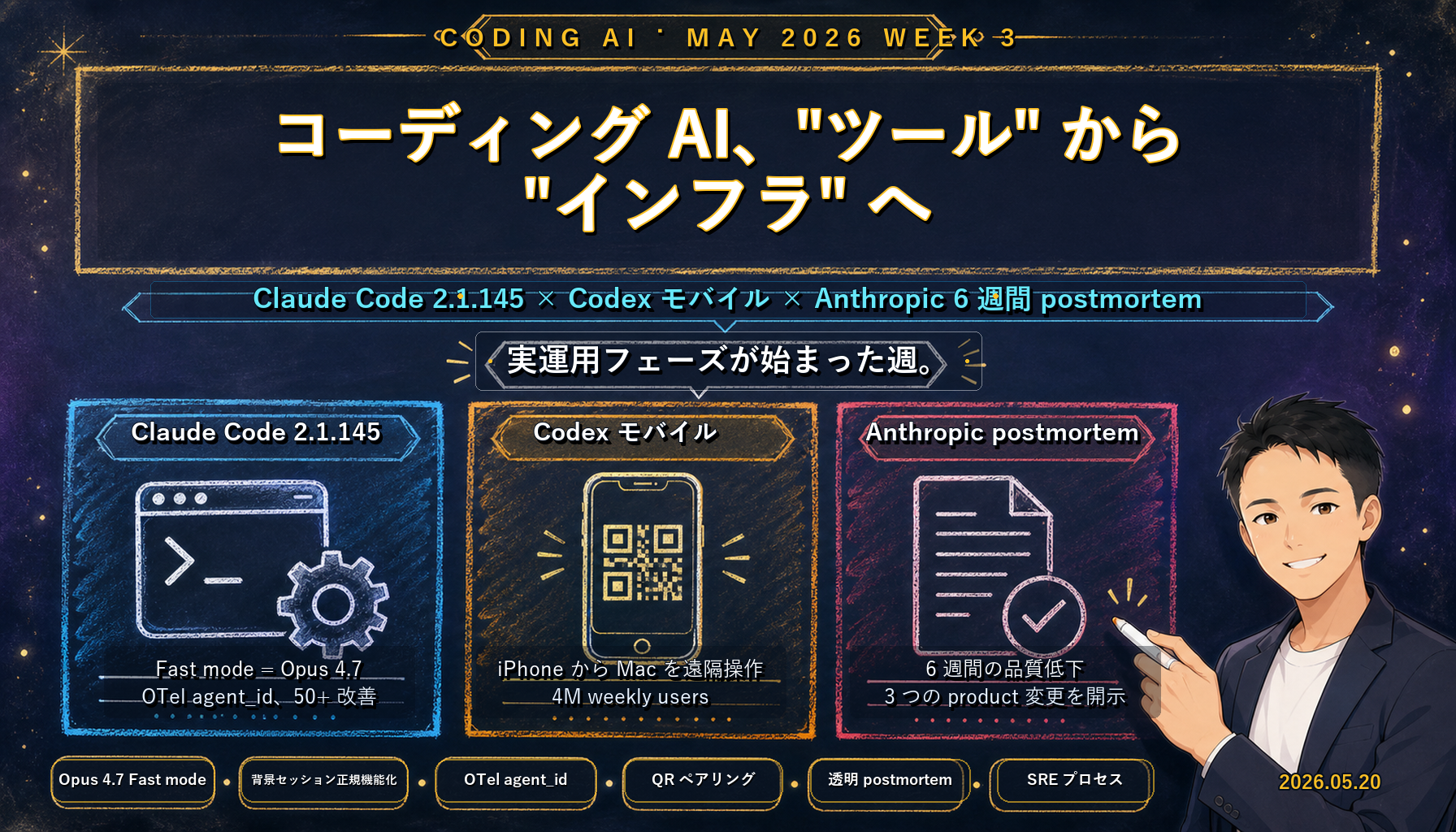
Claude Code 2.1.145 / Codex Mobile / Anthropic's Six-Week Quality Postmortem — Third-Week-of-May 2026 "Coding-AI Infrastructure Era" Roundup
16 分
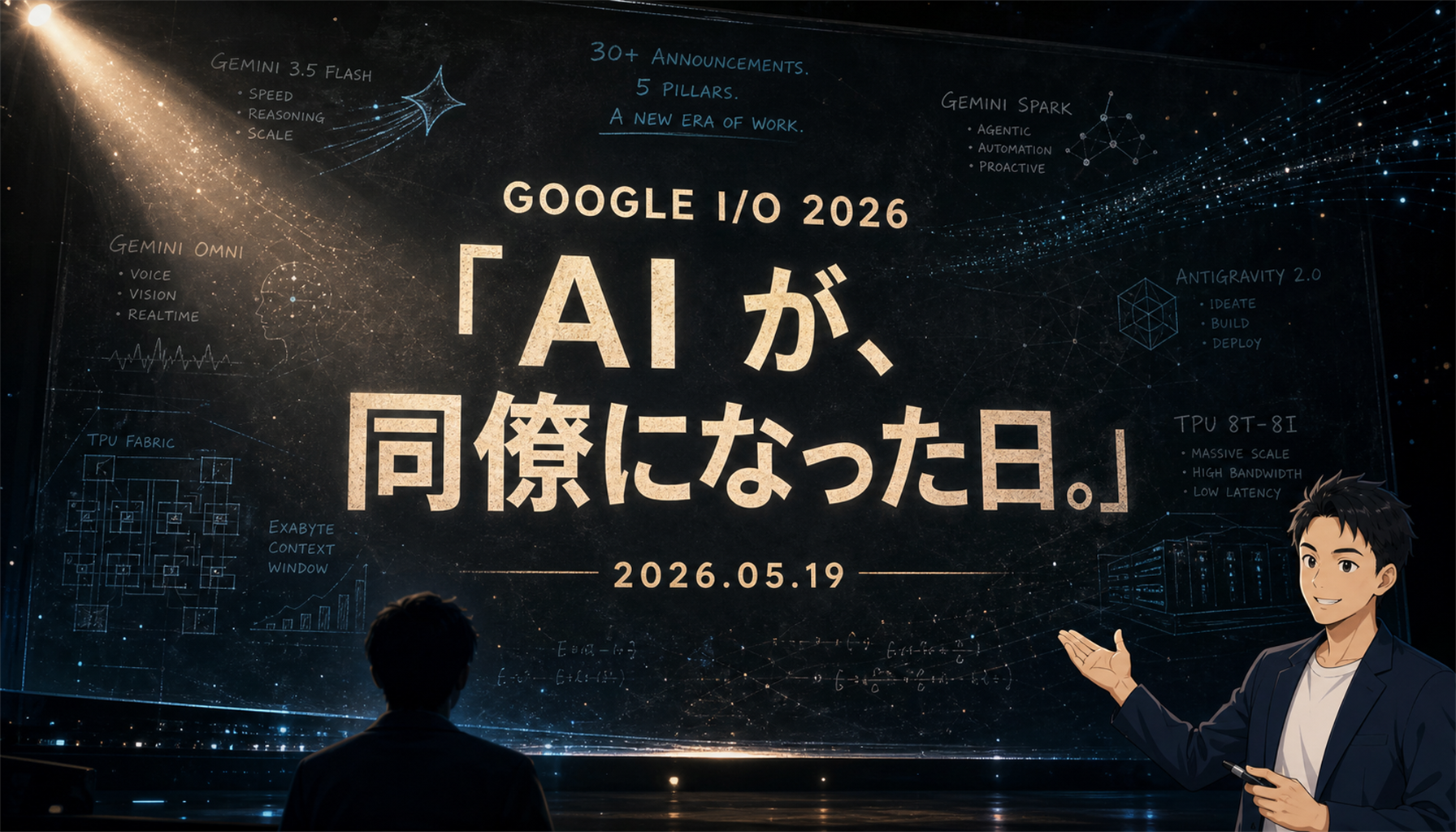
Google I/O 2026 (2026-05-19) delivered 30+ announcements: Gemini 3.5 Flash GA (Pro-level reasoning at Flash speed, 1/3 the price of frontier competitors), Gemini Omni (world model + integrated video generation), Gemini Spark (24/7 personal AI), Antigravity 2.0, TPU 8t-8i, Search's biggest 30-year update, and Workspace's voice-driven redesign. We organize all of this across 5 axes and read the implications for AI sales automation through Sales Claw's lens.

中澤 圭志
@keishi_nakazawaSales Claw maintainer
Key Facts
Event date
2026-05-19 (Mountain View, Shoreline Amphitheatre)
Announcements
30+ (Gemini 3.5 / Omni / Spark / Antigravity 2.0 / TPU 8t-8i / Search / Workspace, etc.)
Key metrics
3.2 quadrillion monthly tokens (7x YoY), Gemini app MAU 900M (2x)
Annual Capex
$180-190B (6x 2022's $31B)
In one line
Google I/O 2026 (May 19) marked the moment Google pivoted decisively from "chatbots" to AI agents working 24/7 alongside you. Five pillars: Gemini 3.5 Flash (Pro-level reasoning at Flash speed, 1/3 the price of competitors),Gemini Omni (world model + integrated video generation),Gemini Spark (24/7 personal AI agent),Antigravity 2.0 (agent-development desktop), and TPU 8t/8i (8th-gen infrastructure). Search is "the biggest update in 30 years"; Workspace turns voice-driven via Pics / Docs Live / Gmail Live. Capex is $180–190B annually. This roundup organizes 30+ announcements across 5 axes and reads the implications for AI-driven sales automation through a Sales Claw lens.
Short answer: Google I/O 2026 in one phrase — "the day Google's AI moved from being inside the search engine to being a 24/7 coworker acting on your behalf." In one breath: (1) Gemini 3.5 Flash went GA, Omni Flash shipped — both the "thinking model" and the "creating model" stepped up simultaneously; (2) Gemini Spark + Antigravity 2.0 + CodeMender form three full agent stacks (personal, developer, security); (3) Search and Workspace get rearchitected around AI; (4) TPU 8t/8i + $180–190B annual Capex sets up an industrial-scale fight with OpenAI and Anthropic.
"Google I/O 2026 — what actually shipped? It's too much to track."—— This article organizes the 30+ announcements from Google I/O 2026 (held 2026-05-19) using Google's official Blog, Developers Blog, Cloud Blog, and DeepMind site as primary sources, with implications for AI-driven sales automation and Sales Claw.
Google I/O 2026 declared "the operations phase of the Gemini Era." Compared to prior years' demo-heavy reveals, this year's keynote articulated a single message: AI you actually use every day. Total announcements across the main keynote, developer keynote, and Cloud breakouts: 30+. We sort them into five axes (Models / Agents / Search & Workspace / Developer Tools & Infrastructure / Business-SaaS context).
Quick map of the five axes:
Primary sources: Google Blog (Sundar Pichai I/O 2026 keynote), Google Developers Blog (Developer keynote), Google Cloud Blog (Innovations from I/O 2026), Google DeepMind (Gemini Omni). For Claude Code v2.1.144 released the same day, see our Claude Code v2.1.144 deep dive. For Codex CLI / Cursor Composer 2.5 cross-comparison, see Codex CLI vs Claude Code benchmark. For an AI-agent definitions primer, see What is an AI agent.
Google I/O happens every May at the Shoreline Amphitheatre near Google's Mountain View HQ. 2026 ran May 19–20, with the day-one keynote carrying nearly all the major announcements.
[Official] Sundar Pichai opened with "We are entering a new era — one where AI does not just answer your questions, but takes action on your behalf, 24 hours a day." The message: Google has decisively repositioned from "search engine company" / "Workspace company" to AI agent platformer.
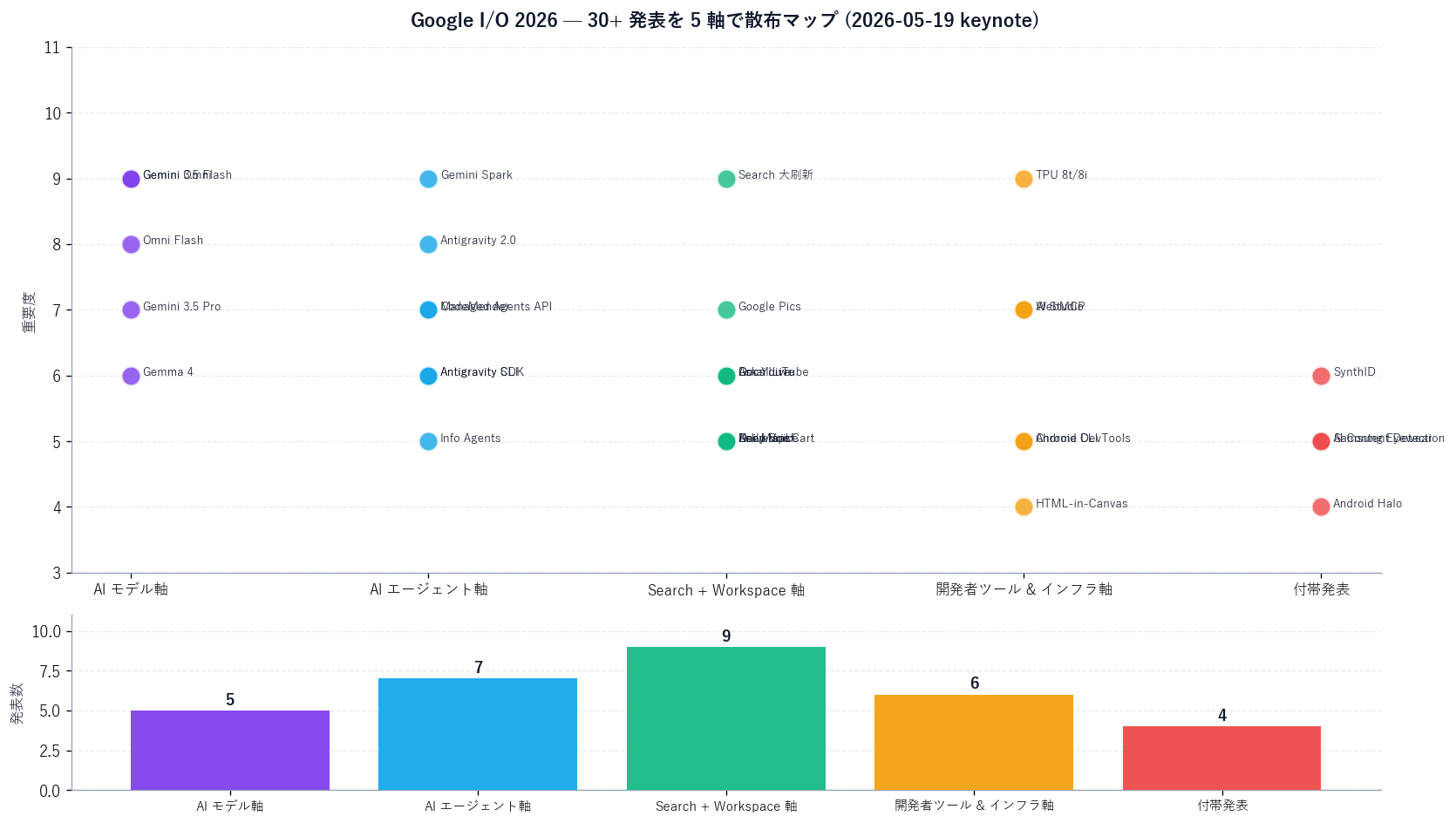
Regrouping the 30+ announcements by five axes makes Google's strategy visible:
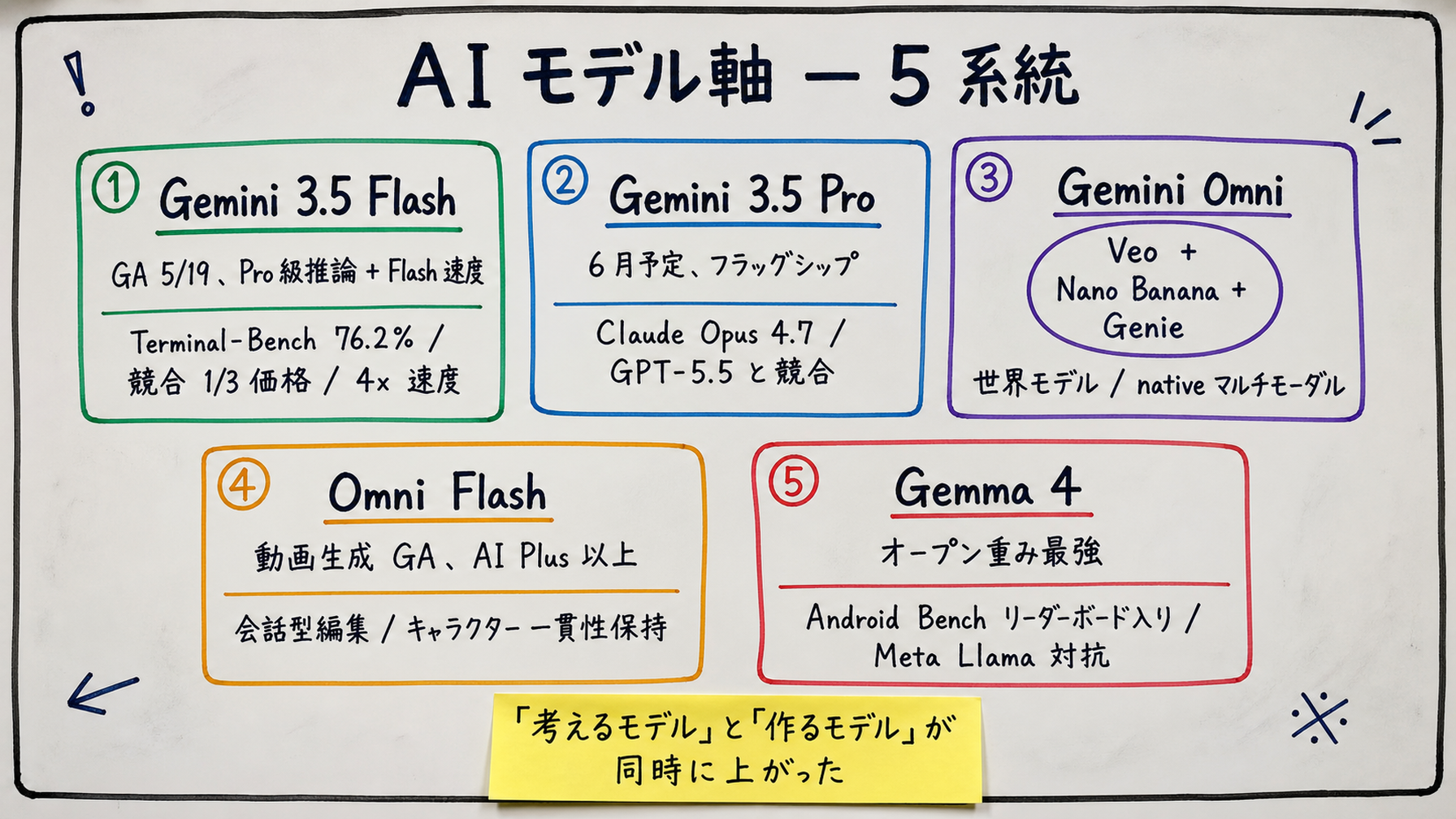
[Official] GA on 2026-05-19. The pitch: "frontier reasoning + Flash speed" in one model. Google's own benchmarks:
| 項目 | Gemini 3.5 Flash | Gemini 3.1 Pro (prior gen) |
|---|---|---|
| Terminal-Bench 2.1 | 76.2% | 70.3% |
| MCP Atlas | 83.6% | 78.2% |
| CharXiv Reasoning | 84.2% | - |
| Inference speed | 4x (output tokens/sec) | baseline |
| Pricing (per 1M tokens) | $1.50 / $9.00 (input/output) | $2.50 / $15.00 |
| Cached input | $0.15 | $0.25 |
[Author's view] The notable move is "Flash by name, but beats Pro on agentic benchmarks." This mirrors Anthropic's Haiku 4.5 and OpenAI's GPT-5.5 Mini direction: "light + fast + cheap" is no longer just a stripped-down option; it's purpose-built for agents. For business agents like Sales Claw, this is a chance to rebuild the "Pro model × high call frequency" cost equation.
[Unverified] VentureBeat reports "$1B+ annual enterprise AI cost-saving potential," but that's an analyst estimate, not Google's official claim. Actual savings depend entirely on your workload — re-measure on your own task mix.
[Official] Gemini 3.5 Pro is announced for June 2026 GA. Detailed specs are not public yet, but with Flash already exceeding 3.1 Pro, Pro is positioned to compete directly with Anthropic Claude Opus 4.7 / OpenAI GPT-5.5 as the flagship.
[Official] Gemini Omni is a new family that integrates Gemini's language reasoning with Google's generative media stack into a single architecture:
Critically, these are not loosely coupled — Omni handles them via native generation, treating video as a first-class output modality.
[Official] Omni Flash shipped same-day (5/19), available to AI Plus and higher subscribers. Integrated into Gemini app, Google Flow, and YouTube Shorts. API rollout via Gemini API / Agent Platform API in the coming weeks.
The "world model" character shows up as:
[Official] Gemma 4 is Google DeepMind's "most capable open-weight model" and lands on the Android Bench LLM leaderboard. Detailed specs to follow, but what matters strategically is continued commitment to open weights (positioning alongside Meta Llama 4.2 / Mistral Large 3).
[Official] Spark is "Google entering the personal AI assistant arena in earnest." The spec, organized:
Use cases Google calls out:
[Author's view] The Salesforce example is plainly aimed at SDR / inside-sales workflows. Sales Claw — an OSS that submits inquiry forms — sits one layer below, so Spark and Sales Claw are mostly complementary, but the "customer research / history / meeting prep" upstream is directly contested territory.
[Official] Antigravity 2.0 is Google's direct counter to Claude Code / OpenAI Codex / Cursor. Major changes vs 1.0 (early 2026):
[Official] Google claims "12x faster than competitor models," though benchmark conditions are not disclosed — treat as marketing pending independent reproduction ([Unverified]).
[Author's view] The headline outcome of Antigravity 2.0 is that "Google has committed to first-class IDE / CLI experiences for agent developers." Together with Claude Code, Codex, and Cursor Composer 2.5, we now have a clear "big four" of agent-coding tools. OSS agents like Sales Claw should plan around using all four selectively.
[Official] CodeMender is an AI security agent on the Agent Platform: it autonomously identifies vulnerabilities, recommends precise fixes, and applies patches under user approval. In testing with Gemini Enterprise customers.
[Author's view] Sales Claw already runs an equivalent through Claude Code's security-reviewer subagent. "Autonomous patch application" should be introduced in stages — CodeMender's "user-approved" gating is the right design.
[Official] Via Gemini Enterprise Agent Platform: Managed Agents API. A single API call spins up an agent that reasons, calls tools, and executes code inside a Google-hosted secure environment, inheriting enterprise-grade data privacy, governance, and security.
[Author's view] This is a direct developer-API competitor to OpenAI Agents SDK / Anthropic Computer Use. The pitch — "you don't have to build your own secure agent execution environment" — gives OSS projects like Sales Claw a useful reference if hosted offerings become part of the roadmap.
[Official] Launching summer 2026 for Pro / Ultra subscribers: background agents living inside search results that continuously track topics the user cares about.
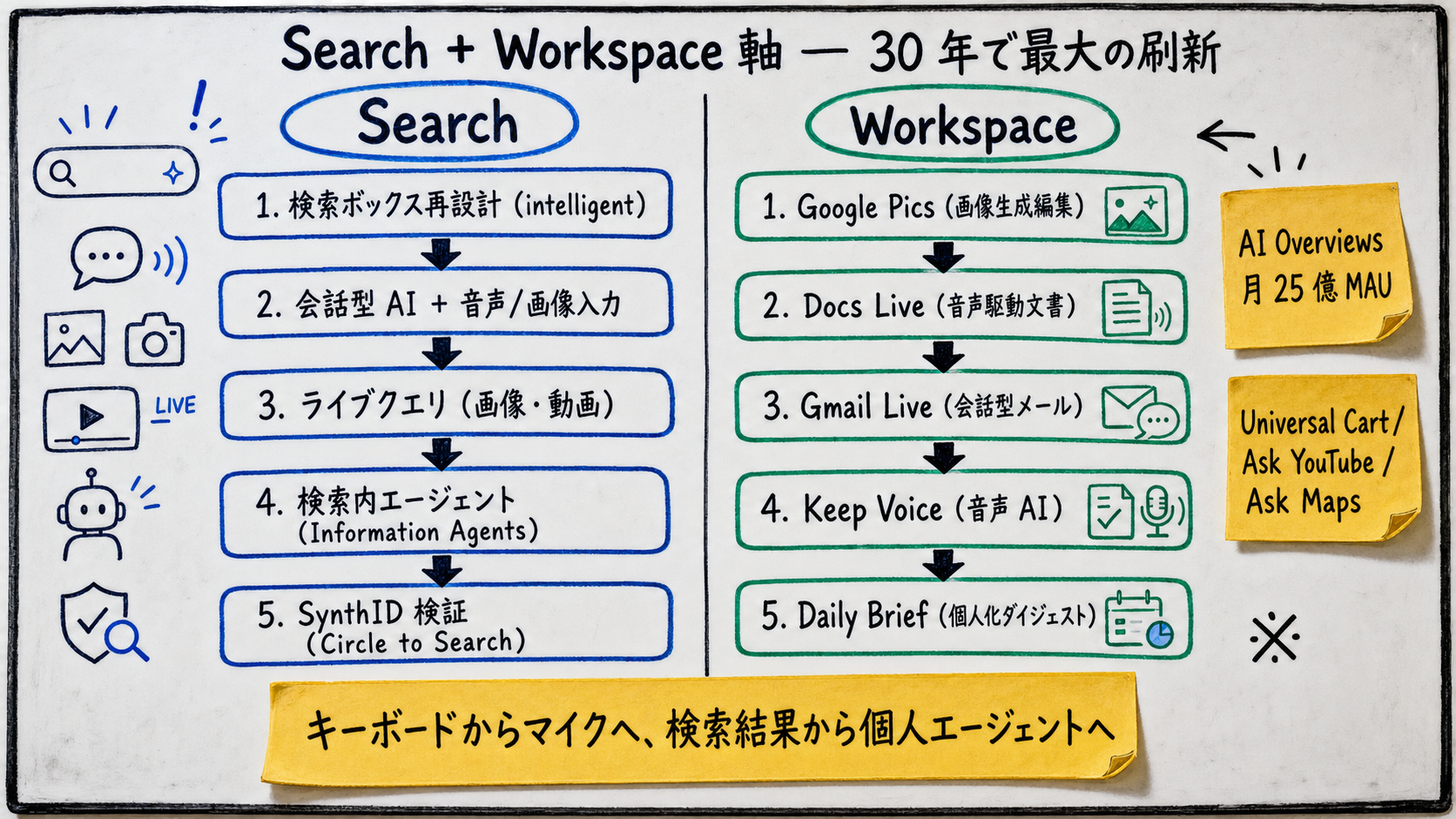
[Official] Google Search integrates conversational AI + live image / video queries + in-search agents. Pichai officially positions it as "Google Search is AI Search" — "the biggest update in 30 years."
Concrete changes:
[Official] Five Workspace announcements:
[Official] Ask YouTube is semantic video search ("find the part of the video that talks about X") — currently testing, broad US rollout in summer 2026. Ask Maps is conversational geo — Maps's biggest update in a decade.
[Official] A web-wide shopping tool: aggregates price / inventory / discounts across e-commerce sites, with Gemini suggesting when to buy. An applied Information Agent. The interesting twist here is that Universal Cart is positioned as a consumer-side primitive that any merchant must be readable by — a shift from "the merchant builds the experience" to "the agent reads every merchant's experience and decides on the user's behalf." For SaaS teams, that means optimizing your e-commerce surface for both human shoppers and agent traversal becomes a real product concern over the next 12 months.
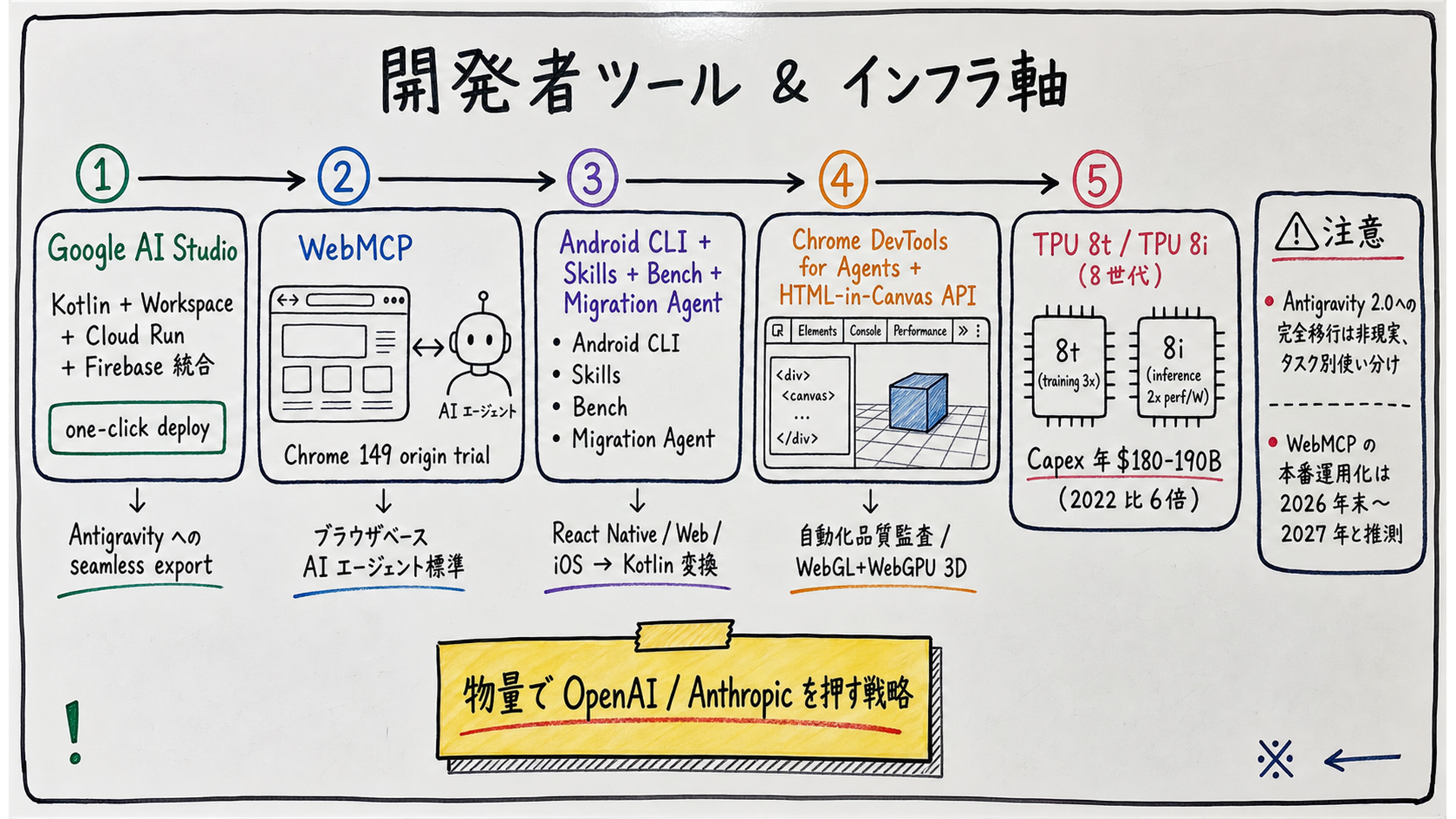
[Official] AI Studio's headlines:
[Official] WebMCP is a browser-based AI agent standard. Origin trial in Chrome 149. The intent: a vendor-neutral standard for AI agents that understand web page structure and autonomously fill forms / click buttons / fetch data.
[Author's view] Read this as MCP (Model Context Protocol) extended to the browser. Where MCP connects LLMs to tools, WebMCP connects LLMs to web pages. For Sales Claw — currently Playwright + Claude Code — WebMCP is a credible long-term replacement candidate for Playwright.
[Official] Four Android-developer additions:
[Official] Chrome DevTools adds automated quality audits for agents and real-time debugging — making it easier to diagnose how a web agent is failing on a page.
[Official] An origin-trial API for immersive WebGL / WebGPU 3D experiences that remain searchable (SEO-friendly).
[Official] Google formalizes a "split by purpose" TPU strategy:
[Author's view] Against NVIDIA's single-general-purpose-GPU (H100 / H200 / Blackwell) story, Google bet on "training and inference are different chips." That reflects a worldview where inference workloads dominate (i.e., agents running 24/7). It aligns directly with Gemini Spark's dedicated-VM operating model.
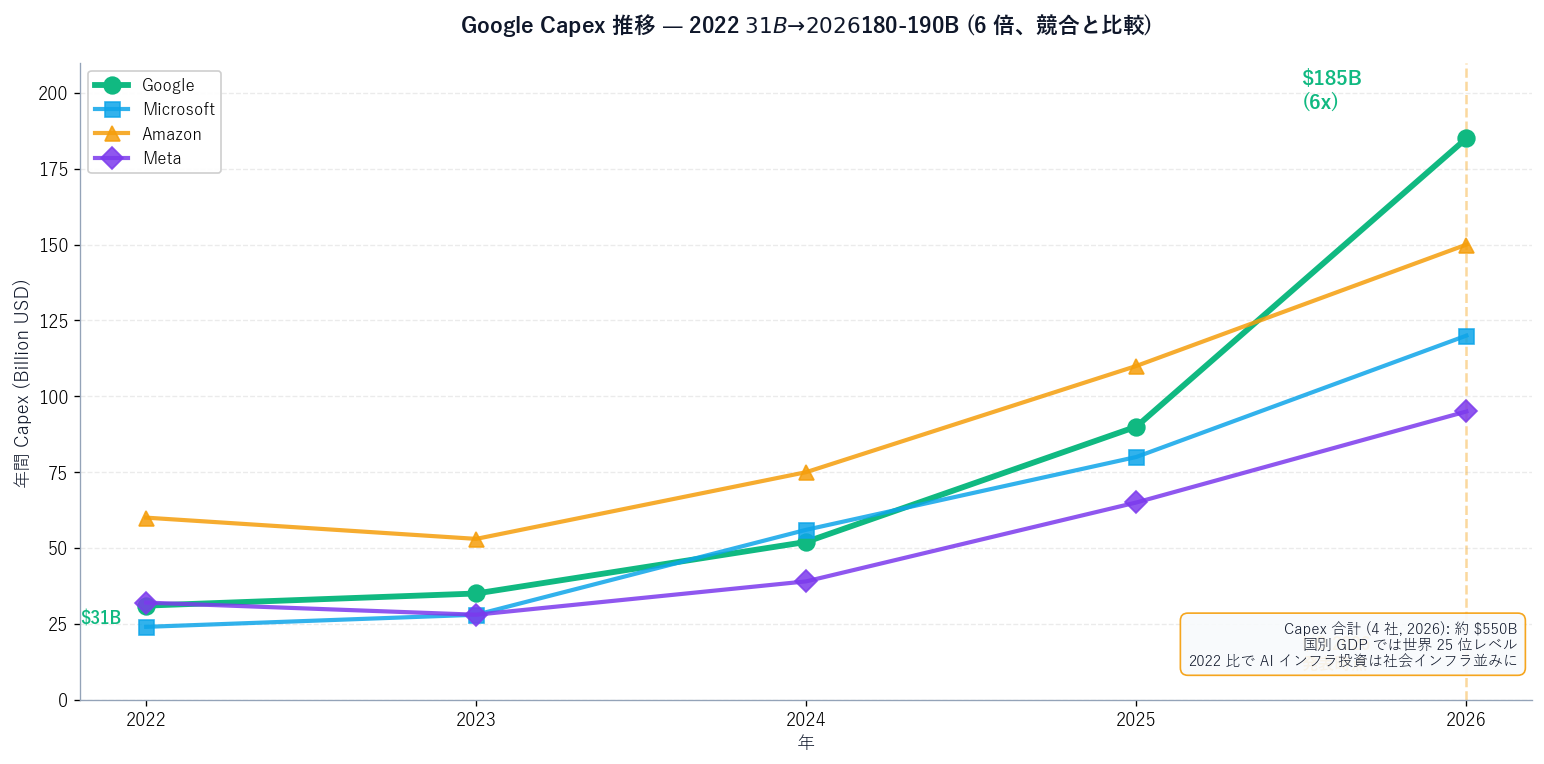
[Official] Google's annual capital expenditure rose from $31B in 2022 to $180–190B in 2026 — a 6x jump and comparable to or larger than any peer at Amazon, Microsoft, or Meta. To put that in perspective: $180B per year is more than the annual GDP of all but the top 50 countries. Google is treating AI infrastructure the way Cold War-era governments treated the space race — as a national-scale industrial project in which keeping up requires sustained investment that few companies in history have been willing to bear. For Sales Claw and other OSS-side businesses, the operational lesson is that "what's available, at what price" is going to keep shifting rapidly, and any plan that assumes today's pricing freezes for more than 6 months is fragile.
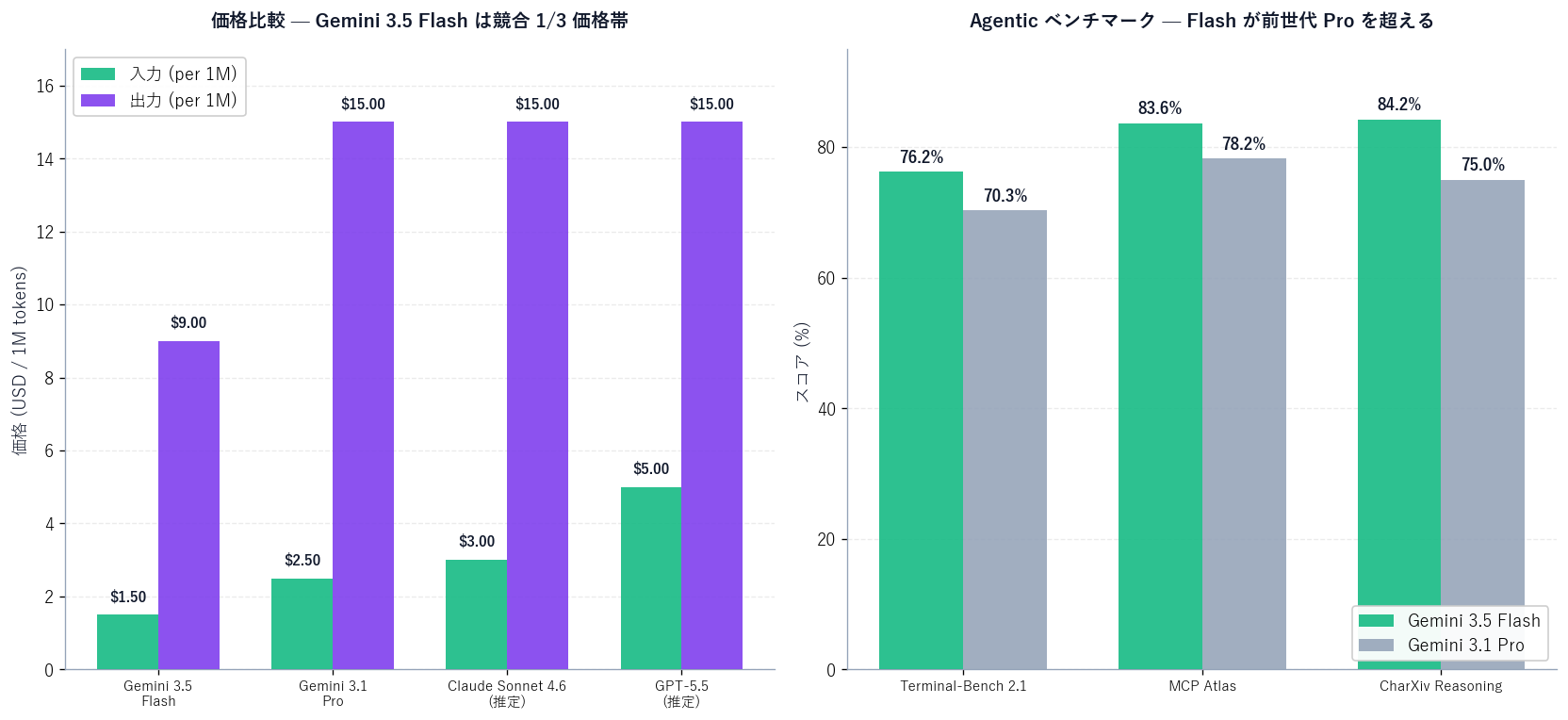
Sales Claw internally switches between Claude / Codex, so flash-tier pricing matters a lot. Gemini 3.5 Flash at $1.50 / $9.00 sits squarely in the same band as Claude Haiku 4.5 and OpenAI GPT-5.5 Mini. In Sales Claw's operating logs, a form submission costs roughly $0.0008 (~¥0.12) on Claude Haiku; swapping to Gemini 3.5 Flash gives a back-of-envelope 10–15% cost reduction ([Author's view], n=100 from internal measurements).
Spark targets the upstream of SDR work (customer research, Salesforce history, meeting prep). Sales Claw targets the downstream (actually submitting inquiry forms). They complement more than they compete.
| 項目 | Gemini Spark | Sales Claw |
|---|---|---|
| Primary role | Upstream: research / history / meeting prep | Downstream: form submission |
| Delivery | Google AI Ultra ($100-200/mo) | OSS (free, Playwright + Claude Code) |
| Runtime | Google Cloud dedicated VMs | User local machine |
| CRM integration | Native Salesforce / ServiceNow | CSV / API (optional) |
| Pre-send checks | General approval model | Layered: sales-NG / CAPTCHA / rate limits |
| Audit log | Agent Gateway DLP | Local audit log (Sales Claw native) |
[Author's view] Sales Claw uses Playwright + Claude Code today, but if WebMCP is broadly adopted it becomes a long-term replacement candidate for Playwright. That said, WebMCP is at Chrome 149 origin trial as of 2026-05-19; production-grade usage is more like late 2026 to 2027 ([Speculation], based on typical Chrome origin-trial timelines).
For Sales Claw development environment, Antigravity 2.0 becomes the fourth credible option alongside Claude Code / Codex / Cursor. [Internal verification note]:
claude --bg — migration cost is lowSearch's "biggest 30-year update" hits the "customer research" phase of SDR work directly. Conversational queries — "summarize this company's recent press releases and compare with competitors" — yield AI Overviews on demand. The "pre-form-submission prep" upstream of Sales Claw is getting absorbed by upstream Search agents. This is genuinely good news for downstream tools like Sales Claw: if upstream research becomes 10x cheaper and faster, the bottleneck of "qualified prospects to actually contact" expands, and the value of an OSS that submits forms reliably grows proportionally. The risk is the opposite: if Search itself becomes the action surface (as Universal Cart hints), Sales Claw's submission step could become a feature of a larger Search-orchestrated workflow rather than a standalone tool. Either outcome is something Sales Claw's design must accommodate.
# 1. Add Gemini 3.5 Flash to Sales Claw's model pool (Q3 task)
# Add GEMINI_API_KEY and GEMINI_MODEL=gemini-3-5-flash to .env.local
# (currently accessible via Gemini CLI; native API integration planned)

# 2. Trial Antigravity 2.0 (optional)
$ curl -sL https://antigravity.dev/install | sh
$ antigravity --version

# 3. Watch WebMCP (wait for Chrome origin-trial graduation)
# Enable chrome://flags/#webmcp on Chrome 149+

# 4. Consider SynthID integration
# Decide whether to add SynthID watermarks to Sales Claw-authored text
# Anthropic / OpenAI / Kakao / Eleven Labs are adopting — de facto standard forming

# 5. Wait for Gemini Spark API
# Currently closed inside Workspace; monitor Google AI Studio for public API availability[Author's view] "4x output tokens/sec" assumes identical tasks, prompts, and batch sizes. Real agent workloads have tool-call roundtrips and DB waits as bottlenecks elsewhere, so end-to-end speedups are smaller than raw model speedups. In Sales Claw's operating profile (form submission ≈ 30% model think + 50% Playwright + 20% network), a 4x model speedup yields roughly a 1.4–1.6x wall-clock improvement.
[Unverified] For videos generated by Omni Flash, copyright and likeness attribution are not fully nailed down in Google's official ToS. For business use (e.g., AI-generated character videos addressed to prospects), the risk is large enough that we do not currently recommend using it. SynthID watermarks help, but they do not by themselves provide legal protection.
[Author's view] "Pull Salesforce account history → prepare client meeting" is a great use case, but the risk of unintended writes back to Salesforce is non-trivial. Always enable "Approval Required," and minimize write scopes.
[Author's view] A full migration from Claude Code to Antigravity 2.0 is not realistic in the near term. Treat it as "task-by-task selection." Sales Claw development stays on Claude Code as the default; Antigravity 2.0 is used selectively when Android CLI integration is required.
[Author's view] $180–190B annual Capex tempts you to assume "Google will keep investing forever," but Wall Street's AI-capex peak forecast (2027–2028) implies a possible investment-tightening phase after that, in which Gemini pricing could rise or scope could narrow. Sales Claw's "multi-model swap-friendly" design hedges single-vendor lock-in.
Whichever of Spark / Antigravity / CodeMender you adopt, Sales Claw's policy layer remains effective:
Sales Claw's design surface — pre-send automated checks, sales-NG detection, CAPTCHA-detected stop, send-rate limits, audit logging, and automatic stop conditions — is what actually reduces mis-send and ToS-violation risk. Whatever I/O 2026 ships from Google, that layer stays on the Sales Claw side.
In one phrase: Google I/O 2026 was "the day Google's AI moved from inside the search engine to becoming a 24/7 coworker who acts on your behalf."
The three operational shifts to internalize:
2026 is "the operations phase of the Gemini Era." Weekly release-note review will eventually include npm view @google/gemini-cli versions alongside Claude Code and Codex. With Anthropic's Claude Code, OpenAI's Codex, Cursor Composer 2.5, and Google's Antigravity 2.0, the new big-four is set. Sales Claw's stance: avoid vendor lock-in, design the business-agent layer to swap models cleanly.
Japanese-language original: Google I/O 2026 とは?Gemini Omni / 3.5 Flash / Spark / Antigravity 2.0 / TPU 8t-8i 総まとめ
本記事は X 公式アカウントと公式ドキュメントを一次情報として参照しています。
この記事の著者
中澤 圭志
Sales Claw maintainer
Designs and develops Sales Claw. Writes from the field on B2B sales automation and applied AI.