業界トレンド
Anthropic Overtakes OpenAI for the First Time — The May 2026 "Changing of the Guard" in Enterprise AI, Explained for Non-Experts
14 分
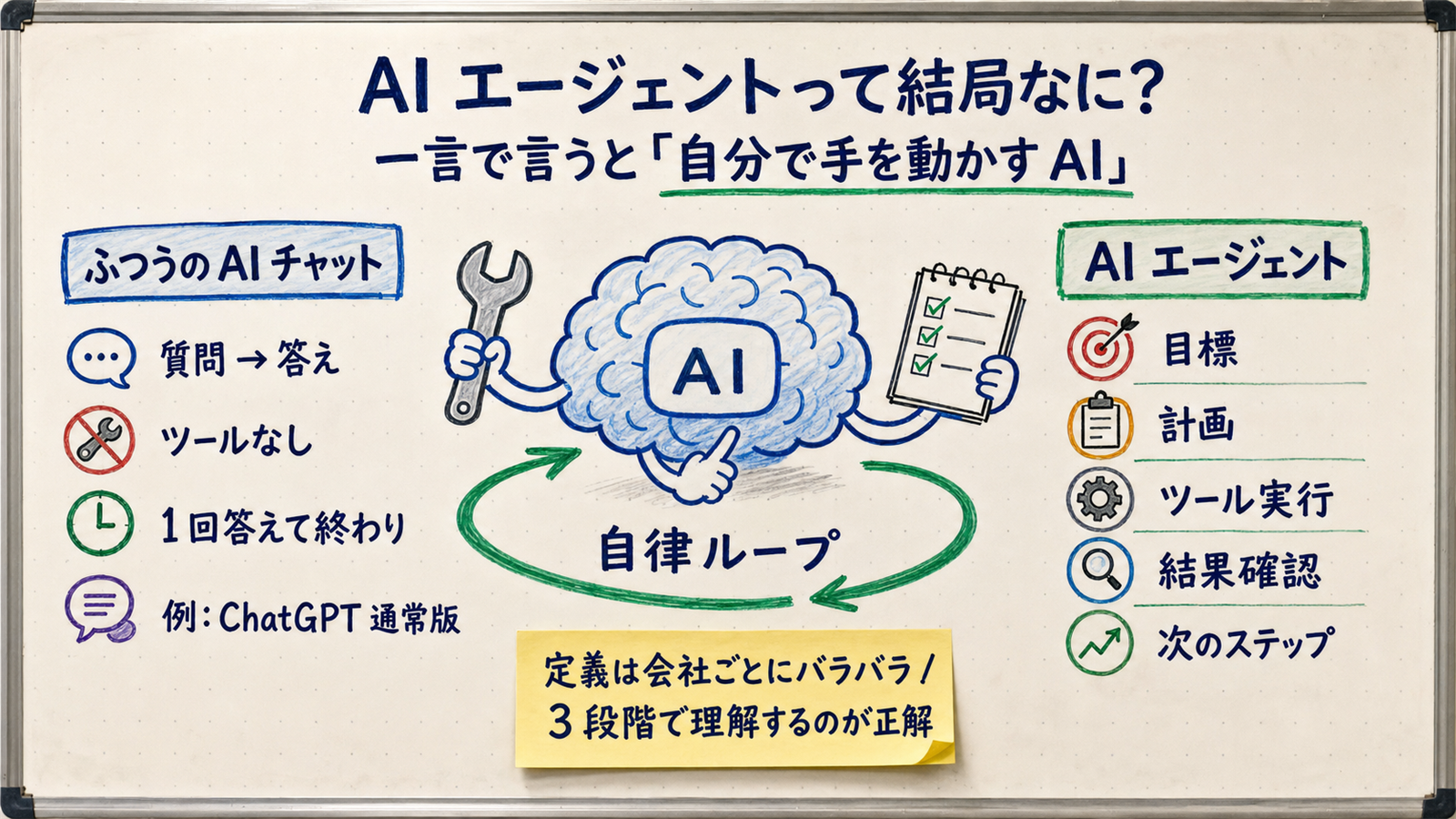
An AI agent is "an AI that, given a goal, plans its own steps, calls tools, and works a task to completion." Nobody summarizes it cleanly because vendors disagree across autonomy, tool-use, and task scope. The practical lens is the 3-tier gradient: Reactive → Tool-use → Autonomous. This article maps the 2026 landscape, lists the 10 agents to know, gives a free 3-step start path, and covers the 5 risks plus a sales context.

中澤 圭志
@keishi_nakazawaSales Claw maintainer
Key Facts
One-line definition
An AI that plans, calls tools, and completes multi-step work toward a goal
3-tier framework
Reactive (ChatGPT) / Tool-use (Claude, Copilot) / Autonomous (Claude Code, Codex)
Top 10 agents
Claude Code, Codex, Devin, Replit Agent, Cursor, ChatGPT Agent, Microsoft Copilot Agent, Salesforce Agentforce, ChatGPT Atlas Agent, Perplexity Comet
Try free today
ChatGPT free + Web Search / Claude.ai + MCP / Microsoft Copilot free / Perplexity free
"I keep hearing 'AI agent' — what is it? How is it different from ChatGPT? Claude calls itself one, Copilot calls itself one — are they all the same?" This article unpacks the term "AI agent" for non-technical readers, working from primary definitions published by Anthropic, OpenAI, Google, and Microsoft. We cover why nobody can summarize it in a sentence and how to draw practical distinctions you can act on.
Primary sources for this article: Anthropic's "Building Effective Agents" (2024-12), the OpenAI Agents Platform Docs, Google's Gemini Agents Whitepaper, and Microsoft Copilot Studio Docs. For deep dives into individual products, see our Claude Code slash-commands guide and Codex Mobile explainer. For the toolbox standard, see the MCP complete guide, and for the browser angle the ChatGPT Atlas explainer.
The simplest analogy: regular ChatGPT is a "teacher who reads the textbook aloud"— answers your questions but doesn't walk to the library or take notes. An AI agent is more like a "research assistant": ask it to "prep next week's meeting deck" and it tries to fetch sources, summarize, open PowerPoint, and lay out slides.
Three machinery pieces make this possible: tool use, memory, and an autonomous loop. Anthropic puts it this way:
【Official statement】 The key phrase is "dynamically direct"— the AI decides the next step, not the human at every turn. That's the line between "chat" and "agent."
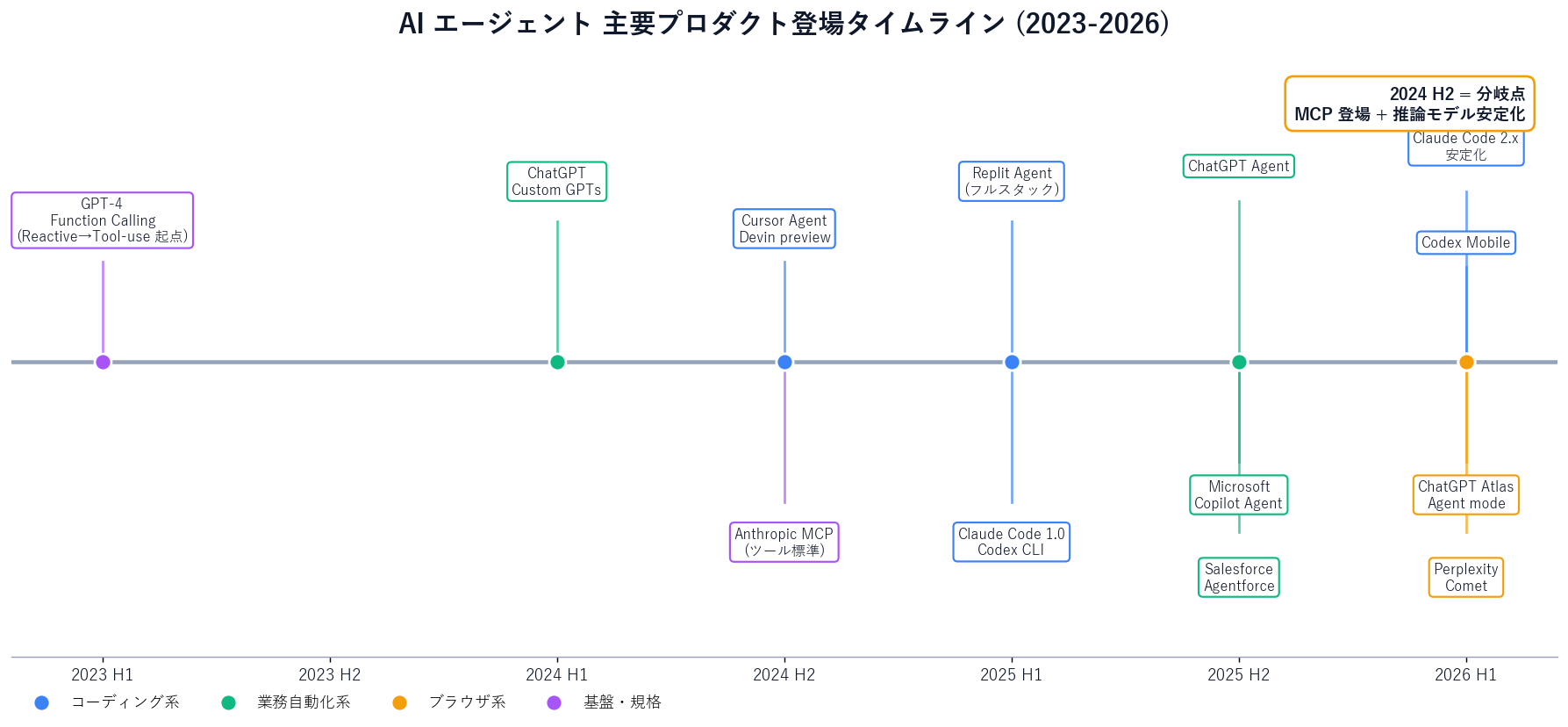
【Author view】 AI agents had been researched for years, but only became practical in 2024-2025. Three breakthroughs lined up: (1) long context (Claude 3.5 Sonnet hit 200K tokens, Gemini 2 crossed 1M); (2) standardized tool-use APIs (OpenAI function calling → MCP); (3) better reasoning (Claude Opus 4 / GPT-5 families made multi-step plans reliable). Devin, Replit Agent, Claude Code, and Codex reached production in 2025; 2026 is the mass-adoption year.
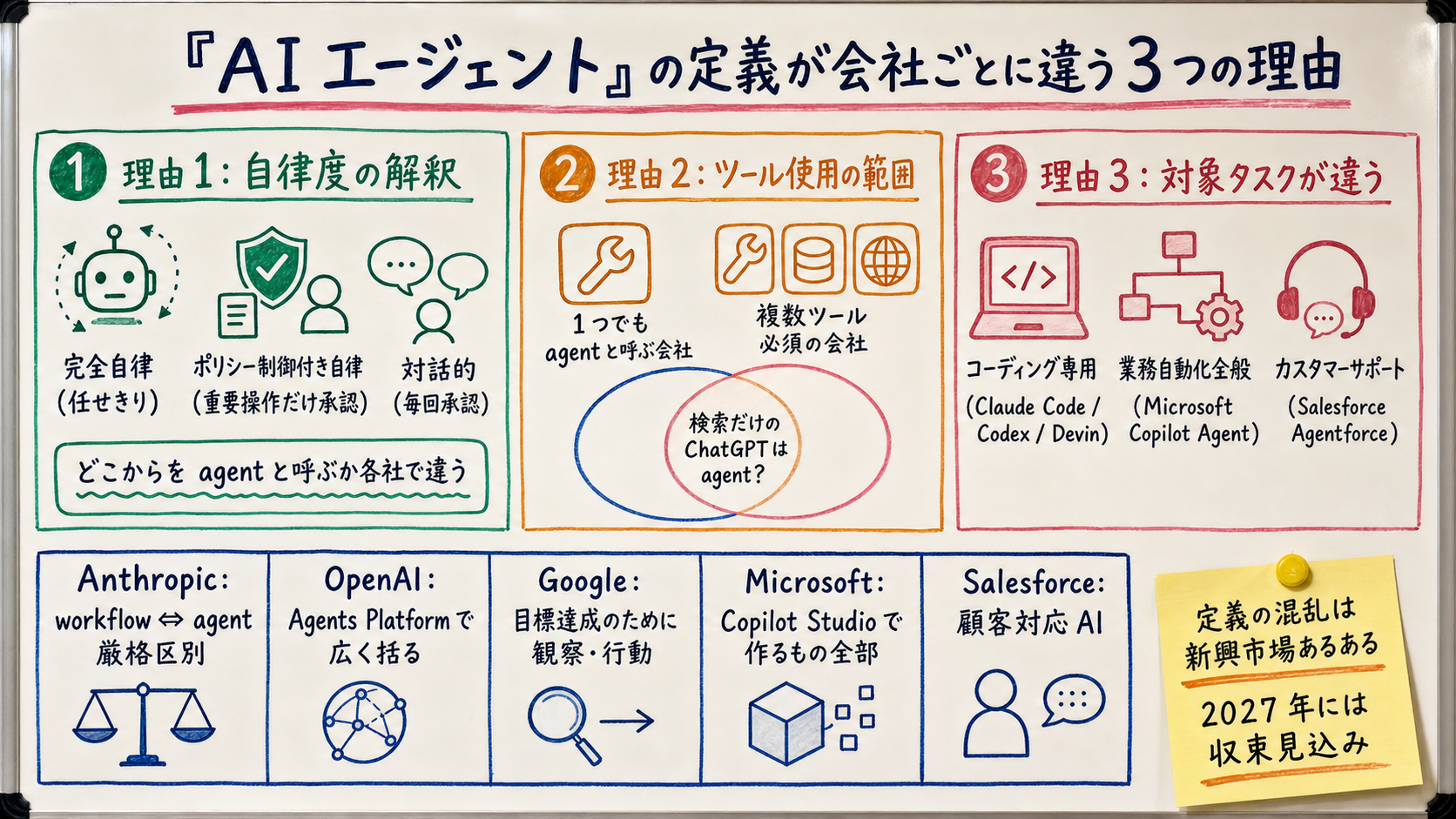
Vendors disagree on how autonomous something must be before it counts. Anthropic is strict: workflow = human directs each step; agent= LLM directs its own steps. OpenAI groups ChatGPT, Codex, and Agents Platform together. Microsoft calls anything generated in Copilot Studio a "Copilot Agent."
Does a single retrieval call qualify? Anthropic says "augmented LLM" — not an agent. Many SaaS vendors market "ChatGPT with search = agentic AI" anyway. That's the rift.
Claude Code, Codex, and Devin are coding-only. Microsoft Copilot Agent targets business automation. Salesforce Agentforce focuses oncustomer support. Comparing them as one category fuels confusion.
| Vendor | How they use "AI agent" | Character |
|---|---|---|
| Anthropic | Strict separation: workflow vs agent | Only LLM-directed counts as agent |
| OpenAI | Bundled under Agents Platform | ChatGPT Agent, Codex, Assistants API all in |
| Gemini Agents Whitepaper | "Observe and act toward a goal" | |
| Microsoft | Copilot Agent ≈ generative business tool | Anything built in Copilot Studio |
| Salesforce | Agentforce = customer-facing AI | Support and engagement focus |
【Author view】 Definition drift is normal in new markets — RAG (2024) and prompt engineering (2023) went through the same phase. Expect convergence by 2027.
Plain ChatGPT replies once and stops — no hands. An AI agent has tool-call permission: ask it to "send Monday's deck to Slack" and it chains calendar lookup → drive search → summary → PowerPoint → Slack post on its own.
Zapier and UiPath need humans to spell out every step. They break on edge cases. AI agents get a goal and improvise the path — they can pivot when things go wrong. The flip side: for rigid, repetitive jobs, classic RPA is cheaper, faster, and more reliable. Agents fit exploratory or variable work.
| 項目 | AI chat (ChatGPT) | Automation (Zapier / RPA) |
|---|---|---|
| Input | Questions, instructions, dialogue | Predefined triggers (e.g., email received) |
| Output | Text, code, images (conversation only) | API calls, file ops, notifications |
| Flexibility | High (tries any question) | Low (rigid scripted flows) |
| Cost | Cheap (per-message) | Medium (monthly subscription) |
| How an agent differs | Agents add hands (tool use) | Agents plan their own steps |
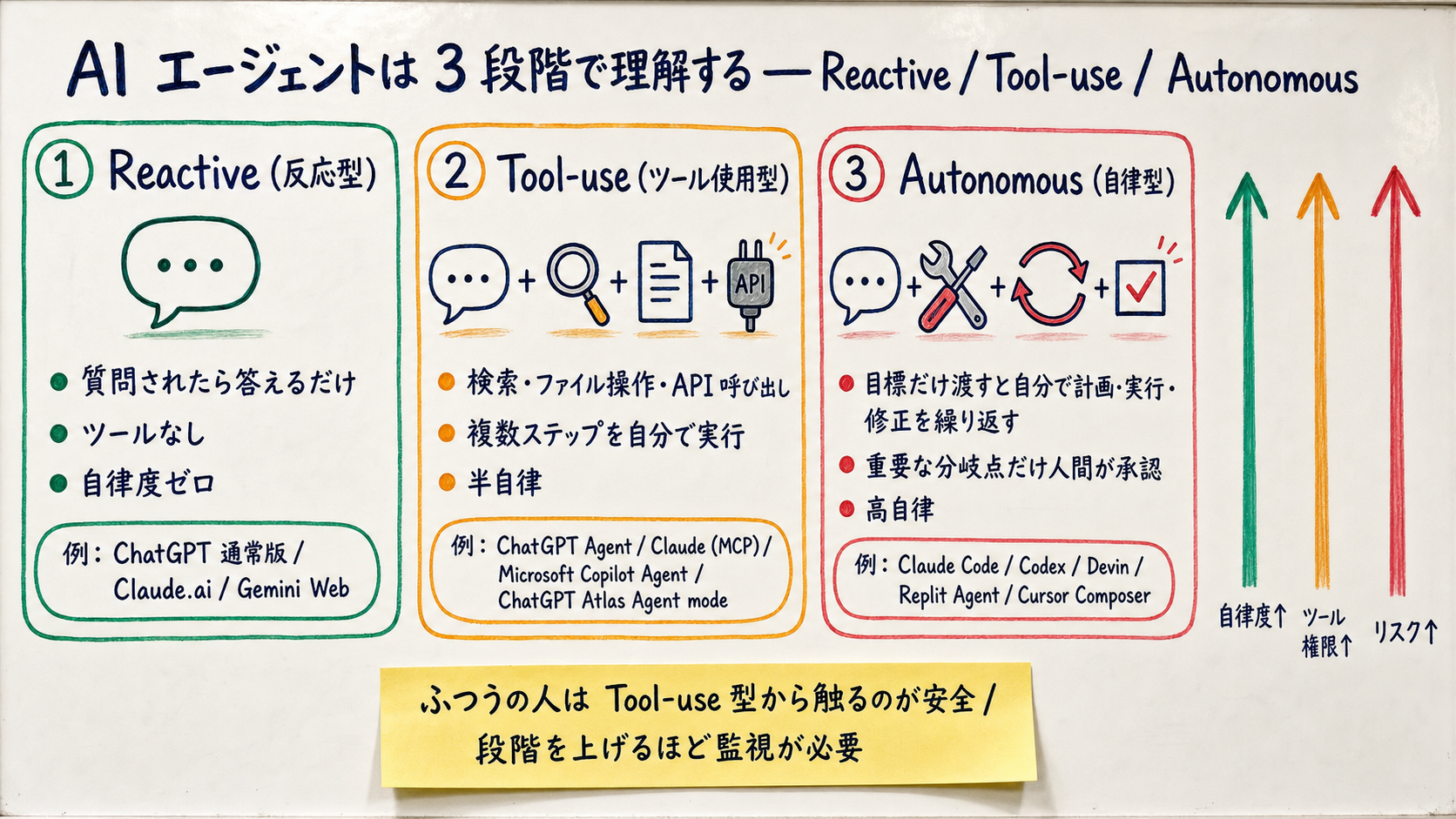
Baseline. You ask, the AI answers. No tools, no outside effect. ChatGPT, Claude.ai, Gemini Web all sit here. Technically not yet an "agent," but a useful zero point for comparisons.
Add tools (search, files, APIs, browser, calculator) and you have an agent. Ask "plan my weekend around the forecast" and it calls a weather API, then composes a plan from the results. ChatGPT Agent (Plus/Pro/Business in May 2026), Claude with MCP, Microsoft Copilot Agent, and ChatGPT Atlas Agent mode all live here.
The most "agentic" tier. Hand it a goal and it loops: plan → act → observe → fix → next. Humans approve at branching moments (delete, send, pay). Examples: Claude Code, Codex, Devin, Replit Agent, Cursor Composer, Aider— all coding-focused, all able to chew on goals like "fix this bug and open a PR" for minutes to hours.
【Author view】 Autonomy is also where risk spikes. File deletes, force-pushes, payments executed without supervision are hard to undo. Anthropic and OpenAI both recommend policy-gated autonomy(humans approve consequential steps); production agents almost universally land there. Vendors selling "high-autonomy, just trust us" deserve careful enterprise scrutiny.
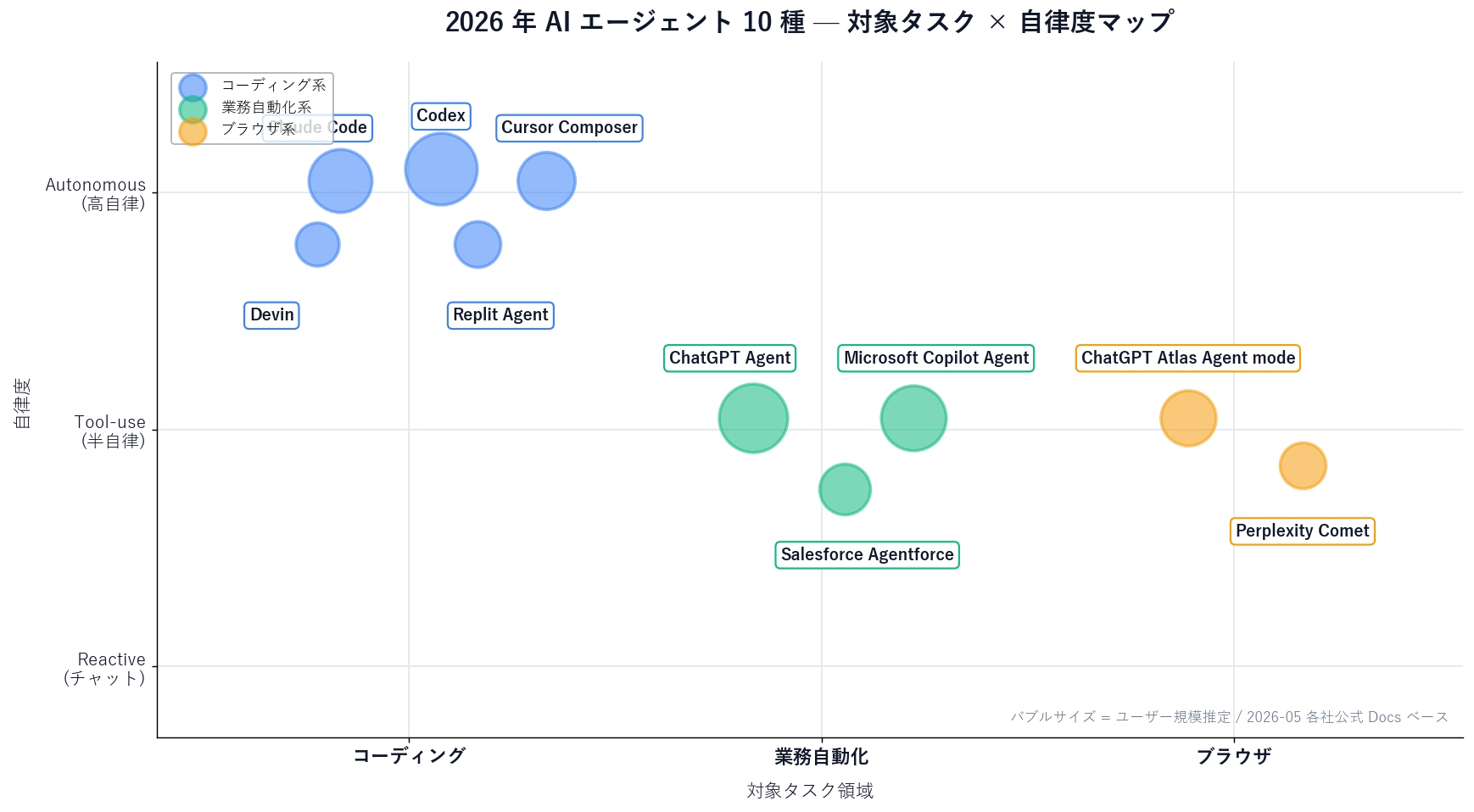
| Agent | Task domain | Autonomy tier | Plan example |
|---|---|---|---|
| Claude Code | Coding (CLI) | Autonomous | Claude Pro / Max |
| Codex | Coding (CLI / web / mobile) | Autonomous | All ChatGPT plans |
| Devin | Coding (web) | Autonomous | Cognition monthly |
| Replit Agent | Full-stack dev (web) | Autonomous | Replit Core/Teams |
| Cursor Composer | Coding (IDE) | Autonomous | Cursor Pro |
| ChatGPT Agent | Business research, task hand-off | Tool-use | ChatGPT Plus/Pro/Business |
| Microsoft Copilot Agent | Office / Teams automation | Tool-use | Microsoft 365 Copilot |
| Salesforce Agentforce | Customer support | Tool-use | Salesforce upper tiers |
| ChatGPT Atlas Agent mode | Browser automation | Tool-use | ChatGPT Plus/Pro/Business |
| Perplexity Comet | Browser + research | Tool-use | Perplexity Pro |
【Author view】 Three lanes: coding (autonomous), business automation (tool-use), browser (tool-use). Non-technical users get the smoothest first experience with business-automation or browser agents — start with ChatGPT Agent or Microsoft Copilot Agent. Coding agents stay in the engineer's lane; they multiply dev productivity rather than replacing roles.
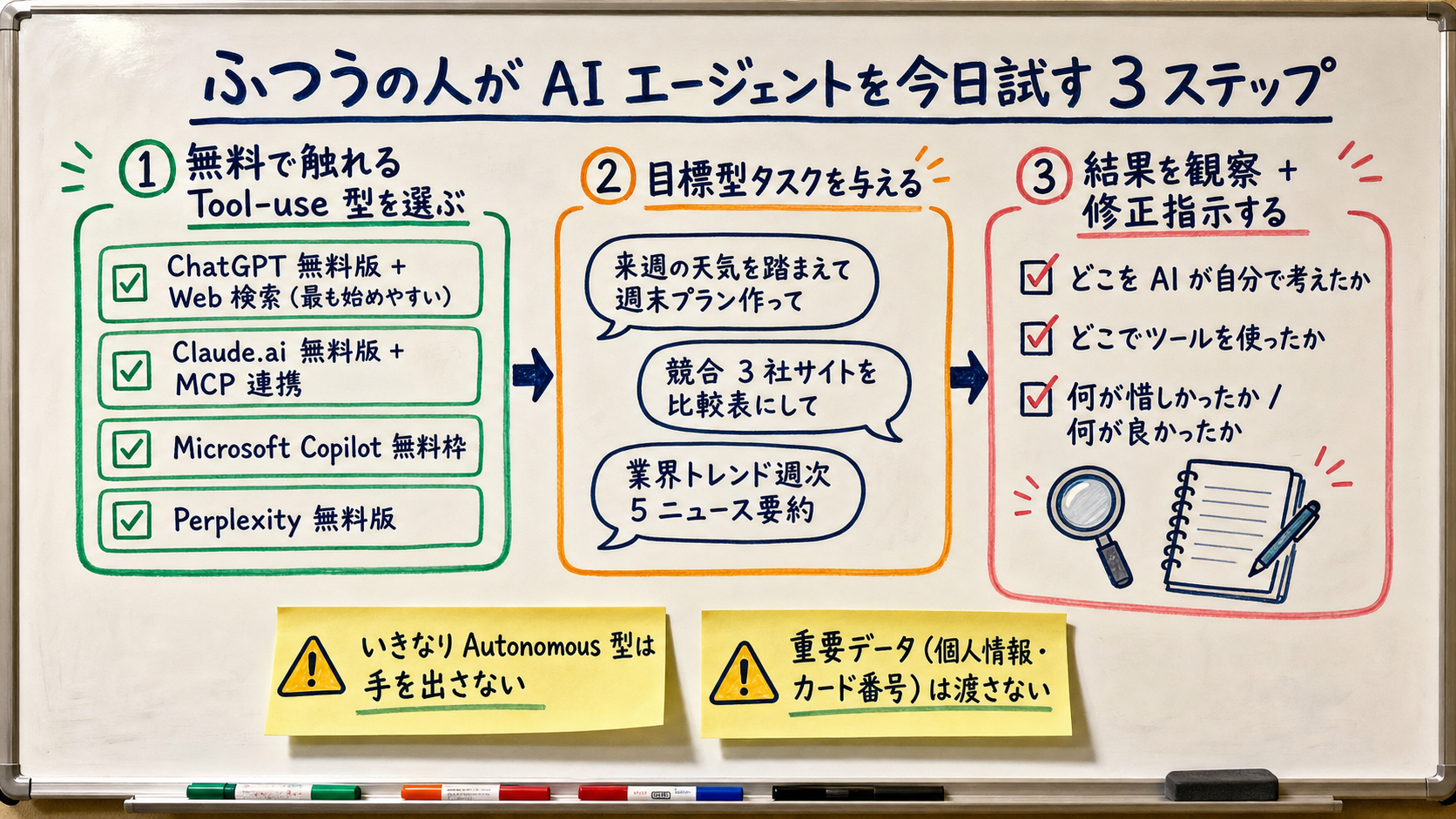
Pick one and use it 5 minutes a day. ChatGPT free + Web Search is the lowest-friction starting point.
Agent answers leave tool-call traces — citations, search results, computed values. Watching what the AI thought versus what it offloaded teaches you its strengths and weak spots. Once Tool-use feels natural, you can graduate to Autonomous tools (Claude Code / Codex) without flying blind.
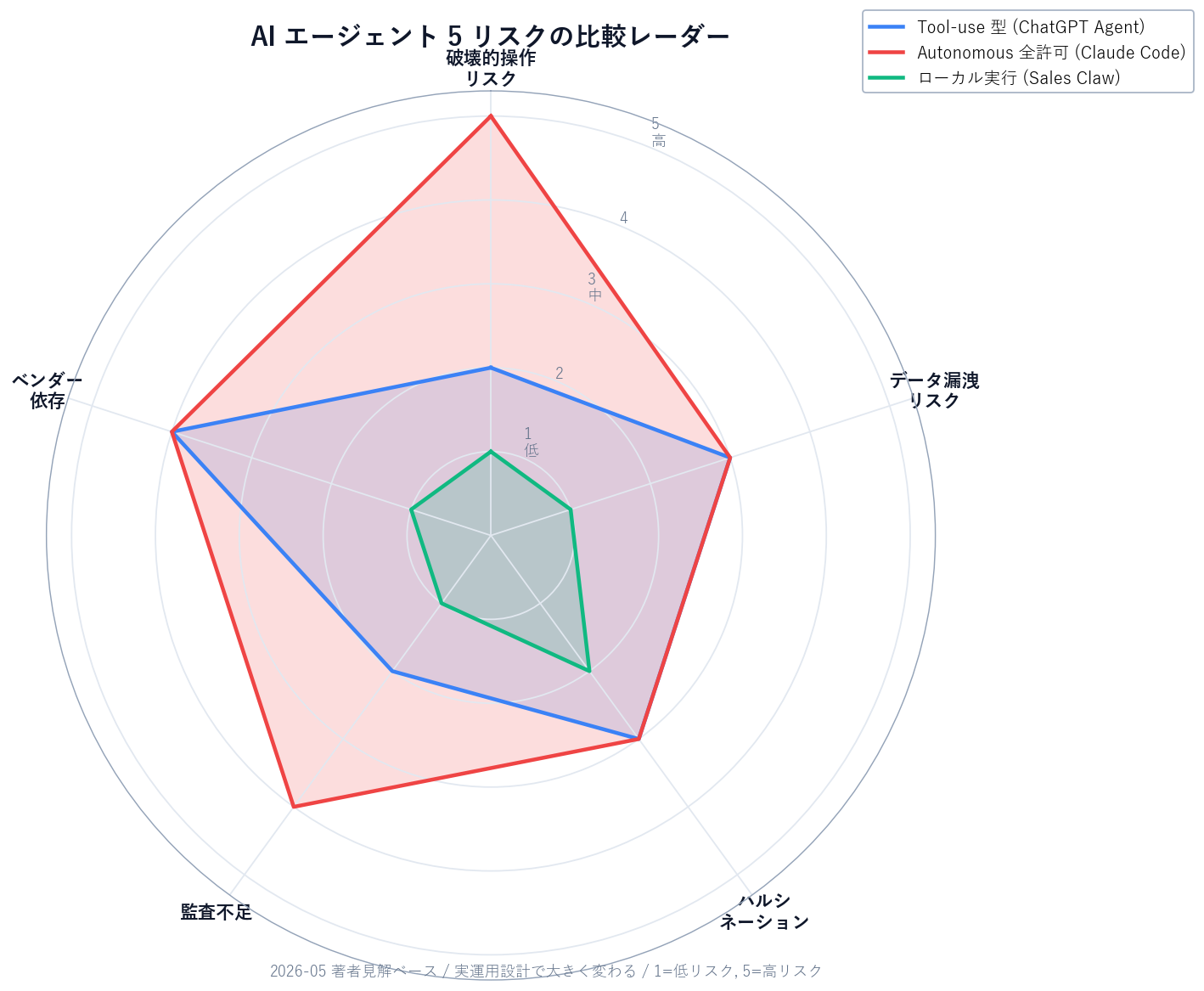
Tool use is the appeal — and the risk vector. File deletes, force-pushes, payments, and leaked API keys are all in scope once an agent has shell or API access. The mitigation is policy-gated human approval: Claude Code, Codex, and Microsoft Copilot Agent all ship per-command approval. Disabling or rubber-stamping it is how incidents happen.
Most agents run in vendor clouds. Customer PII, payment data, sealed strategy docs, and credentials should never sit in prompts; they end up in logs (and possibly in training data when opt-in). Mitigations: vet vendor policy, use Enterprise plans with training disabled, and run sensitive work in local-execution OSS like Sales Claw.
Agents still hallucinate in 2026 — misreading search results, inventing functions, fabricating citations. Important decisions need a human cross-check.
For business use, "who ran what, when, through which tool" must be loggable. Microsoft Copilot Studio, Salesforce Agentforce, OpenAI Agents Platform, and Anthropic Claude for Enterprise all ship audit logging. Sales Claw, as local-execution OSS, logs every send by design.
Most agents are cloud SaaS, exposing you directly to vendor policy changes, repricing, or shutdown. 2026 has already seen frequent plan changes — long- range plans need slack.
The most mature use case in 2026. ChatGPT Agent, Claude, and Perplexity Pro can all crawl multiple pages and produce summaries fit for competitive research, prospect prep, or weekly industry digests.
Microsoft Copilot Agent integrates cleanly into Office / Teams / Outlook estates. Salesforce Agentforce does the same on the Salesforce side. Both centralize access control and meet enterprise audit requirements.
The "sales agent" category includes Sales Claw, Apollo.io, Outreach AI, and Salesloft, but the design philosophies diverge sharply. Cloud SaaS (Apollo / Outreach / Salesloft) runs lead-extraction-to-send on the vendor's infrastructure — fast to onboard but customer data lives with the vendor. Sales Clawis local-execution OSS specialized in delivering contact-form messages to prospects' sites.
Sales Claw runs policy-gated autonomy: pre-send automated checks, sales-NG detection, CAPTCHA-aware stop, send-rate limits, and full audit logsreduce the risk of misdelivery and policy violations. On the 3-tier framework, its execution loop is Autonomous but bounded by pre-send policy — not a free hand.
Rather than betting everything on one vendor, real-world adoption blends agents by task profile.
| 項目 | Cloud agents (ChatGPT Agent / Copilot) | Local-execution (Sales Claw) |
|---|---|---|
| Fits | Research, summarization, office automation, coding | Sales-form sends, sensitive-data processing |
| Data location | Vendor cloud (training-off available on Enterprise) | Local PC / self-hosted only |
| Cost | USD 20-200 / user / month | OSS free + self-run cost |
| Time to value | Same day | 1-3 days setup |
| Vendor lock-in | High (vendor policy hits you directly) | Low (OSS continuity is portable) |
This is an English overlay of the Japanese-language original article. The Japanese version is canonical. 日本語原文はこちら.

無料・MIT ライセンス。インストールせずにライブデモも試せます。
本記事は X 公式アカウントと公式ドキュメントを一次情報として参照しています。
この記事の著者
中澤 圭志
Sales Claw maintainer
Designs and develops Sales Claw. Writes from the field on B2B sales automation and applied AI.