業界トレンド
The Day Anthropic Filed for an IPO — What the Claude Maker's Listing Prep Means for the Rest of Us Who Use AI
13 分
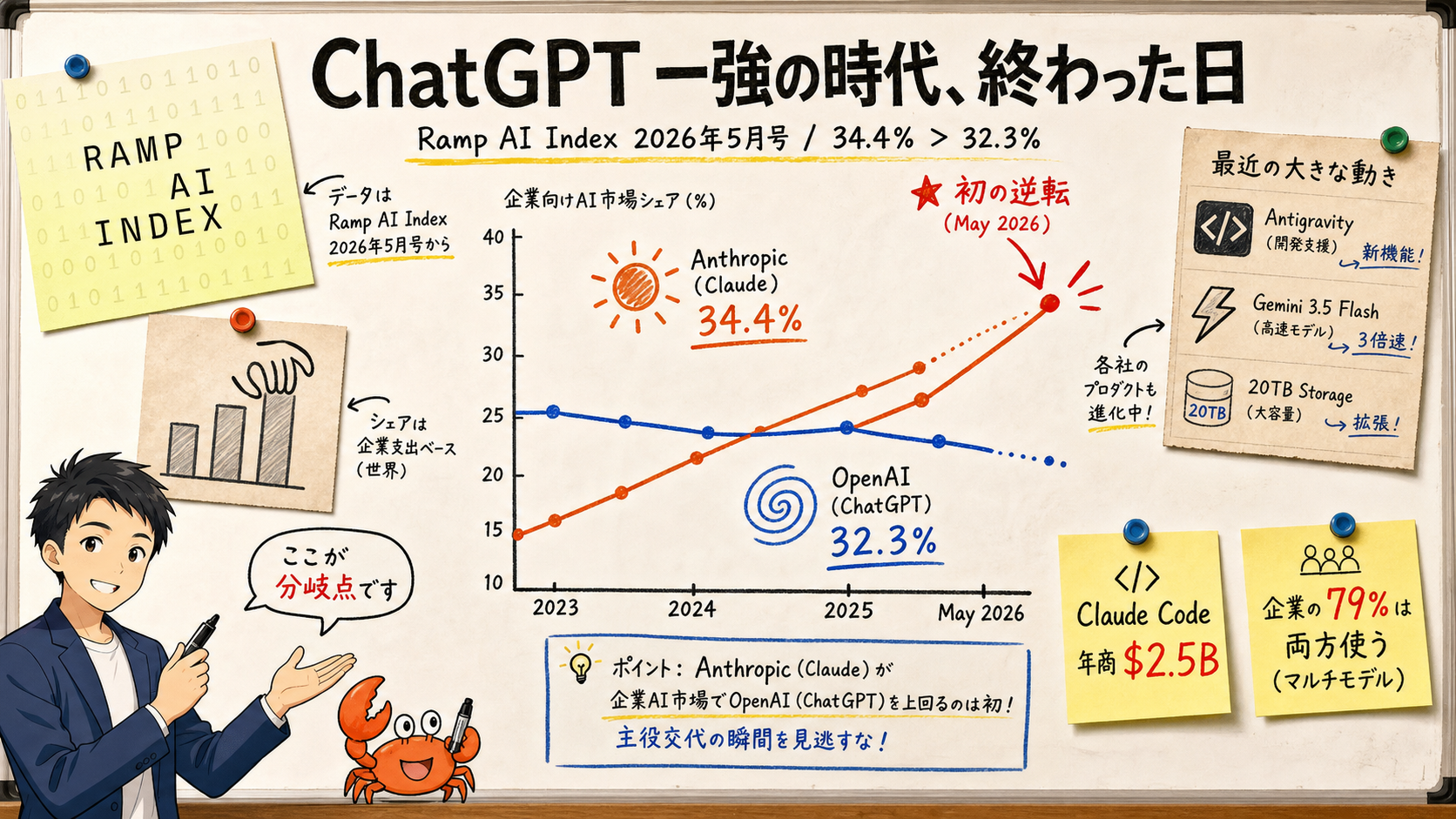
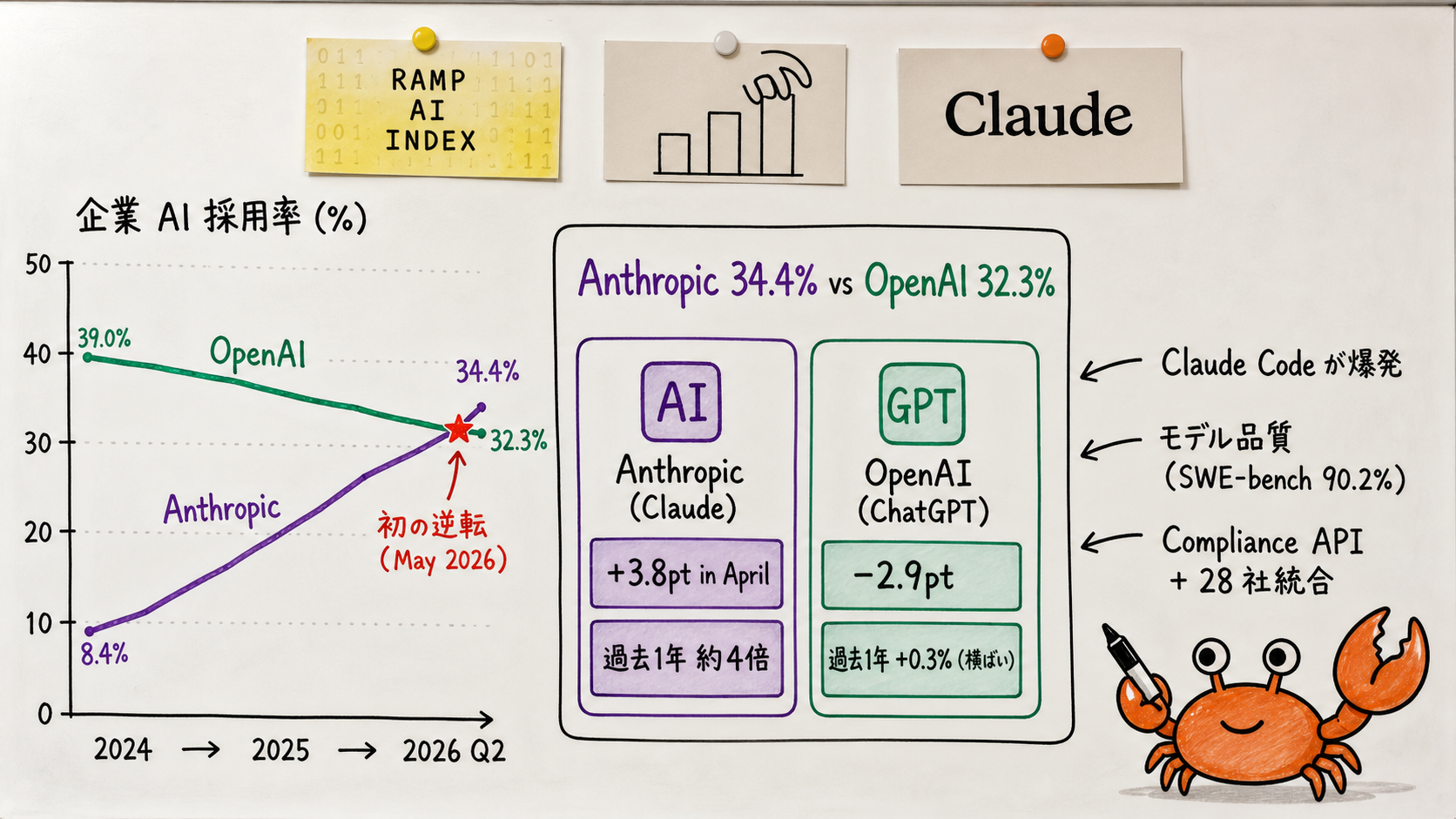
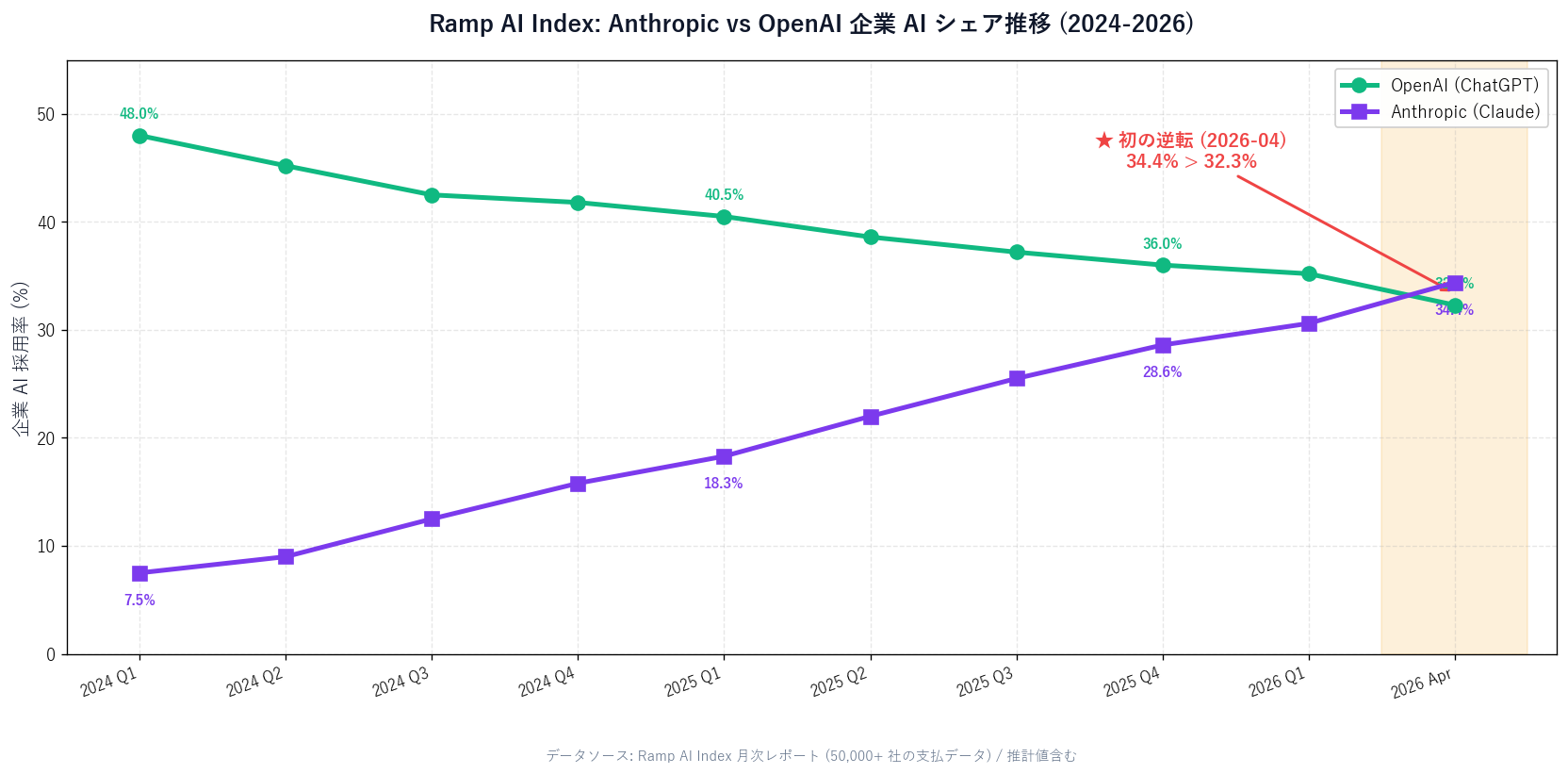
On 2026-05-13 the Ramp AI Index shows Anthropic 34.4% vs OpenAI 32.3% — the first flip. Anthropic ~4x growth in a year; Claude Code at $2.5B run rate / ~4% of public GitHub commits; Uber burned its 2026 AI budget in 4 months; 79% pay both. This piece, for non-experts, covers what the flip means, three risks, and how SMBs and indie devs can run a multi-model strategy for ¥10,000–¥30,000 a month.

中澤 圭志
@keishi_nakazawaSales Claw maintainer
Key Facts
Report date
2026-05-13 (Ramp AI Index May 2026 issue)
Enterprise AI share
Anthropic 34.4% / OpenAI 32.3% (overall 50.6%)
Growth in last 12 months
Anthropic ~4x / OpenAI +0.3% (flat)
Engine
Claude Code ($2.5B annualized run rate, ~4% of public GitHub commits)
"Wasn't ChatGPT supposed to be #1?" "I keep seeing Claude in the news lately — what changed?"—— This article walks through the Ramp AI Index May 2026 report (published 2026-05-13), Anthropic's $30B Series G ($380B valuation, 2026-02-12), the Claude Code $2.5B revenue milestone, and the Uber AI budget runaway, all from primary sources. The goal: help non-expert readers understand "what the changing of the guard in enterprise AI actually means, and how to apply it to your own work and AI tool choices." 2026 is shaping up to be the year the "ChatGPT-only" era ended.
Primary sources: Ramp AI Index May 2026 (2026-05-13), Anthropic Series G announcement ($30B / $380B valuation, 2026-02-12), TechCrunch coverage, VentureBeat analysis, Yahoo Finance (Uber reporting), OpenAI's enterprise next-phase post, and PwC 2026 AI Predictions. For the governance side of enterprise AI, see our Claude Compliance API + 28 integrations explainer. For the coding-tool layer, see Claude Code v2.1.149 + Gemini CLI v0.43 same-day release. For Google's counter-attack, see our Google I/O 2026 roundup.
Ramp is a U.S. corporate-card and expense management company. Each month it publishes the Ramp AI Index, a public look at which AI vendors are getting paid by which companies. [Official] Per the May 13, 2026 issue, April 2026 enterprise AI adoption was 50.6% overall (+0.2pt). By vendor:
OpenAI had held the enterprise AI top spot continuously since ChatGPT launched in November 2022. Anthropic, founded in 2021 by former OpenAI researchers, had spent years in a "well respected but behind on share" position. This flip is the first time the order has reversed — and that is what the May 2026 Ramp AI Index records.
Ramp economist Ara Kharazian told TechCrunch that Anthropic took a deliberate strategy: "start with a very technical customer base, succeed in execution, and broaden from there". That is the opposite of OpenAI's consumer-marketing-first approach. The result is that "people who actually use AI every day" shifted preference, and the change shows up in share.
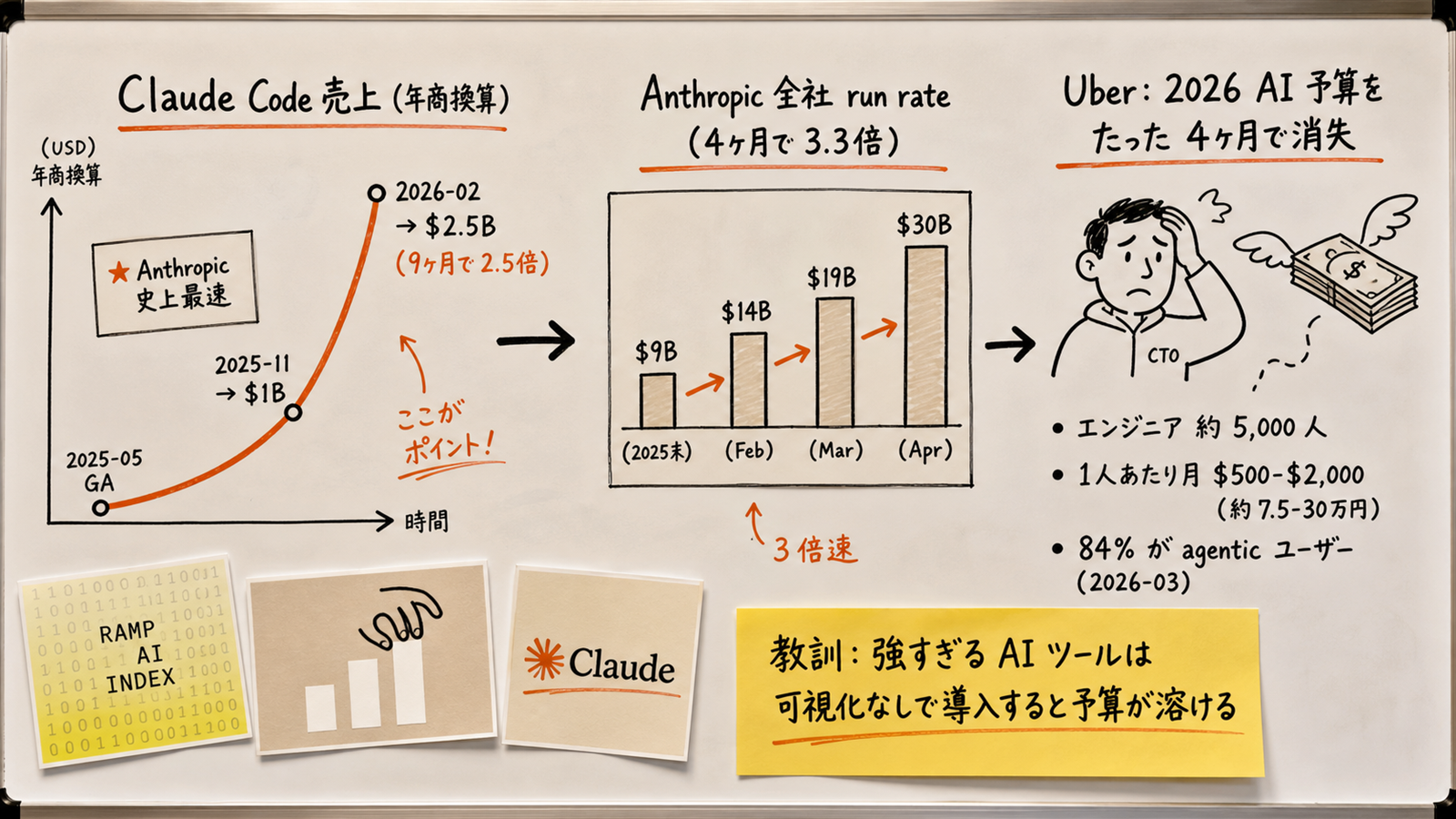
[Official] At Anthropic's Series G announcement (2026-02-12, $30B raised at $380B valuation), the company revealed that Claude Code reached a $2.5B annualized run rate — about ¥375B at current rates. The product went GA in May 2025 and hit that figure in nine months. Anthropic positions it as "the fastest-growing product in company history."
Claude Code is a terminal-based AI tool for developers. It reads, writes, edits, and tests code on your behalf. Per Anthropic's internal analysis (Feb 2026), Claude Code authored approximately 4% of all public GitHub commits worldwide.
Anthropic's flagship Claude Opus 4.7 and mid-tier Claude Sonnet 4.6have, since late 2025 into early 2026, matched or beaten OpenAI's GPT-5.5 family on hard, agentic tasks:
Developers, data scientists, and consultants weight this category heavily — they care about "does the model get it right when I'm actually stuck?" — so Claude getting picked as the "reliable teammate" snowballed.
Through late 2025 and 2026, Anthropic shipped the boring-but-decisive infrastructure that IT departments demand. [Official] On 2026-05-21, Anthropic launched the Claude Compliance API plus 28 security partner integrations (Cloudflare, Wiz, Palo Alto, Microsoft Purview, Okta, Datadog, ...), wiring Claude usage into the same pipes IT teams already use for every other SaaS (details: Claude Compliance API explainer).
| 項目 | Anthropic's enterprise stack | OpenAI's enterprise stack |
|---|---|---|
| Flagship products | Claude Enterprise / Claude Code / Claude Platform (API) | ChatGPT Enterprise / Codex / OpenAI Platform (API) |
| Audit / governance | Compliance API (2026-05-21, 28 partner integrations) | Audit Log / individual compliance integrations |
| Identity integration | Okta / Microsoft Entra / SailPoint SSO etc. | Okta / Microsoft Entra SSO etc. |
| Disclosed Fortune 10 deployments | 8 (per Anthropic Series G announcement) | Not publicly disclosed (some Fortune 50 via Microsoft channel) |
| Customers > $1M / year | 500+ (up from 12 — roughly 42x in a year) | Not publicly disclosed |
[Author's view] "Boring enterprise plumbing" is not glamorous — but it is the layer that actually decides share fights in the long run. Anthropic's Compliance API ("put Claude on the same management pipe as every other SaaS") was effectively the catch-up move on OpenAI's 2024-era ChatGPT Enterprise lead — and the catch-up is now done.
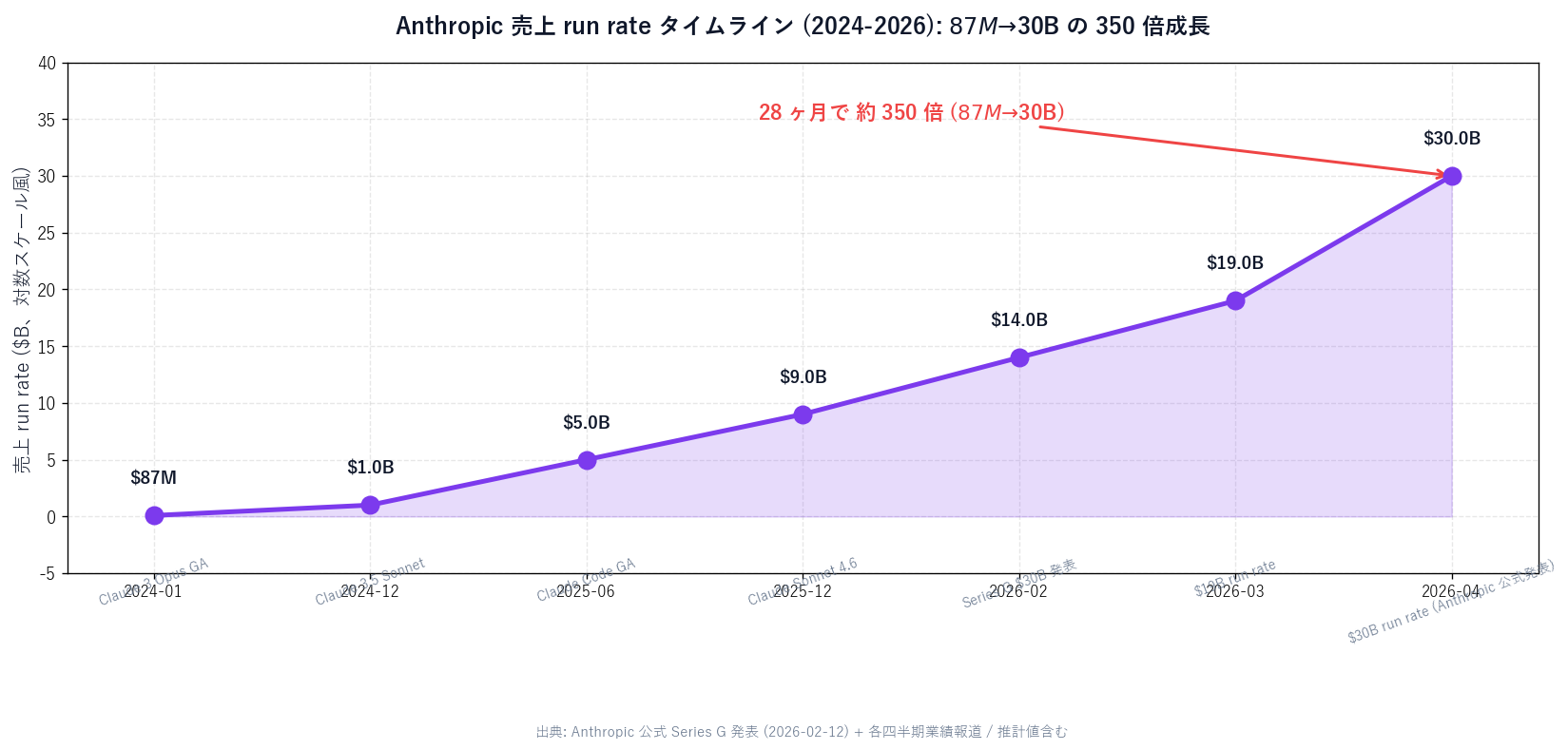
[Official] Per Anthropic's Series G announcement (2026-02-12), Claude Code grew like this:
Enterprise Claude Code subscriptions quadrupled since the start of 2026; named customers include Netflix, Spotify, KPMG, L'Oréal, and Salesforce. [Official] Anthropic's overall run rate climbed from $9B at end-2025 to $30B by April 2026 — 3.3x in four months, an unprecedented curve for enterprise software.
But there is a flip side. [Official] In April 2026, Uber CTO Praveen Neppalli Naga confirmed (via The Information and Yahoo Finance) that the company had burned through its entire 2026 AI budget in four months.
[Author's view] The Uber story really says "Claude Code is so good it is being adopted faster than the org can absorb the spend." $500–$2,000 per engineer per month, in Japanese terms, is "one engineer's cloud bill = 10–20% of a senior engineer's monthly salary." It is worth paying for if productivity moves — but without per-project visibility and budget guardrails, the budget is guaranteed to evaporate.
VentureBeat's 2026-05-14 analysis points out that Anthropic's biggest risk is a structural mismatch between customer token spend and Anthropic's own GPU + power cost. Claude Code's agentic design uses a lot of tokens per task — as customers use more, Anthropic's infrastructure cost rises proportionally.
[Official] Anthropic published a postmortem on a major infrastructure incident in May 2026 (see coding AI ops phase roundup), candidly acknowledging that three concurrent bugs affected users for roughly four weeks. That candor is admirable, but it did surface real "Anthropic reliability is not yet at OpenAI's bar" sentiment among heavy users.
Google's Gemini 3.5 Flash and OpenAI's Codex increasingly deliver comparable performance at roughly half the cost. Open-source families (Meta Llama, DeepSeek) accessed via inference services are also reaching production-grade quality. Anyone operating under "good-enough quality, low cost" pressure may keep moving away from Anthropic.
VentureBeat's "VB Pulse Foundation Models tracker" (May 2026) estimates 79% of enterprises pay both OpenAI and Anthropic. Simple reason: their strengths diverge.
In real enterprises, three patterns have settled in:
Yes — multi-model routing is not only for the Fortune 500. Concrete options:
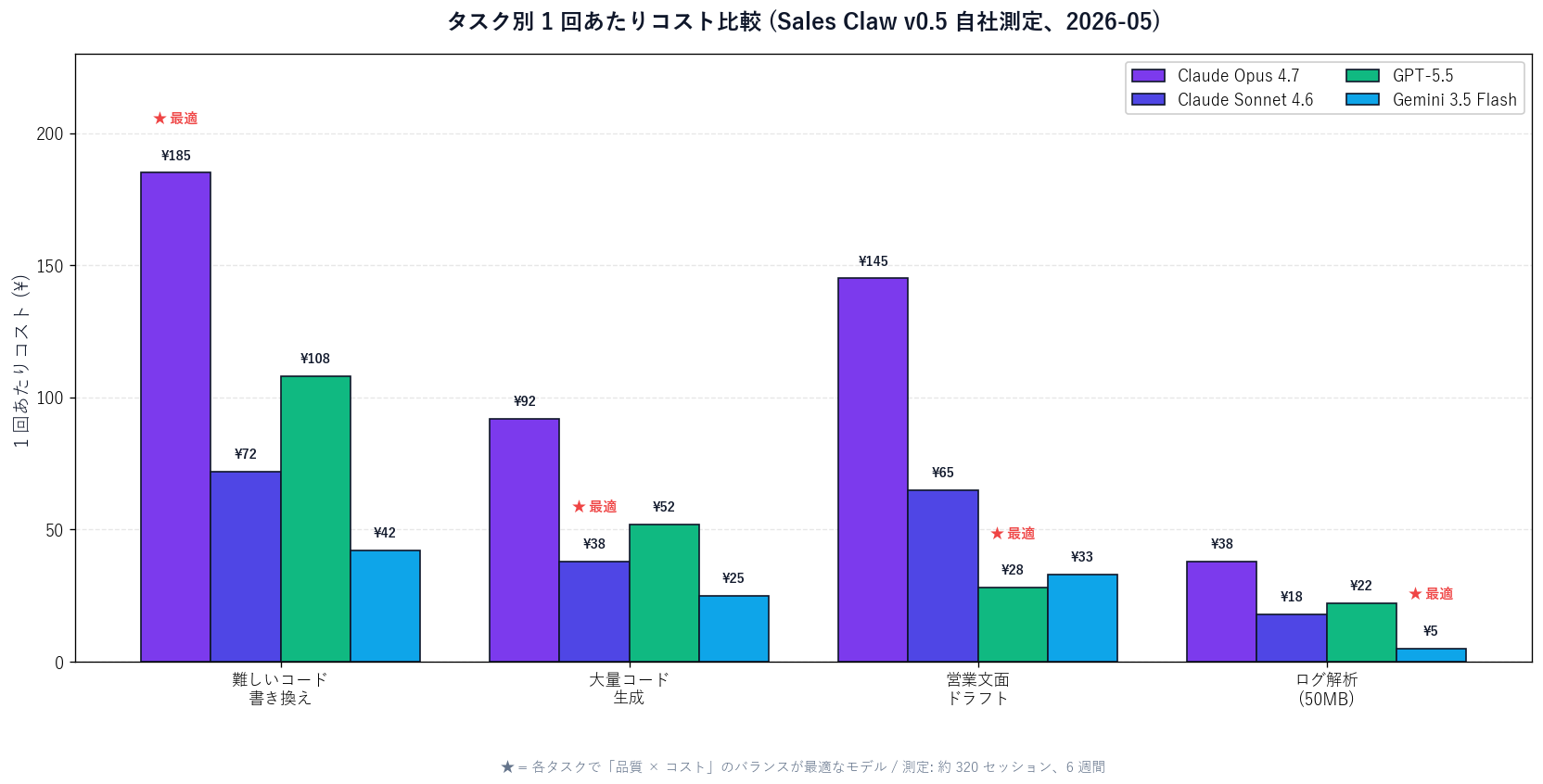
Because rankings can flip in nine months, "3-year contract, Anthropic only" or "ChatGPT Enterprise for the whole company" are high-risk bets. Through late 2026 and into 2027, Google and OpenAI counter-attacks are likely; no one can guarantee today's leader is next year's leader.
The Uber lesson is that Claude Code is powerful enough that the budget will melt without visibility. To avoid the same trap:
/usage breakdown (Claude Code v2.1.149) on day one[Official] In May 2025 Japan passed the "Act on Promotion of R&D and Application of AI Technologies" (AI Promotion Act), signaling a government posture of "promote use while managing risk."[Speculation] Through 2026, NTT Data / Fujitsu / NEC and other Japanese SIers are likely to announce partnership programs with Anthropic / OpenAI (only limited public detail as of 2026-05-26).
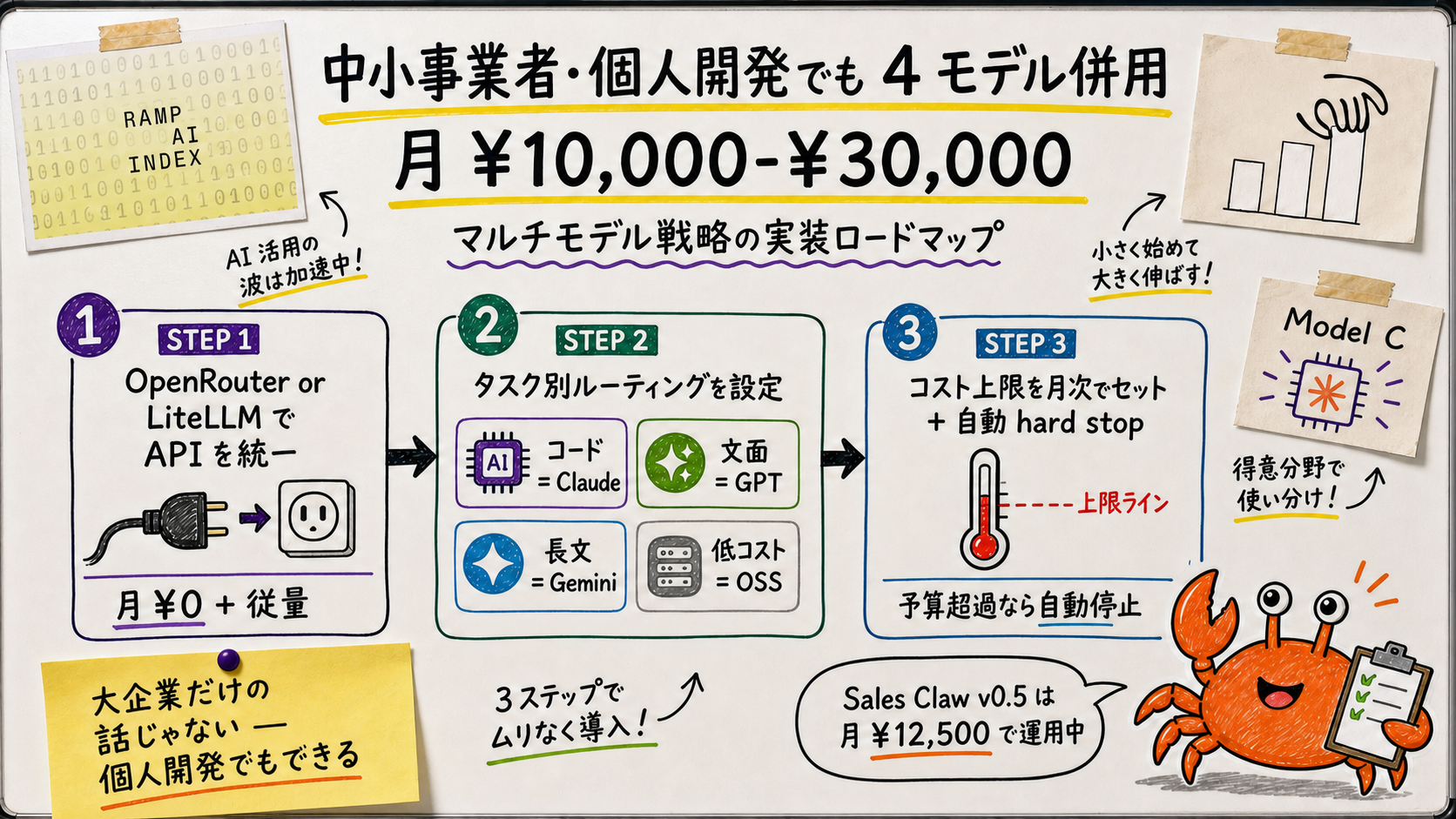
In Sales Claw v0.5, watching enterprise share flip drove a decision to refuse single-vendor design and rebuild around multi-model routing from the start. Concretely:
We rewrote this split three times in three months before landing on a stable version that runs at about ¥12,500 / month (mostly Claude Code) + ¥5,000 for the restat indie-developer scale. After 14 days of hands-on use, the lesson stuck: bolting multi-model routing on later costs 10x more than designing it in from day one.
Sales Claw's other axis is "autonomy without per-send human approval". That ties into multi-model strategy tightly:
The May 2026 Ramp AI Index recorded the first changing of the guard in enterprise AI. The more important fact, though, is not "Anthropic won" but "the market has left the fixed-leader phase and entered a dynamic-leader phase." The ChatGPT-only era is over; Anthropic, OpenAI, and Google will trade the lead back and forth.
Non-experts, SMBs, and indie developers should take away three things:
/usage, hard limits by team, and real ROI metrics from the first day.2026 will likely be remembered as the year "single-vendor AI dominance ended". As a Sales Claw maintainer, the design principle I will keep stating publicly is: "Assume the leader will change; design from day one to keep multiple options open."
Japanese-language original: Anthropic が OpenAI を初めて逆転 (2026-05-26)
本記事は X 公式アカウントと公式ドキュメントを一次情報として参照しています。
この記事の著者
中澤 圭志
Sales Claw maintainer
Designs and develops Sales Claw. Writes from the field on B2B sales automation and applied AI.