AI NewsClaude Compliance API

Claude Compliance API Launches — Anthropic Wires Claude into 28 Security Tools, Bringing AI Under the Same Governance Frame as Every Other SaaS

On 2026-05-21 Anthropic announced the Claude Compliance API and 28 security / compliance partner integrations. Claude Enterprise conversations + attachments and Claude Platform admin events can now stream into Datadog, Cloudflare, Wiz, Microsoft Purview, Okta, and more. Written for non-expert readers: the shadow AI context, the 8-category taxonomy, enablement flow, risks, and a Sales Claw perspective.

中澤 圭志

中澤 圭志

@keishi_nakazawa

Sales Claw maintainer

·15 min
Claude Compliance API Launches — Anthropic Wires Claude into 28 Security Tools, Bringing AI Under the Same Governance Frame as Every Other SaaS
This English article is a concise version of the original. For the full Japanese deep-dive, see the Japanese original.

Key Facts

Announcement date

2026-05-21 (Anthropic official blog; 28 partners published same day)

API type

REST API for Claude Enterprise + Claude Platform

Data exposed

Conversation content + Activity Events (Platform: admin events only)

Main partners

Cloudflare / Wiz / Palo Alto / Microsoft Purview / Okta / Datadog + 22 others

"My company just rolled out Claude — does IT see what I type in chats?" "Why is the security team suddenly talking about Claude?"—— This article walks through the Claude Compliance API and the 28 launch-partner integrationsannounced by Anthropic on 2026-05-21, based on Anthropic's official blog, the partner blogs from Cloudflare, Wiz, Palo Alto Networks, and SailPoint, and Anthropic's Help Center documentation. The goal is to help non-experts understand "how my AI use is about to be monitored, and what I should be careful about." Individual users are barely affected, but anyone using Claude Enterprise at work should know how much visibility their employer is gaining.

This article draws on Claude's official blog post "Claude now works with more security and compliance tools" (2026-05-21), the Claude Help Center article "Get started with Claude Compliance API integrations," Cloudflare's official blog "Announcing Claude Compliance API support with Cloudflare CASB" (2026-05-21), Palo Alto Networks' official blog, Wiz's official blog, and SailPoint's press release as primary sources. For broader Claude enterprise context, see our Claude for Small Business breakdown; for the developer-side Claude Code enterprise features, see Claude Code 2.1.142 walkthrough; for general AI governance literacy, see AI agents explained for non-experts.

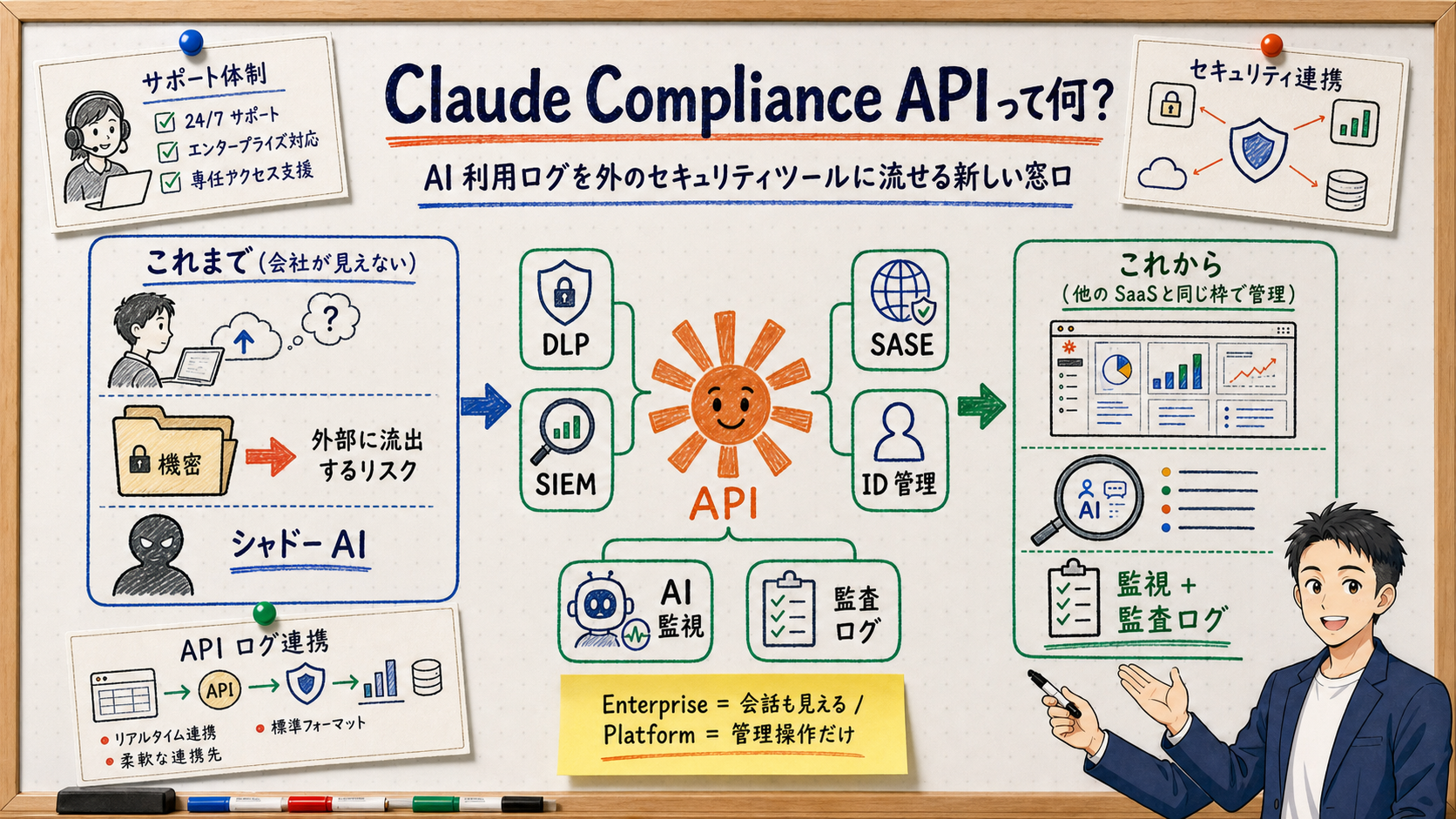
1. What is the Claude Compliance API — "a doorway to export AI usage logs"

Hero illustration of the Claude Compliance API. Big title 'Claude Compliance API' in bold Japanese, subtitle 'a doorway to export AI usage logs to external security tools.' Center shows Claude logo with arrows flowing to icons for Cloudflare, Wiz, Palo Alto Networks, CrowdStrike, Okta, and Datadog. Left zone shows 'Before: companies cannot see what employees upload to AI.' Right zone shows 'After: integrated into the same DLP / SIEM / IDM dashboards.' Yellow sticky note highlights 'Claude Enterprise = conversation visible / Claude Platform = admin actions only.'
Figure: Claude Compliance API — a new doorway to send AI usage logs to security tooling

The Claude Compliance API (Compliance API hereafter) is a new enterprise APIannounced by Anthropic on 2026-05-21. [Official] The official Anthropic blog headlines it as "Claude now works with more security and compliance tools," with the key promise that "Claude activity will flow into the same dashboards and workflows your team uses for every other application."

The shift in plain language: where Claude used to be "another isolated SaaS box," after Compliance API it joins the same management pipeline your IT team already runs for Salesforce or Slack. In concrete terms:

  • Shadow AI usage becomes visible: who uploaded what file to Claude, and when
  • Sensitive data uploads are flagged: customer lists or source code hitting Claude trigger alerts
  • Admin trails are preserved: who granted admin rights to whom, who changed which setting

The fundamental significance of the Compliance API is enabling "AI usage trails to be integrated into existing security operations." Previously, Claude Enterprise admins manually exported audit logs as CSV files. Now Anthropic is pointing toward a world where "Claude is wired into the same operational plumbing as the rest of your SaaS."

[Author's view] Until now, "using AI at work" implied "managing it in a separate frame." With Compliance API, AI moves into the same frame as every other SaaS. For security teams, having Claude show up as one more line item in their existing SIEM / DLP / IDM is materially easier than maintaining a parallel dashboard per AI tool.
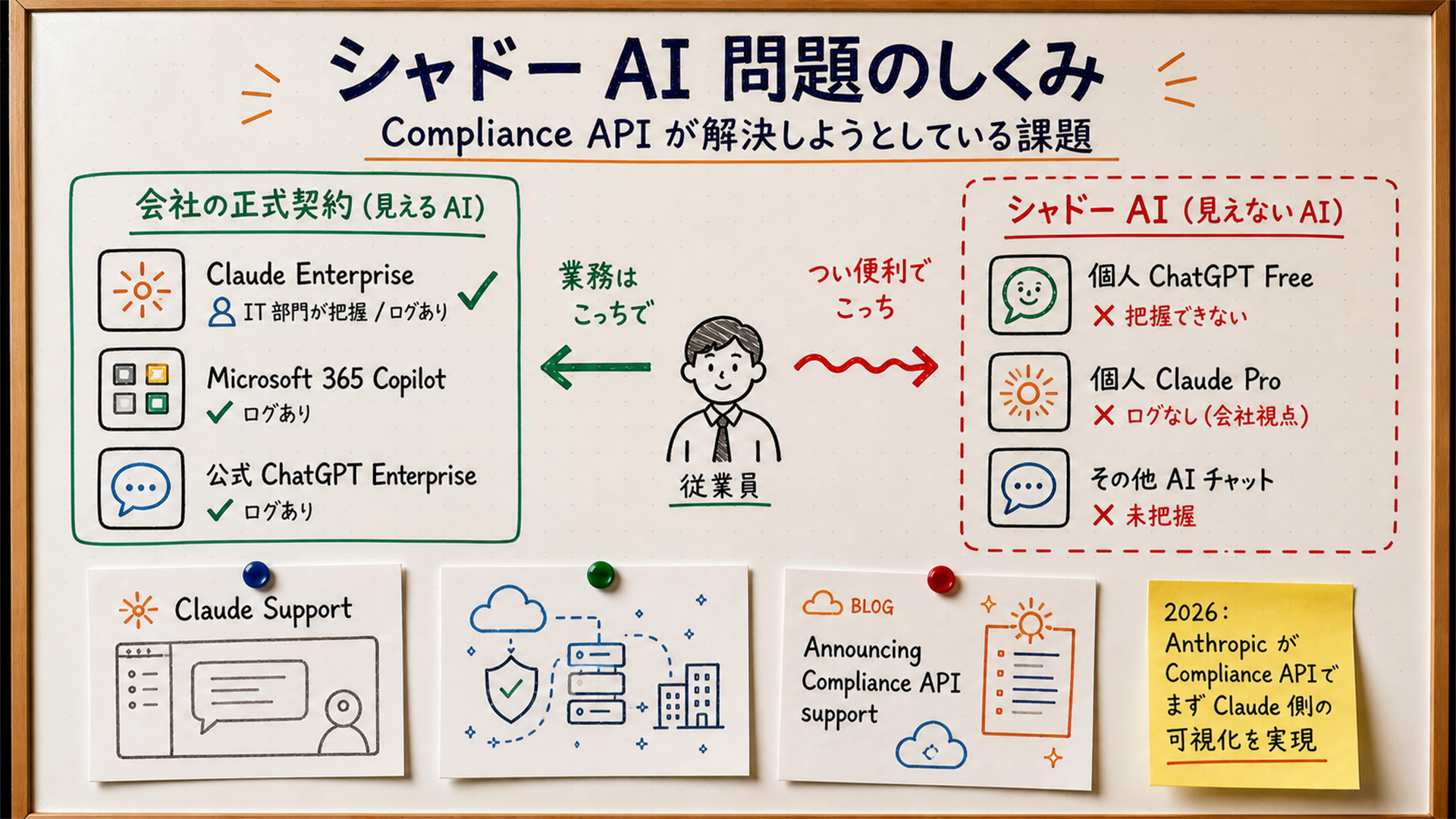
2. Why this matters now — the shadow AI context

Diagram of the shadow AI structure. Left side: 'Official contracts — Claude Enterprise / Microsoft 365 Copilot / ChatGPT Enterprise.' Right side: 'Shadow AI — personal ChatGPT Free / personal Claude Pro / other AI chats.' Center shows an employee icon. The official route is labeled 'tracked by IT, logged.' The shadow AI route is labeled in red 'invisible to IT, leak pathway.' Bottom-right sticky note: '2026: Anthropic addresses this with the Compliance API.'
Figure: The shadow AI problem the Compliance API targets — the structural diagram

What is shadow AI and why does it matter

Shadow AI means AI usage the company doesn't know about. Examples: an employee pasting a draft contract into personal ChatGPT on a phone, a salesperson uploading a client list to personal Claude Pro for analysis. IT can't see it, so they can't even tell whether confidential data ended up on an AI vendor's servers.

  • 2024-2025: surveys report that 50-70% of employees have used personal AI at work
  • Late 2025: listed-company filings start naming "delayed AI governance" as a finding from internal audits
  • Early 2026: ISO/IEC 42001 (AI management system standard) drives compliance work in finance and healthcare
  • 2026-05: Anthropic's Compliance API answers "at least make our own Claude usage observable from external tools"

How this differs from existing Audit Log

Claude Enterprise has had manual Audit Log export for some time. Operationally it suffered from:

  • Admins had to manually export CSV files periodically
  • Ingesting those CSVs into existing SIEM / DLP was a custom build per company
  • Conversation content and attachments lived on a separate path, with data-leak detection essentially after the fact
  • Each partner required bespoke integration work with low reusability

The Compliance API replaces this CSV-and-glue world with one where "existing tools pull Claude data in real time via API," and where "Claude activity appears in your Datadog dashboard on the same row as the rest of your SaaS."

3. The two data categories — "conversations" and "admin events"

A: Conversation content (Claude Enterprise only)

[Official] Anthropic's blog defines conversation content as "chats, uploaded files, and projects."The intended use is applying existing corporate security policies — especially DLP — against it.

  • Chats: user prompts and AI responses as plain text
  • Uploaded files: PDFs, DOCX, code, images attached to Claude
  • Projects: knowledge / artifacts shared inside the Claude Enterprise "projects" feature

Cloudflare's CASB blog enumerates the detected resources as "project sharing across the organization, project attachments, chat files, chat messages, and artifacts," which gives you a concrete sense of what the API actually surfaces.

B: Activity Events (both Enterprise and Platform)

[Official] Activity Events are defined as "user logins, administrative actions, and configuration changes." This is the classic audit-log substrate — perfectly aligned with SIEM and identity-management (IDM) tools.

項目Claude Enterprise (full corporate plan)Claude Platform (API / developer)
Conversation content accessYes (chats / files / projects)No (prompts and responses are NOT exposed)
Activity events accessYesYes (admin / system / resource events)
Target userCompanies where employees use claude.ai for workCompanies building apps on the API
Main integrationsDLP / SIEM / SASE / eDiscoverySIEM / IDM / audit backbones
Enablement entryOrg settings → API enable → connect partner productContact Anthropic sales

[Author's view] Excluding conversation content on the Platform side makes sense: API customers typically wrap Claude inside their own product, so the conversation belongs to them, not Anthropic. Not having a vendor-side copy of those prompts is the right call for enterprise API consumers.
4. The 28 partners across 8 categories

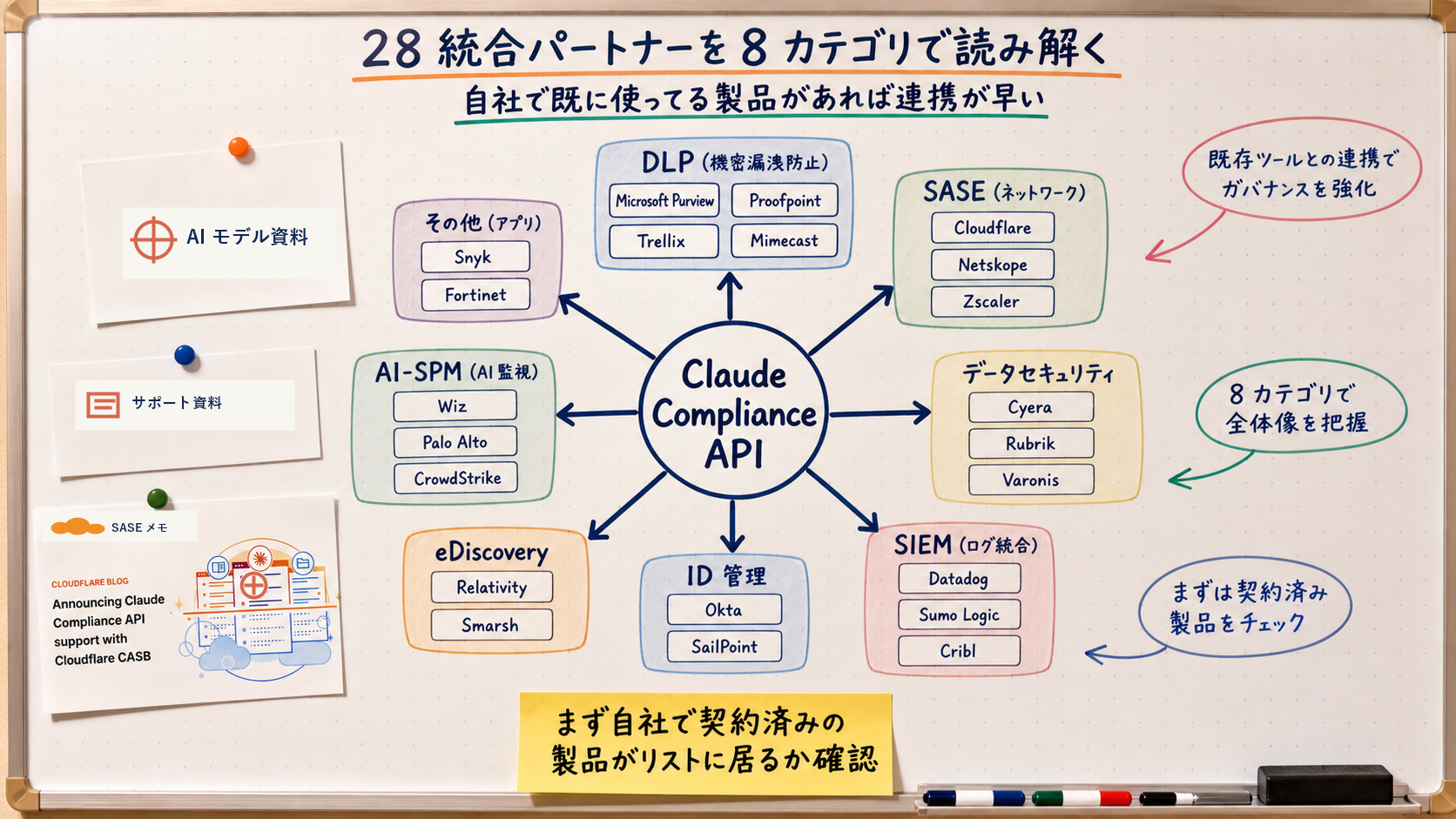
Map of the 28 partner products clustered into 8 categories. Center: 'Claude Compliance API.' Radial branches lead to DLP (Microsoft Purview / Forcepoint / Proofpoint / Trellix / Mimecast), SASE (Cloudflare / Netskope / Zscaler), data security (Cyera / Rubrik / Varonis), SIEM (Datadog / Sumo Logic / Cribl / ReliaQuest), identity management (Okta / SailPoint), eDiscovery (Relativity / Theta Lake / Smarsh), AI-SPM (Wiz / Palo Alto Networks / Geordie AI), and observability (Datadog / Sumo Logic).
Figure: The 28 partners across 8 categories — start with what you already own

The 28 partners (alphabetical order per Anthropic's blog)

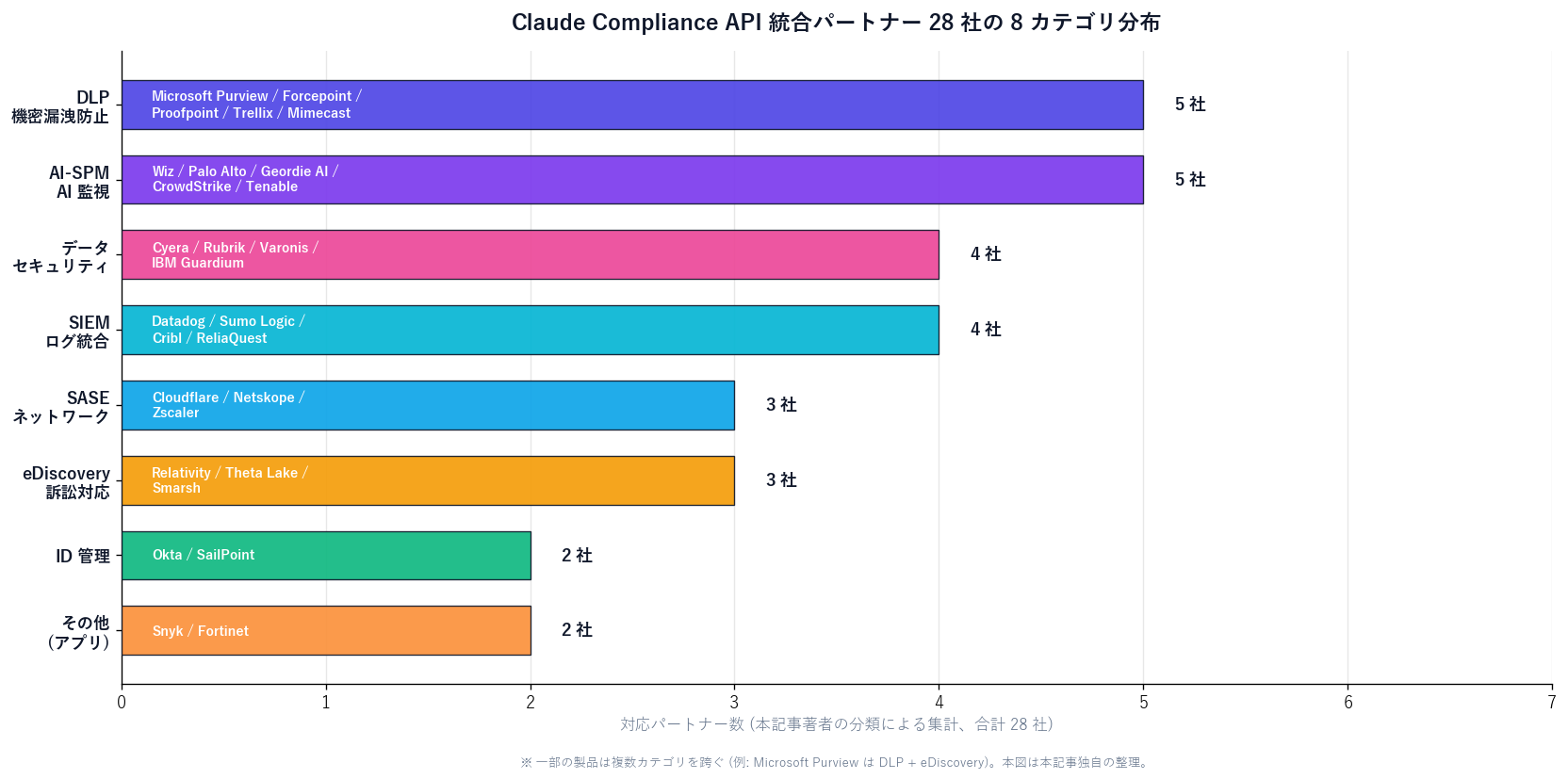
Horizontal bar chart of the 28 Claude Compliance API partners across 8 categories. X axis: partner count, Y axis: 8 categories. DLP (5) / AI-SPM (5) / data security (4) / SIEM (4) / SASE (3) / eDiscovery (3) / identity management (2) / other (2). Each bar lists representative partner names.
Figure: Distribution of the 28 Claude Compliance API partners across 8 categories

[Official] Per the Anthropic blog and the Help Net Security coverage, the 28 partner products are listed below (alphabetical). The Help Center now says "30+", suggesting ongoing additions.

CategoryRepresentative partners
DLP (Data Loss Prevention)Microsoft Purview / Forcepoint / Proofpoint / Trellix / Mimecast
SASE (Network)Cloudflare / Netskope / Zscaler
Data securityCyera / Rubrik / Varonis / IBM Guardium
SIEMDatadog / Sumo Logic / Cribl / ReliaQuest
Identity ManagementOkta / SailPoint
eDiscovery / litigationRelativity / Theta Lake / Smarsh
AI-SPM / monitoringWiz / Palo Alto Networks / Geordie AI / CrowdStrike / Tenable
Other (application security)Snyk / Fortinet

Managing how Claude or ChatGPT are used internally, and automating outbound sends, are two different problems that need different controls.

無料・MIT ライセンス。インストールせずにライブデモも試せます。

5. What partners actually do — Cloudflare, Wiz, and Palo Alto in detail

Cloudflare CASB — real-time DLP + Gateway integration

[Official] Per Cloudflare's blog, Cloudflare CASB detects the following via the Compliance API:

  • How projects are shared across the organization and between users
  • Whether project attachments contain DLP policy violations
  • Chat files uploaded by users or generated by Claude
  • The content of chat messages (user prompts plus Claude responses)
  • AI-generated artifacts

Detected violations (e.g. a user uploading a file with sensitive data) can "become a Gateway policy in minutes," according to Cloudflare. The point is not just after-the-fact detection — it is the ability to install a guardrail to prevent recurrence.

For organizations already operating Cloudflare Zero Trust, this is essentially a one-step extension: the same dashboard now shows Claude alongside Salesforce, Slack, GitHub, and the other SaaS apps already onboarded. No new agent on the endpoint, no parallel reporting pipeline, no extra integration project — the security team gains visibility into a new application using muscle memory they already have.

Wiz — mapping AI assets into the Security Graph

[Official] Wiz folds AI usage into its Wiz Security Graph. Concretely:

  • Claude Enterprise organizations, users, and roles are mapped against permissions
  • Project metadata (attachments, chat counts, privacy settings, ownership) is collected
  • Datasets connected to Claude projects and their relationships to broader cloud resources are mapped
  • Shadow Claude usage and early sensitive-data exposure are surfaced via cross-cloud graph analysis

[Author's view] Wiz's approach — treat AI as one asset in the broader cloud, not as a standalone — is compelling for large enterprises already running Wiz, because they don't have to add a new dashboard.

Palo Alto Networks (Cortex Cloud DSPM) — 4-stage governance

[Official] Palo Alto outlines phased governance across four stages:

  1. Visualization: detect sensitive data (PII / PHI / IP) flowing into Claude
  2. Detection: catch API key leaks, policy violations, prompt-injection attempts
  3. Prevention: user coaching (warning messages) plus blocking of AI-specific risks
  4. Anomaly detection: ML-driven detection of impossible-travel scenarios and abnormal data-sharing patterns

SailPoint — identity security for AI platforms

[Official] SailPoint comes from the identity governance (IGA) angle: it pulls Claude Enterprise users, roles, and entitlements into SailPoint Identity Security Cloud, extending role-based access control to AI tools. Who can access Claude and who manages projects becomes part of the same identity discipline that governs the rest of corporate IT.

Concretely, this lets enterprises enforce joiner-mover-leaver workflows on Claude access automatically. When an employee changes roles, their Claude project ownership and admin rights can be adjusted by the same SailPoint policy that rebalances their Salesforce and Jira permissions. When an employee leaves, their Claude access is deprovisioned at the same moment as everything else — instead of becoming a multi-week task on a manual checklist that someone forgets halfway through.
6. Getting started — how to enable it in Claude Enterprise

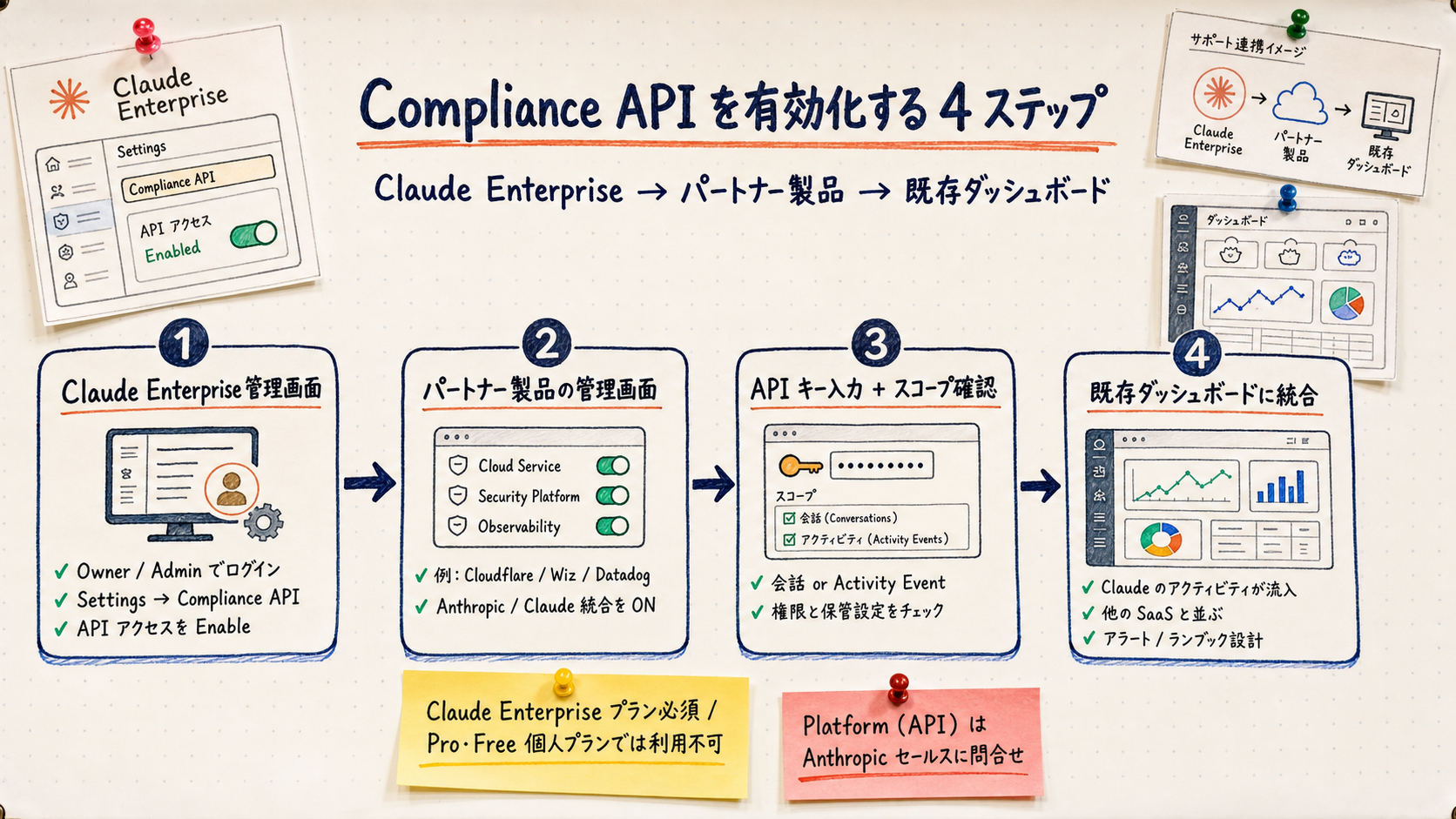
A 4-step flow for enabling the Compliance API. Step 1: enable Compliance API in Claude Enterprise org settings. Step 2: switch on the Claude integration in the partner product (e.g. Cloudflare dashboard). Step 3: enter the API key and confirm the scope (conversation / activity event). Step 4: detection starts, Claude activity appears in existing dashboards. A sticky note at the bottom warns 'Claude Enterprise plan required, not available on Pro / Free personal plans.'
Figure: Compliance API enablement flow — four steps to wire it into existing security tooling

Path 1: enable from Claude Enterprise

  1. Sign in to the Claude Enterprise admin console (Owner / Admin role required)
  2. Open Settings → Compliance API and enable API access
  3. Open the partner product (Cloudflare / Wiz / Datadog, etc.)
  4. In that partner UI, turn on the Anthropic / Claude integration and paste in the API key generated in step 2
  5. Confirm that Claude activity is flowing into the partner's dashboard

Path 2: enable from Claude Platform (API)

  1. Contact Anthropic sales (e.g. sales@anthropic.com) and request Compliance API access
  2. Align on target org, partner product, and intended use case
  3. Note: conversation content is not exposed on the Platform side — the value lives in SIEM / IDM
  4. Once the API key is issued, enable the Anthropic integration inside the partner product

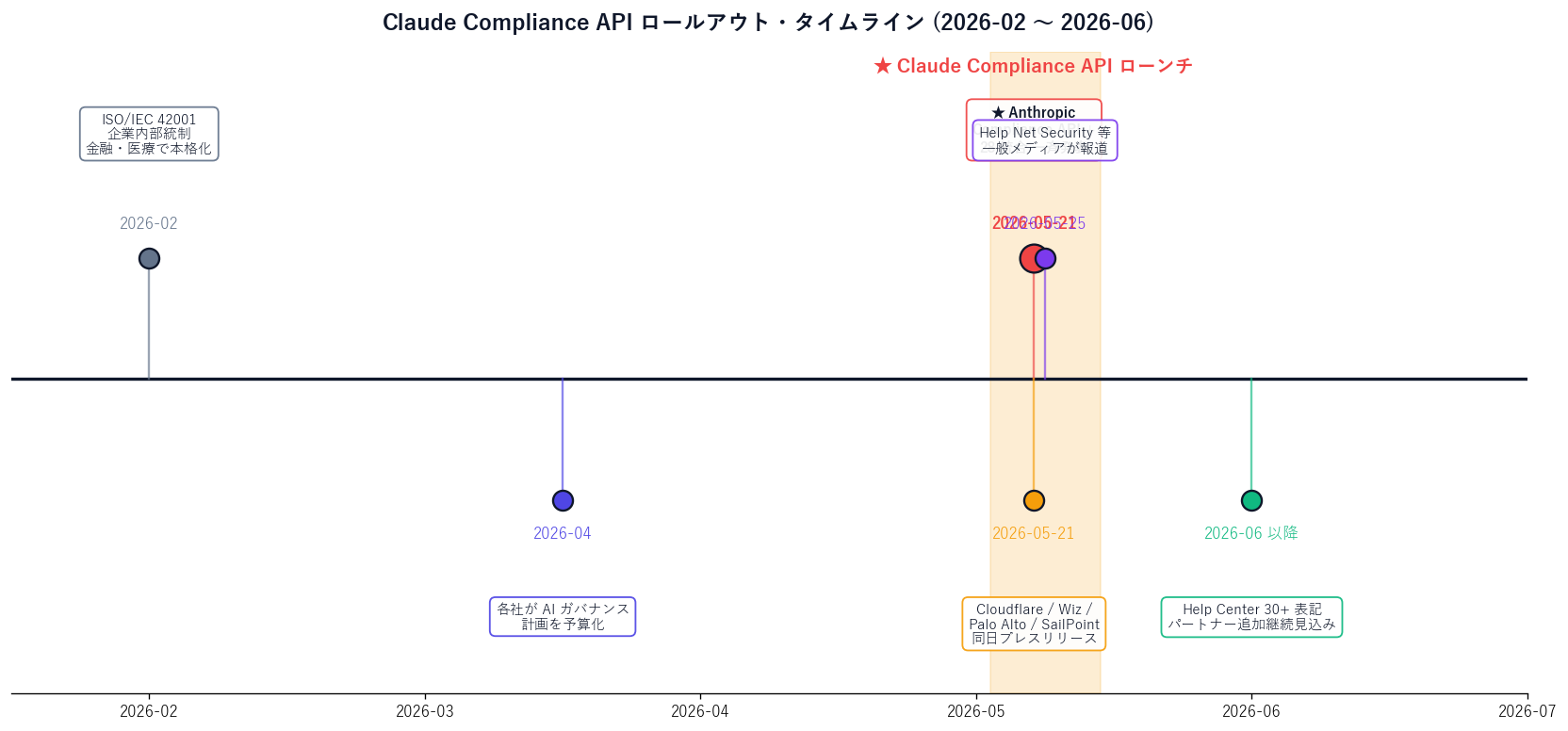
Compliance API rollout timeline

Timeline of Claude Compliance API events. 2026-02 ISO/IEC 42001-based internal controls scale in finance and healthcare; 2026-04 companies budget for AI governance plans; 2026-05-21 Anthropic announces Compliance API + 28 integrations in a coordinated release with same-day partner posts from Cloudflare / Wiz / Palo Alto / SailPoint; 2026-05-25 mainstream coverage (Help Net Security and others); from 2026-06 onward the Help Center lists 30+ integrations, with continued additions expected.
Figure: Claude Compliance API rollout timeline (May 2026, based on Anthropic and partner announcements)

7. Risks and limits — "visible ≠ entirely safe"

Limit 1: Claude-only scope

The Compliance API is specifically a Claude usage API. If an employee pastes sensitive data into a personal ChatGPT or a free Gemini, this API does not see it. To cover non-Claude AI use you still need SASE (Netskope / Zscaler / Cloudflare) or AI-SPM (Wiz / Palo Alto) for network-layer enforcement.

Limit 2: invisible holes from configuration drift

The plumbing works at the API level, but without thoughtful DLP rules, SIEM alert thresholds, and IDM role design on the partner side, you get "wired up but detects nothing."At deployment time, you also need to build runbooks: which violations get detected, who gets paged, who owns response.

Limit 3: excessive surveillance backfires

[Author's view] "Ingest every Claude conversation across the company into SIEM and review them live" is technically feasible and organizationally almost guaranteed to fail. The moment employees feel watched, they stop using Claude and start using personal AI on personal devices. Shadow AI gets worse, not better.
Additional cautions for business deployments

  • Privacy law alignment: codify how personal data inside Claude conversations is handled
  • Industry regulation: healthcare, finance, education, and public sector each have rules — get legal review
  • Employee disclosure: state in work rules / privacy notice that Claude Enterprise use is monitored
  • Log retention period: ensure SIEM retention aligns with statutory retention windows (e.g. 5-7 years)

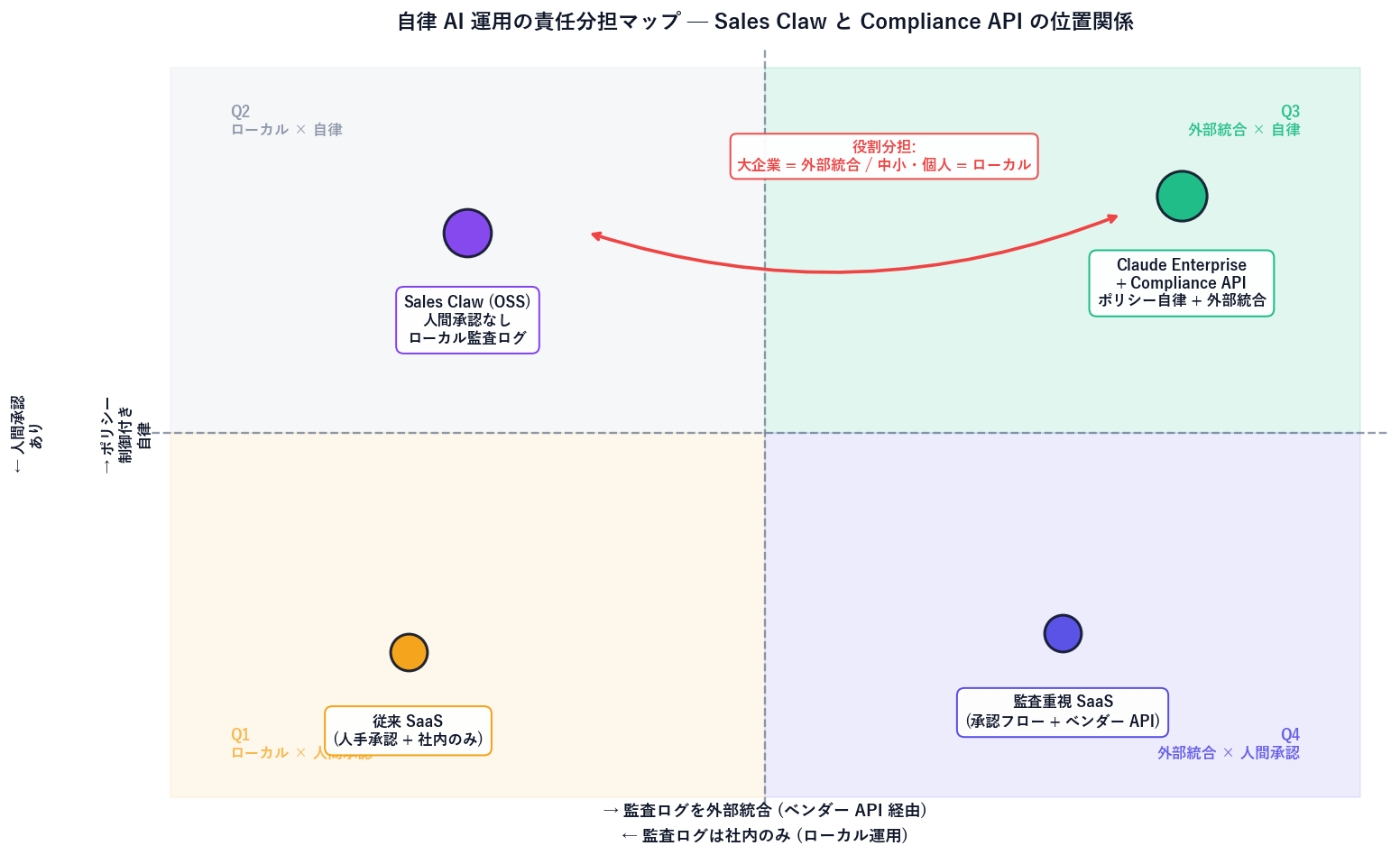
8. Sales Claw's perspective — "autonomy with audit logs"

Quadrant map of responsibility split in autonomous AI ops. Horizontal axis: audit log scope (in-house only vs. exported to external vendor APIs). Vertical axis: automation level (human approval vs. policy-controlled autonomy). Quadrant 1 (bottom-left): traditional SaaS. Quadrant 2 (top-left): personal OSS — where Sales Claw initially lives. Quadrant 3 (top-right): enterprise AI — Claude Enterprise + Compliance API. Quadrant 4 (bottom-right): audit-heavy SaaS. Explanation overlays the Sales Claw position straddling Q2 and Q3.
Figure: Where Sales Claw sits and where the Compliance API sits — a quadrant map of autonomous AI ops responsibility

Why audit logs are a prerequisite for AI automation

Once you delegate work to AI, your organization can't operate it at scale unless "what happened" is traceable after the fact. This is true for Claude Compliance API and equally true for Sales Claw. What differs is who receives the logs, and where they live.

項目Claude Enterprise + Compliance APISales Claw (OSS, local operation)
Audit log locationAnthropic cloud + partner products (Wiz / Datadog / etc.)Local file on the user's PC (JSONL)
Conversation / action contentConversation content + activity eventsPre-send check log + send results + CAPTCHA detection log
Human reviewOptional post-hoc review (depends on ops)No human approval; only sends that pass automated checks go out
Target userEnterprise IT / compliance teamsIndividual developers and small business operators
OutputGeneral Claude-powered knowledge workB2B contact-form outreach (specialized)

"No human approval" and "full audit logs" can coexist

Sales Claw's "no human approval" stance is a claim that "automated checks plus local audit logs can provide enough safety without per-item human review." Concretely:

  • Pre-send automated checks: machine inspection for sales-NG terms, exaggerations, personal data, discriminatory language
  • Sales-NG detection: forms with "no solicitations" or "no inquiries" language are skipped
  • CAPTCHA-triggered stop: no machine-circumvention of CAPTCHA — when one appears, processing halts
  • Rate limiting: excessive sends to a single IP or domain are mechanically blocked
  • Audit log persistence: send history, check results, and stop decisions are written to local JSONL

What the Compliance API era means for Sales Claw

[Author's view] As the trend toward "manage all AI usage centrally via cloud APIs" accelerates, the value of "OSS that runs end-to-end locally" rises in parallel. The reason is simple: a non-trivial set of use cases (lead lists, pre-contract conversations, exploratory outreach) will never be acceptable to hand to a cloud vendor wholesale. The Compliance API standardizes enterprise AI ops; Sales Claw and similar OSS handle the corners that can't move to vendor cloud. We are entering a division-of-roles era, not a winner-takes-all era.

Practically, the two approaches answer different questions. Compliance API answers "how do we make AI usage visible to the security team across the entire organization?"; Sales Claw answers "how does one operator run B2B contact-form outreach safely without delegating their lead list to a cloud vendor?" Both share the same root principle — never operate AI automation without an audit trail — but they apply it at very different scales and trust boundaries. A mature 2026 stack will use both, not pick one over the other.

9. Conclusion — adapting to "AI in the same governance frame as every other SaaS"

The Claude Compliance API moves AI governance competition from "the AI model's own features" to "how well it integrates with existing security operations."OpenAI and Google will plausibly follow, and by late 2026, "using AI at work means audit logs come with it" is likely to be standard.

For individuals, the practical takeaway is to know how much of your AI usage your employer actually sees. If your company runs Claude Enterprise, expect IT to enable a Compliance API integration soon. If you only use personal Pro / Free plans, you are unaffected. Either way, having private conversations or side-business research inside a company Claude account is now even more inadvisable than before.

For IT and security teams, the immediate next 30 days are about discovery and prioritization rather than full deployment. The right first move is an inventory pass: which Claude plans does your organization actually pay for, who has admin access, which existing security products on your stack already appear in the supported-partner list. Once that inventory is in hand, pick one DLP partner (for conversation content) and one IDM partner (for activity events) and run a focused 30-day pilot — not a 28-product simultaneous rollout. Most of the failures we expect to see in the second half of 2026 will come from teams that treated this as a checkbox exercise instead of a focused integration.

Next steps: if your company uses Claude Enterprise, ask your IT / infosec team whether a Compliance API integration is on the roadmap. If you are evaluating procurement, start by checking whether your existing security tools (Datadog / Cloudflare / Microsoft Purview / Okta / etc.) are on the supported list — that is the highest-leverage place to begin. If you want local-first form-outreach automation, you can grab Sales Claw from the free download page. Related reading: Claude for Small Business — 7 SaaS integrations breakdown.

This is the English overlay of the Japanese-language original. The Japanese version is canonical and authoritative; if anything differs, defer to the Japanese.

Managing how Claude is used internally and automating outbound contact-form sends are two sides of the same governance coin.

無料・MIT ライセンス。インストールせずにライブデモも試せます。

よくある質問

In one paragraph, what is the Claude Compliance API?
The Claude Compliance API is a REST API announced by Anthropic on 2026-05-21 that lets external security tools read activity from Claude Enterprise and Claude Platform organizations. Same-day, 28 partners — Cloudflare, Wiz, Palo Alto Networks, Microsoft Purview, Okta, Datadog and others — announced integrations. Per Anthropic's blog, "Claude activity will flow into the same dashboards and workflows your team uses for every other application." Two data categories are exposed: (A) Claude Enterprise conversation content (chats, uploaded files, projects), and (B) Activity Events (user logins, admin actions, configuration changes). Claude Platform exposes only (B); conversation content is intentionally out of scope on the Platform side. Personal Claude Pro / Free plans are not affected. Analogy: Anthropic added a "security checkpoint window" to the front entrance of the Claude building, so what employees upload and which admin changes happen now show up in the same Datadog or Wiz dashboard your IT team already uses for everything else.
Which companies and people are affected?
Directly affected: IT, security, and compliance teams at organizations that subscribe to Claude Enterprise; developer companies using Claude Platform (API) commercially are also in scope for Activity Events. For regular employees, "if I use Claude Enterprise at work, my usage logs may now be visible to IT" is the new reality. People who only use personal Claude Pro / Free, or who only use other AI vendors (OpenAI, Google) are NOT affected by this specific API. However, if you use shadow AI (personal AI accounts for business work), your employer's Compliance API rollout may trigger a parallel push to also detect and limit other-vendor AI usage. [Author's view] OpenAI ChatGPT Enterprise and Google Workspace Gemini are likely to ship comparable features in late 2026, so "using AI at work = audit logs exist" will become standard for everyone in corporate AI use.
What can the 28 partners actually do?
The partners cluster across 8 categories: DLP (Microsoft Purview, Forcepoint, Proofpoint, Trellix, Mimecast); SASE (Cloudflare, Netskope, Zscaler); data security (Cyera, Rubrik, Varonis, IBM Guardium); SIEM (Datadog, Sumo Logic, Cribl, ReliaQuest); identity management (Okta, SailPoint); eDiscovery (Relativity, Theta Lake, Smarsh); AI-SPM (Wiz, Palo Alto, Geordie AI, CrowdStrike, Tenable); and other application security (Snyk, Fortinet). Examples: Cloudflare CASB detects DLP violations in chat messages and attachments, and can turn detected findings into a Gateway policy "in minutes" to prevent recurrence. Wiz pulls Claude Enterprise users, roles, permissions, and project metadata into the Wiz Security Graph, treating AI as one asset in the broader cloud. Palo Alto Networks (Cortex Cloud DSPM) implements phased governance — visualize → detect → prevent → anomaly detection. SailPoint extends role-based access control to Claude from the identity governance (IGA) angle. Start with whichever supported product your company already pays for.
Are personal Claude Pro / Free users affected?
No direct effect. The Claude Compliance API is open to Claude Enterprise plans and Claude Platform customers; personal Pro / Free plans are explicitly out of scope per Anthropic's Help Center documentation. Caveat: if you currently use a personal Claude Pro / Free account for company work (i.e. shadow AI), your employer's Compliance API rollout may coincide with stricter policies forbidding shadow AI. Review your company's rules and which device / network you use for AI work. [Author's view] In the Compliance API era, consciously separating "which plan / which device / which network" you use for personal vs. work AI becomes the baseline operating posture.
Does Claude Code (CLI) usage fall under the Compliance API?
[Unverified / Author's view] Based on the official announcement (Anthropic blog 2026-05-21, Help Center docs), the Claude Compliance API specifically references Claude Enterprise and Claude Platform; Claude Code (CLI developer tool) is not explicitly listed as a target. Because Claude Code calls Anthropic APIs internally, some billing and aggregate activity may show in Claude Platform Activity Events, but as of 2026-05-26, there is no public spec confirming that Claude Code local file edits or submitted prompts are retrievable via the Compliance API. Enterprise admins who want unified Claude Code monitoring should contact Anthropic sales or consider network-layer monitoring (SASE / proxy) separately. This area is likely to expand — always check the latest Anthropic docs.
How does this relate to Sales Claw? Can "no human approval" coexist with "full audit logs"?
Sales Claw runs "policy-controlled autonomy without human approval" as an OSS philosophy — but this does NOT mean abandoning audit logs. The opposite: instead of relying on a human approver, Sales Claw ships pre-send automated inspection, sales-NG detection, CAPTCHA-stop-on-detect, rate limiting, audit log persistence (local JSONL), and automatic stop conditions as a complete local stack. Compliance API solves "centralize visibility of enterprise AI usage via vendor API"; Sales Claw solves "let one operator run B2B contact-form outreach safely without delegating their lead list to a cloud vendor." Different scale, different trust boundary, but the same root rule: never operate AI automation without an audit trail. [Author's view] The more centralized cloud governance accelerates, the more value local-first OSS gains in parallel, because a non-trivial set of use cases (lead lists, pre-contract outreach, exploratory conversations) will never move to vendor cloud. Late 2026 will be a "division of roles" era — using both, not picking one over the other.

参考文献

本記事は X 公式アカウントと公式ドキュメントを一次情報として参照しています。

  1. [01]
  2. [02]
  3. [03]
  4. [04]
  5. [05]
  6. [06]
  7. [07]
  8. [08]

この記事の著者

中澤 圭志

中澤 圭志

Sales Claw maintainer

Designs and develops Sales Claw. Writes from the field on B2B sales automation and applied AI.
Share this article